
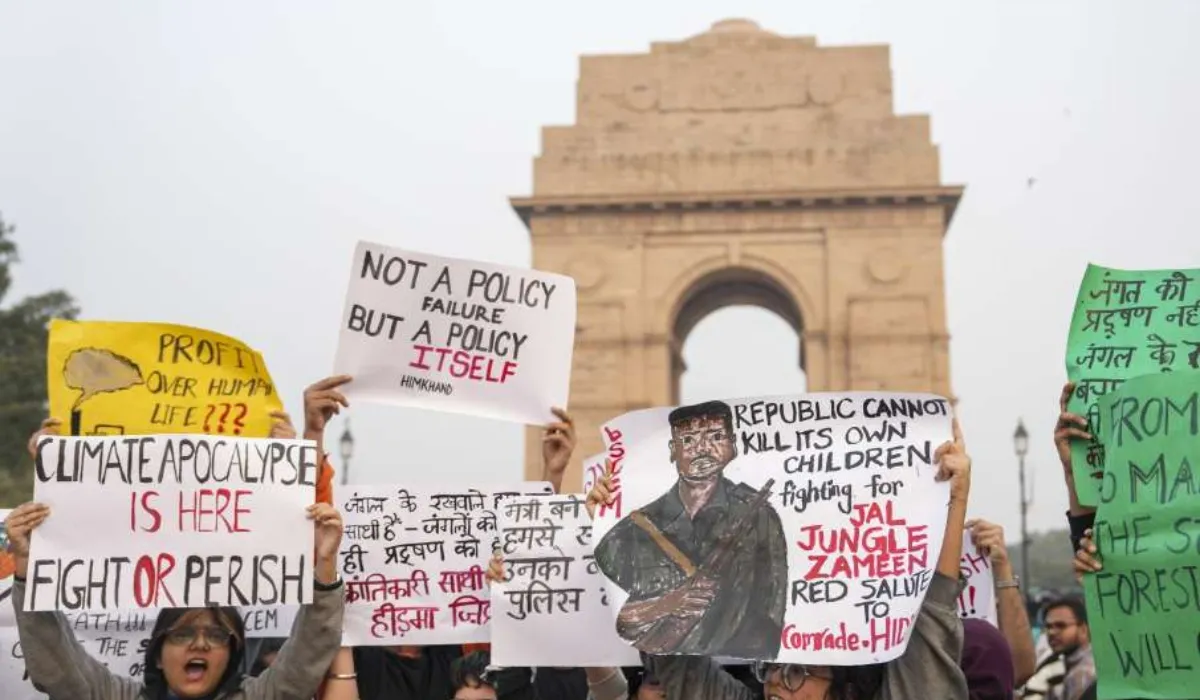
A protest over Delhi's worsening air pollution at India Gate spiralled into controversy on Sunday evening after demonstrators were seen displaying posters of top Maoist commander Madvi Hidma, who was killed in a police encounter in Andhra Pradesh last week. The unexpected appearance of Hidma’s image — along with slogans allegedly praising him — has triggered a political firestorm and prompted a police crackdown.
Posters of Madvi Hidma emerge at India Gate protest
A video widely circulated on social media shows protesters sitting near the C-Hexagon area raising slogans against Delhi’s toxic air. Among them, one person is seen holding a poster featuring a sketch of Madvi Hidma, one of India’s most wanted Maoist leaders who carried a reward of Rs 1 crore on his head.
Hidma, the commander of CPI (Maoist)'s deadly Battalion 1, was responsible for orchestrating some of the worst Naxal attacks, including the Burkapal ambush (2017), Chintalnar attack (2010), and multiple strikes on security forces across Bastar. He was killed in an encounter with Andhra Pradesh Police on November 18 in Alluri Sitaramaraju district.
The presence of his poster at a pollution protest has baffled authorities and ignited political commentary.
Scuffle breaks out; 22 protesters arrested
The demonstration, organised by the Delhi Coordination Committee for Clean Air, was meant to highlight hazardous pollution levels in Delhi-NCR. However, tensions escalated when protesters blocked traffic and allegedly used chilli powder and pepper spray on police officers trying to disperse them.
Police said the situation turned violent when protesters refused to vacate, broke barricades, and sat on the road, obstructing emergency vehicles. According to officials, three to four police personnel sustained injuries to the eyes and face and were taken to Ram Manohar Lohia Hospital.
In total, 22 protesters have been arrested for assaulting on-duty government officers.
Political reactions: 'New face of extremism'
Delhi Development Minister Kapil Mishra reacted sharply, saying the posters represented extremist infiltration under the guise of environmental activism.
"Posters in hand under the guise of pollution, Red Salute slogans on their lips… the new face of jihadis and Naxalites posing as social activists," he wrote on X.
Police are investigating how Hidma's posters surfaced during a pollution protest and whether it was part of an organised attempt to push extremist messaging.
Hidma: The shadowy maoist commander behind deadliest attacks
Madvi Hidma, believed to be in his mid-40s, operated from the dense Sukma forests and was regarded as one of the most ruthless and tactically skilled Maoist commanders in the country. He was known for planning high-casualty ambushes on CRPF and police units, repeatedly escaping intelligence-led operations, leading the CPI (Maoist)’s operations wing in South Bastar, and training new cadres in guerrilla warfare. His death last week in an encounter was considered a major breakthrough for anti-Naxal forces.
Protest meant for air crisis, hijacked by controversy
The protest originally focused on Delhi’s "toxic air emergency", — with the AQI touching the severe category in several areas. Organisers accused authorities of taking only "cosmetic measures" like water sprinklers and cloud seeding.
But the sudden appearance of Hidma's poster and the violent clash with police have overshadowed the environmental message and shifted focus to possible extremist involvement.
Probe Underway
Delhi Police DCP Devesh Kumar Mahla confirmed that a thorough investigation is underway into the India Gate protest where demonstrators used chilli spray on officers and displayed posters of Naxalite leader Madvi Hidma. He stated that an FIR has been registered under multiple sections covering the use of force against police, road blockades, and the controversial posters, adding that strict legal action will be taken as the probe continues.
The police are now examining CCTV footage, social media videos, and the backgrounds of those detained. More arrests are likely.
The incident has raised serious concerns about political infiltration, security risks, and the misuse of civic protests in the capital.
