
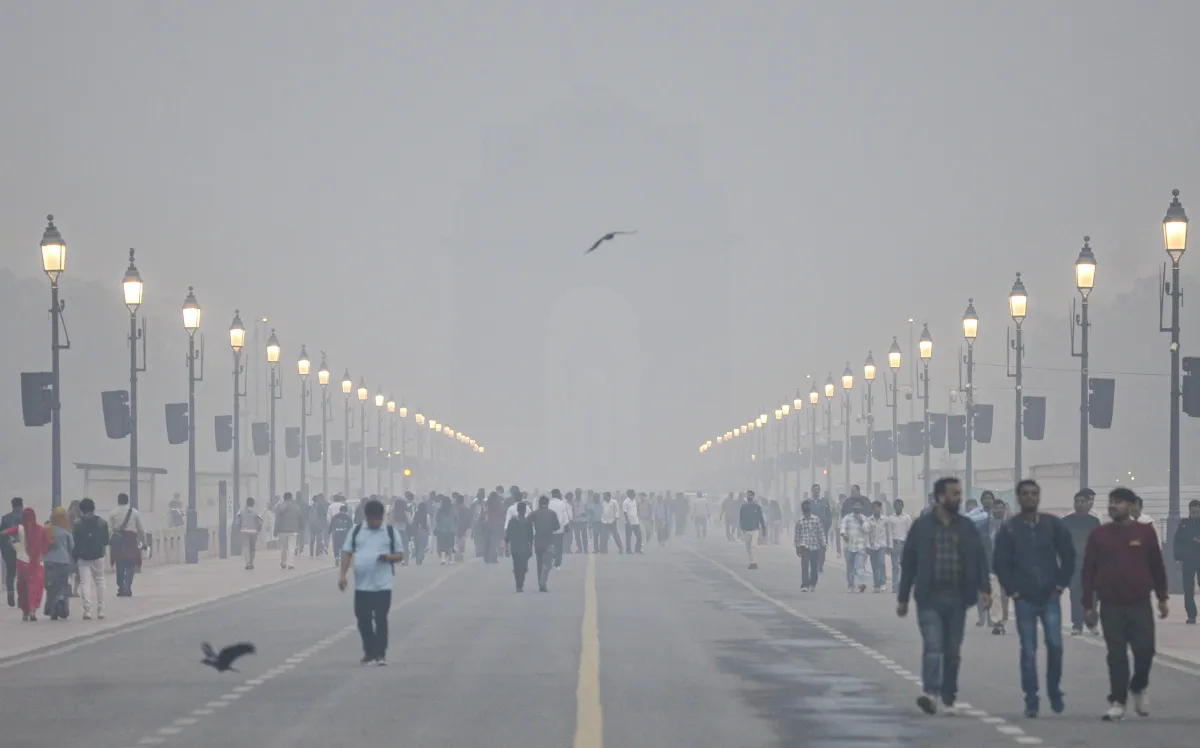
Delhi began Monday under an oppressive blanket of toxic smog, with the city’s air quality index (AQI) recorded at 493 at 7 am, placing it deep in the ‘severe-plus’ category, according to data from the Central Pollution Control Board (CPCB). The reading signals extremely hazardous conditions, posing serious health risks to residents.
The alarming morning figures come a day after air quality across Delhi spiralled to its worst levels this season. On Sunday, 38 of the 39 operational air monitoring stations in the Capital reported air quality in the ‘severe’ or ‘severe-plus’ range for prolonged periods.
At three locations Wazirpur, Rohini and Ashok Vihar the 24-hour average AQI hit the maximum measurable limit of 500, the highest reading recorded by the CPCB. Since the index does not account for values beyond this ceiling, experts caution that actual pollution exposure, particularly during peak hours, may have been far worse.
Multiple areas near maximum pollution levels
Several parts of the city hovered dangerously close to the maximum AQI mark throughout Sunday. Jahangirpuri and Mundka recorded an AQI of 499, followed by Bawana (498), Delhi Technical University and Vivek Vihar (497 each), Narela (493) and Anand Vihar (492).
Other heavily impacted locations included IHBAS, Dilshad Garden (491) and Okhla Phase-2 (490). Even the relatively cleaner pockets of the city offered little respite. Shadipur, which recorded the lowest AQI on Sunday, still stood at 375, firmly within the ‘very poor’ category.
As per CPCB standards, an AQI between 51–100 is considered “satisfactory”, 101–200 “moderate”, 201–300 “poor”, 301–400 “very poor”, while any reading above 400 falls in the ‘severe’ category, associated with serious health consequences.
GRAP stage-IV enforced across NCR
With pollution levels breaching critical thresholds, the Commission for Air Quality Management (CAQM) has enforced Stage-IV of the Graded Response Action Plan (GRAP) across the entire National Capital Region. This is the most stringent level of restrictions, activated when AQI crosses 450, and aims to prevent further deterioration while protecting public health.
Among the toughest measures under GRAP-IV is a complete halt on all construction and demolition activities across Delhi-NCR. Authorities have also ordered the shutdown of stone crushers, mining operations and allied activities, major contributors to dust and particulate pollution. These steps build upon restrictions already in place under earlier GRAP stages.
To reduce children’s exposure to hazardous air, schools up to Class V have been directed to shift to a hybrid mode of learning. Institutions have been advised to limit physical attendance, combining online and offline classes. Governments also have the option to suspend physical classes for Classes VI to IX and Class XI, depending on local conditions.
Vehicular curbs have been intensified, with the movement of BS-III petrol and BS-IV diesel four-wheelers banned across Delhi and neighbouring districts, including Gurugram, Faridabad, Ghaziabad and Gautam Buddha Nagar.
