
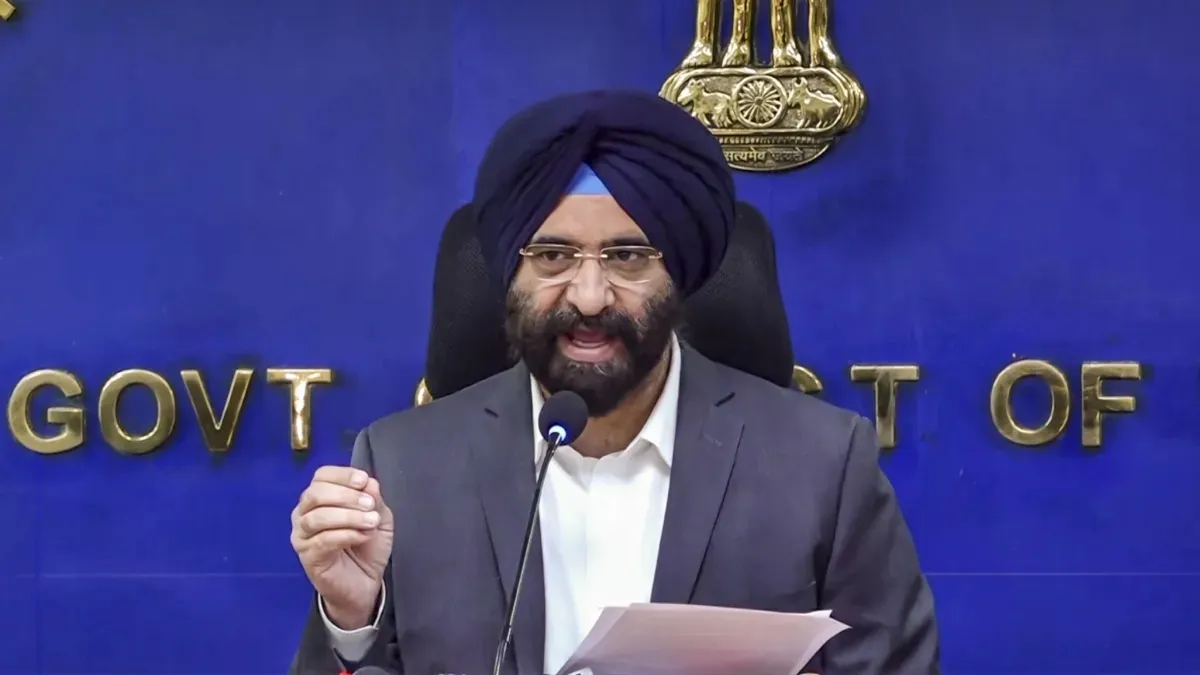
Amid rising concerns over air pollution in the national capital, the Delhi Cabinet on Tuesday took a series of major decisions aimed at strengthening public transport, improving environmental governance, and tightening pollution control measures. Delhi Environment Minister Manjinder Singh Sirsa announced the decisions during a press conference.
DTC to operate all buses
One of the key decisions involves public transport operations in the city. The Cabinet has terminated the responsibility of the Delhi Integrated Multi-Modal Transit System (DIMTS), which earlier operated 50 per cent of buses in Delhi. Now, the Delhi Transport Corporation (DTC) will handle 100 per cent of bus operations in the national capital. The move is expected to facilitate better route rationalisation and improve efficiency in public transport services.
In another major step, the Delhi government has approved the establishment of an e-waste recycling plant at Holambi Kalan. The facility will be spread over 11.5 acres and will function with zero water waste.
The Cabinet also approved a plan to rejuvenate water bodies across the capital. Delhi has more than 1,000 water bodies, of which 160 fall directly under the government's jurisdiction. An initial allocation of Rs 100 crore has been made for the restoration, with provisions for additional funds if required.
No PUCC, no fuel
To further tighten pollution control, the government has decided that petrol will not be sold in Delhi without a valid Pollution Under Control Certificate (PUCC), even after the lifting of the Graded Response Action Plan (GRAP).
Authorities have also begun scrutinising PUCC centres across the city. So far, irregularities have been detected at 12 centres, which have been suspended.
The Cabinet has approved four automatic vehicle testing centres and granted permission for the use of mist cannons with anti-smog gun machines on high-rise buildings to combat air pollution.
800 industries to shut
Cracking down on industrial pollution, the government has ordered the closure of more than 800 polluting industries in Delhi. The Delhi Pollution Control Committee (DPCC) has issued closure notices to 411 units, while the Municipal Corporation of Delhi (MCD) has sealed around 400 such industries.
Meanwhile, the Delhi Government has taken a series of decisive steps to curb rising pollution levels in the national capital and ensure a cleaner environment. Delhi Chief Minister Rekha Gupta reiterated that the government will enforce a zero-tolerance policy against all sources of pollution.
A high-level review meeting was held on Monday at the Delhi Secretariat to assess pollution control measures and take effective decisions. Key decisions include strict enforcement of Pollution Under Control (PUC) norms without any waiver of challans, exploring pooled and shared electric bus services in Delhi-NCR, issuing new guidelines for e-rickshaws and rationalising Delhi Transport Corporation (DTC) bus routes.
Senior officials from the Environment and Transport Departments, the Delhi Pollution Control Committee (DPCC), Public Works Department (PWD) and Delhi Traffic Police, along with Environment Minister Shri Manjinder Singh Sirsa, were present at the meeting.
Also Read: 'You did nothing for 11 years': Delhi LG Saxena blames Kejriwal for pollution in scathing letter
