
India has witnessed an unprecedented rise in digital transactions, and the centre of this revolution is the Unified Payments Interface (UPI). According to data released by the National Payments Corporation of India (NPCI), transactions through UPI touched a record high of Rs 25.14 lakh crore in May 2025. But this has led to financial pressure on banks. The government is reportedly considering reintroducing the Merchant Discount Rate (MDR) to provide support to banks and payment service providers. According to a report by NDTV, discussions are underway to allow MDR based on transaction value.
“While small-ticket UPI payments would likely remain exempt, larger transactions could soon carry a merchant fee, reversing the zero-MDR policy in place since January 2020,” a source was quoted as saying the report.
The development comes as several banks and payment services have raised concerns about the rising cost involving high-value digital transactions.
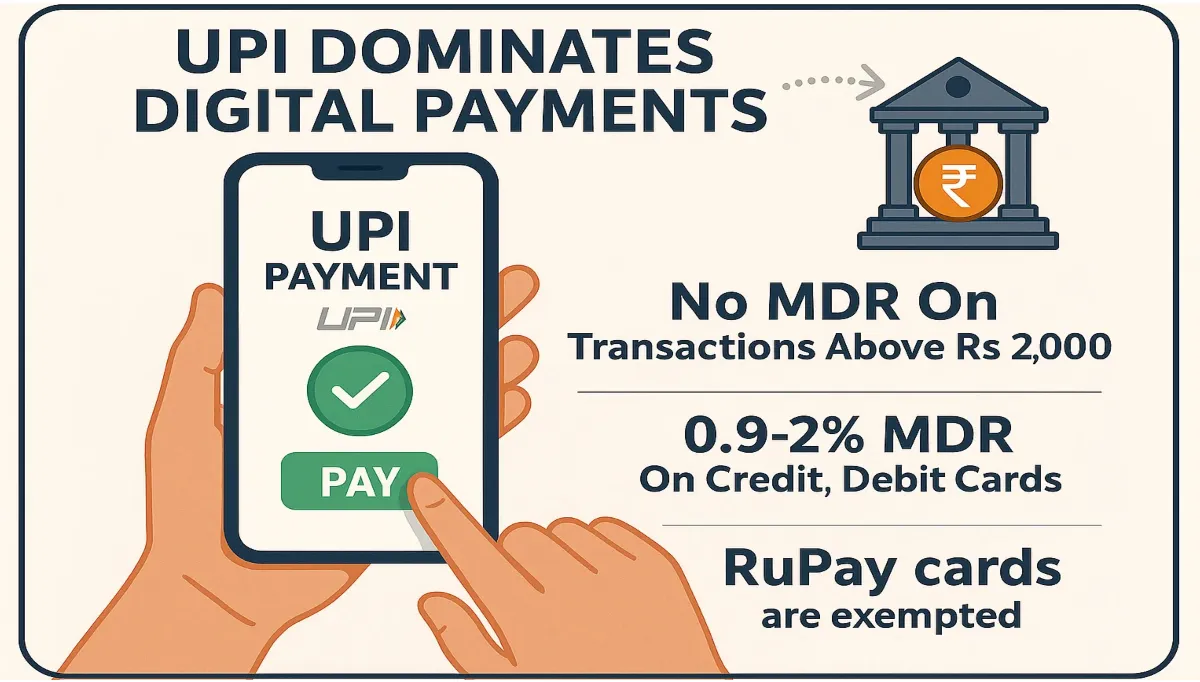
UPI Dominates Digital Payments
UPI, which was launched 10 years ago, accounts for 80 per cent of digital retail transactions in the country. Moreover, the person-to-merchant (P2M) UPI transactions have reached 60 lakh crore since 2020.
No MDR On Transactions
At present, there is no MDR on person-to-merchant (P2M) UPI transactions. The decision was taken by the Central Board of Direct Taxes (CBDT) and has been effective since January 2020.
0.9-2% MDR On Credit, Debit Cards
The Payments Council of India (PCI) has suggested a 0.3 per cent MDR for big merchants. Currently, credit and debit cards have an MDR of 0.9 per cent to 2 per cent, but RuPay cards are exempt from this.
No GST On UPI Transactions Above Rs 2,000
Earlier, the government issued clarification that it is not considering levying GST on UPI transactions above Rs 2,000.
GST is levied on charges, such as the Merchant Discount Rate (MDR), relating to payments made using certain instruments. As there is no MDC on UPI transactions, there is consequently no GST applicable to these transactions.
