
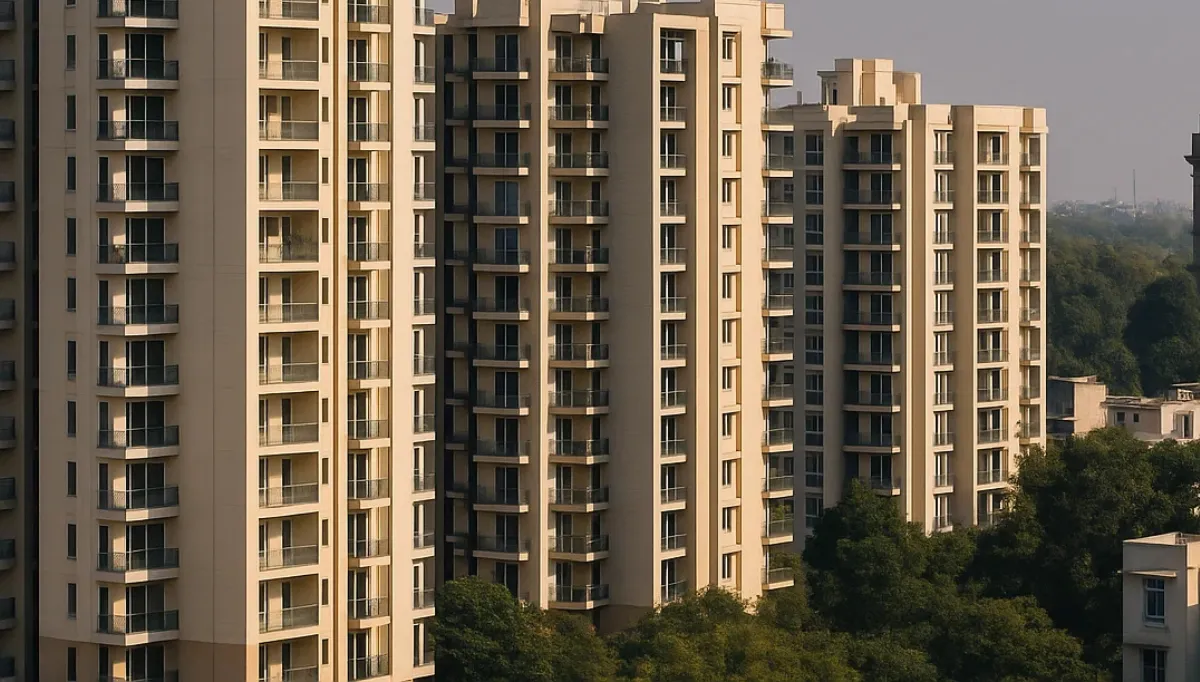
2025 emerged as a year of reset for the NCR real estate market, marked more by consolidation and renewed buyer confidence than by aggressive expansion. After years of uneven cycles, homebuyers displayed a clear shift in intent; moving away from speculative purchases towards well-planned, end-user–oriented homes backed by credible developers and visible infrastructure progress. Sales momentum across NCR stabilised, supply remained measured, and decision-making became more discerning. Within this broader transition, Gurugram stood out as the market that most clearly mirrored this change, combining disciplined supply, sustained end-user demand and infrastructure-led growth to set the tone for how NCR’s residential markets began to recalibrate in 2025.
5,100 luxury home sales in H1 2025
The first half of the year 2025 (H1 2025) reinforced the growing centrality of luxury housing in NCR’s residential landscape. Industry data showed that Delhi-NCR recorded over 5,100 luxury home sales during the period, registering a year-on-year increase, even as residential markets in several other Indian cities experienced moderation. The trend underlined a clear divergence in buyer behaviour, with demand at the premium end remaining largely insulated, driven by end-users prioritising location, product quality and long-term value over short-term market movements. Within NCR, Gurugram emerged as the strongest contributor to this momentum, accounting for the overwhelming majority of luxury transactions and anchoring the region’s leadership among India’s top residential markets.
The city’s luxury demand remained sharply concentrated along infrastructure-led corridors, particularly the Southern Peripheral Road and the Dwarka Expressway, reflecting the growing importance of execution-ready connectivity in shaping purchase decisions. Higher disposable incomes and changing lifestyle expectations continued to sustain interest in larger, amenity-rich homes, even as overall residential activity moderated. While established addresses such as Golf Course Road maintained steady traction, limited new supply shifted the spotlight towards emerging corridors, allowing areas like SPR to consolidate their position as Gurugram’s next luxury growth engines within NCR’s evolving housing market.
According to Sandeep Chhillar, Founder & Chairman, Landmark Group, 2025 has been a remarkable year for the real estate sector, registering impressive growth numbers across the residential and commercial markets in key cities.
"While each market witnessed strengthened sentiments, Delhi-NCR emerged as one of the most resilient and outperforming regions, backed by infrastructure momentum, enhanced connectivity and a sharp rise in end-user confidence,” Chhillar said.
He adds that within NCR, Gurugram led the growth, particularly in the luxury housing and Grade-A office segments. The city benefited from corridor-led developments along Golf Course Road, Golf Course Extension Road, Dwarka Expressway, and SPR, attracting both end-users and investors seeking quality, scale and long-term value. The growth graph of Gurugram’s real estate market reflects a more disciplined and mature market cycle pattern, further cementing its strong position amongst key cities. The coming year outlook remains positive for the market with sustained demand expected in well-planned micro-markets, continued institutional interest, and infrastructure-led expansion."
Alongside the stabilisation seen in NCR’s core residential markets, 2025 also saw select Tier-II cities emerge as parallel growth centres, driven by affordability and improving infrastructure. Cities such as Mohali, Chandigarh, Dehradun and Jaipur witnessed steady traction from value-driven buyers and first-time investors, drawn by lower entry prices, improving connectivity and expanding employment hubs.
Land transactions in H1 2025 had already surpassed full-year 2024 levels
Industry data through H1 2025 pointed to growing developer conviction beyond India’s largest metros, with land acquisition activity emerging as a clear indicator of long-term confidence. According to Anarock, land transactions in H1 2025 had already surpassed full-year 2024 levels, with Tier-II and Tier-III cities accounting for a larger share of deal volumes than Tier-I markets. The scale of acquisitions highlighted a strategic recalibration by developers, as emerging cities collectively absorbed significantly more land than their metropolitan counterparts during the period.
Complementing this trend, PropEquity data showed that residential sales value across India’s leading 15 Tier-II cities rose year-on-year in Q1 2025, signalling sustained end-user and investor participation. Together, these indicators suggest that the momentum in Tier-II markets is not cyclical but reflective of a broader structural shift, as capital increasingly follows affordability, infrastructure expansion and long-term growth potential.
According to Udit Jain, Director, ONE Group, 2025 has turned out to be a resilient and confidence-building year for Indian real estate.
"Residential sales across key markets grew by an estimated 10–12 per cent, driven largely by strong end-user demand and a renewed preference for home ownership. Tier 1 markets continued to perform steadily, supported by ongoing infrastructure development and buyers increasingly choosing quality, well-planned homes over speculative purchases. Tier 2 markets such as Mohali and Chandigarh, Rohtak and Bahadurgarh, also witnessed strong momentum, with better connectivity, aspirational pricing and lifestyle-led developments pushing end-user housing demand up by nearly 15–20 per cent. These markets are no longer just value-driven but are evolving into mature residential destinations. Looking ahead to 2026, the outlook remains optimistic. Continued infrastructure investments and improving buyer sentiment are expected to keep demand healthy, paving the way for sustainable and long-term growth,” Jain said.
Meanwhile, Noida–Greater Noida continued to post steady, infrastructure-led momentum through 2025, supported by visible progress on the Noida International Airport, expanding metro connectivity and the gradual maturation of industrial and IT corridors. These factors not only sustained residential demand but also strengthened the region’s commercial outlook, with improving connectivity enhancing its appeal for office, industrial and mixed-use developments.
Unlike Gurugram’s premium-heavy trajectory, Noida–Greater Noida’s performance was anchored in volumes, underpinned by its dual residential–commercial ecosystem, reinforcing its role within NCR as a scale-driven market, in contrast to Gurugram’s more value-led growth.
Azad Ahmad Lone, President, Business Development and Operations, Biigtech, said that Noida and Greater Noida had one of their strongest commercial years in 2025 in NCR.
"Average office rentals in the city have increased 18% between 2019 and 2025, benefiting from a combination of infrastructure readiness, improved connectivity and sustained demand from IT, data centres and manufacturing-linked occupiers. What stood out was the quality of leasing; occupiers were clear about efficiency, compliance and future scalability. As we move into 2026, Noida–Greater Noida is well-positioned to see steady, disciplined growth rather than a short-term spike,” Lone added.
As the region looks ahead to 2026, NCR enters the next phase of its real estate cycle with sharper market segmentation and clearer roles across geographies. The region is moving towards maturity, with micro-markets offering a template for sustainable, execution-led growth.
