
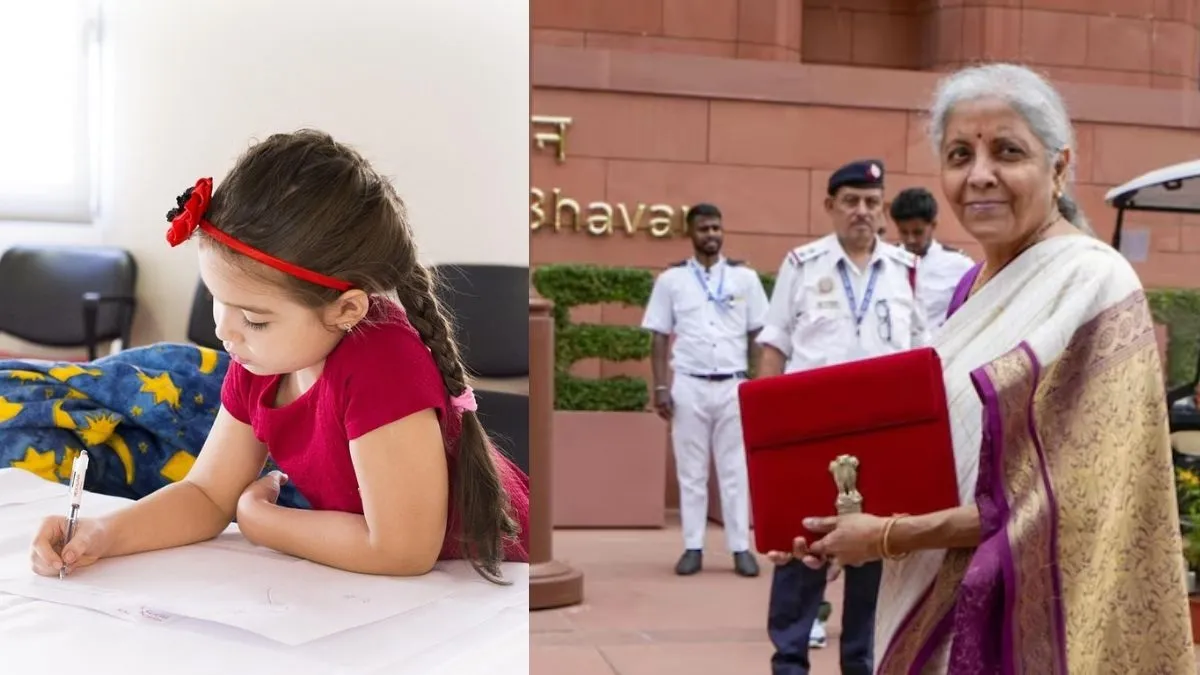
Finance Minister Nirmala Sitharaman has proposed setting up of three new All India Institute of Ayurveda, National Institute of Pharmaceutical Education and Research. Sitharaman has also announced setting up of five university townships. The minister has proposed to reduce TCS rate for pursuing education and for medical purposes under the liberalised remittance scheme, popularly known as LRS, from 5 per cent to 2 per cent.
Government has also proposed the formation of high-level committee in the area of 'Education to Employment and Entrepreneurship'. This committee will recommend measures focused on the services sector as a key driver for a developed India.
Downlod Education Budget 2026 here
Education Budget 2026: Check education stakeholders' reaction on Union Budget 2026
Arpit Mittal, Founder & CEO at SpeakX.ai (formerly Yellow Class) - "The Budget’s emphasis on AI, digital capacity building, and technology led growth is encouraging for the education and skilling ecosystem. The proposed capacity building AI missions aimed at reaching 25 crore people, along with continued support for AI, quantum, and national research and innovation funds, signals long term commitment to technology driven inclusion. The education to employment standing committee is also a timely move, as it can help align learning outcomes with industry demand and continuously review how AI and new technologies are reshaping services and job roles. As the need for English communication and AI era workplace skills rises across regional India, digital learning platforms will play a critical role. Support for digital infrastructure, semiconductor and AI missions, and broader skill development initiatives will help scale high quality, tech enabled learning to underserved geographies. This is a meaningful step toward making workforce readiness more inclusive and outcome driven.”
Piyush Agarwal, the co-Founder and CRO at Reo.Dev- “The Budget’s strong emphasis on AI missions, research and innovation funds, semiconductor scale up, and digital infrastructure sends a clear signal that India is serious about becoming a technology first economy. Capacity building AI missions at population scale and continued support for deep tech research will expand both the developer base and enterprise adoption of advanced tools. For developer focused and software product companies, this creates a larger, more mature buyer and builder ecosystem. As technology procurement becomes more data driven, AI native platforms that interpret real developer and product usage signals will play an important role in helping software vendors go to market more effectively and build faster, more qualified pipelines.”
Vishwanathan Iyer, Sr Associate Professor, Great Lakes. Chennai- "Budget 2026 marks a substantive shift in education policy from access and enrolment to employability and economic productivity. The proposed Education to Employment and Enterprise Standing Committee is a significant institutional signal that the government recognizes India’s core challenge as a skills mismatch rather than a capacity deficit. This is reinforced by the explicit focus on services, exports, and the impact of AI on jobs, which is economically sound given that services contribute over half of India’s GVA and nearly half of exports. The Budget also moves beyond abstractions by committing to concrete workforce outcomes, including adding 100,000 allied health professionals over five years and training 150,000 caregivers, sectors with high employment elasticity. However, the real test will be whether these reforms translate into binding curriculum changes, industry participation, and state-level execution. Without accountability mechanisms, even well-designed institutions risk remaining advisory rather than transformative."
Deepak K. Sinha, Dy. Director, Faculty of Engineering & Technology, Jain University, Bangalore - "The Union Budget 2026 strategically invests in India’s future-ready workforce by focusing on high-growth sectors. It integrates AI and the National Quantum Mission into formal career pathways and prioritizes Allied Healthcare, targeting the training of 1 lakh professionals and establishing five Yoga Science Institutes. The creative economy is bolstered through support for Animation, Comics, and Content Creation to address a shortfall of 2 million professionals. Major institutional announcements include a new NID for the Northeast, a National Institute of Tourism, and a plan for IIMs to train 10,000 guides. The expansion of NIMHANS to North India enhances mental health infrastructure. While progressive, observers note that deeper investment in core technical education is still needed to fully bridge the skills gap."
Naman Jain, Education Policy Expert and Vice Chairman, Silverline Prestige School- "The government’s renewed emphasis on education with a strong push for skill-building, design labs, and digital innovation marks a real turning point for India’s educational and skilling landscape. We welcome this visionary approach. The announcement of AVGC Content Creator Labs in 15,000 secondary schools and 500 colleges signals a commitment to moving beyond rote learning and equipping students with real-world skills that match today’s industry needs.
However, the real challenge lies in making sure these opportunities reach every student, not just those in a select few schools. The true measure of success will be how well we close the gap between what’s taught in classrooms and the expectations of the modern workplace. If implemented well, these commendable initiatives can transform India’s education system into a true engine of innovation, employability, and opportunity for all."
Neelima Kamrah, Principal, KIIT World School- “The Union Budget 2026 reflects a clear intent to build a future-ready education ecosystem aligned with the realities of a rapidly evolving world. The focus on AI, creative technologies, and skill-linked learning signals a welcome shift from rote education to meaningful, application-driven learning. Initiatives such as regional education infrastructure, university townships, and dedicated STEM hostels for girls are progressive steps toward inclusivity and equal opportunity. Strengthening vocational, design, and interdisciplinary pathways will empower students to explore diverse career choices with confidence. This budget reassures educators and parents that policy is steadily moving toward holistic student development and long-term national growth.”
Vishwanathan Iyer, Sr Associate Professor, Great Lakes. Chennai - "Budget 2026 marks a substantive shift in education policy from access and enrolment to employability and economic productivity. The proposed Education to Employment and Enterprise Standing Committee is a significant institutional signal that the government recognizes India’s core challenge as a skills mismatch rather than a capacity deficit. This is reinforced by the explicit focus on services, exports, and the impact of AI on jobs, which is economically sound given that services contribute over half of India’s GVA and nearly half of exports. The Budget also moves beyond abstractions by committing to concrete workforce outcomes, including adding 100,000 allied health professionals over five years and training 150,000 caregivers, sectors with high employment elasticity. However, the real test will be whether these reforms translate into binding curriculum changes, industry participation, and state-level execution. Without accountability mechanisms, even well-designed institutions risk remaining advisory rather than transformative."
Arti Dawar, CEO, Shiv Nadar School - “The Union Budget recognises young people as India’s most valuable asset and places education at the heart of the nation’s growth story, reflecting a Yuva Shakti–driven vision. The focus on the Education-to-Employment Standing Committee, AVGC labs (Animation, Visual Effects, Gaming and Comics Labs), and skilling pathways reflects a strong commitment to preparing students for future-ready careers. The proposed strengthening of scientific infrastructure, research capabilities, and AI-led capacity building will further inspire young learners, particularly in STEM disciplines. By aligning education with emerging technologies, creative industries, and inclusive skill development, the Budget ensures that learning remains relevant in a rapidly evolving world. At Shiv Nadar School, we see this as a timely step towards nurturing confident, capable, and globally competitive learners for a Viksit Bharat.”
