
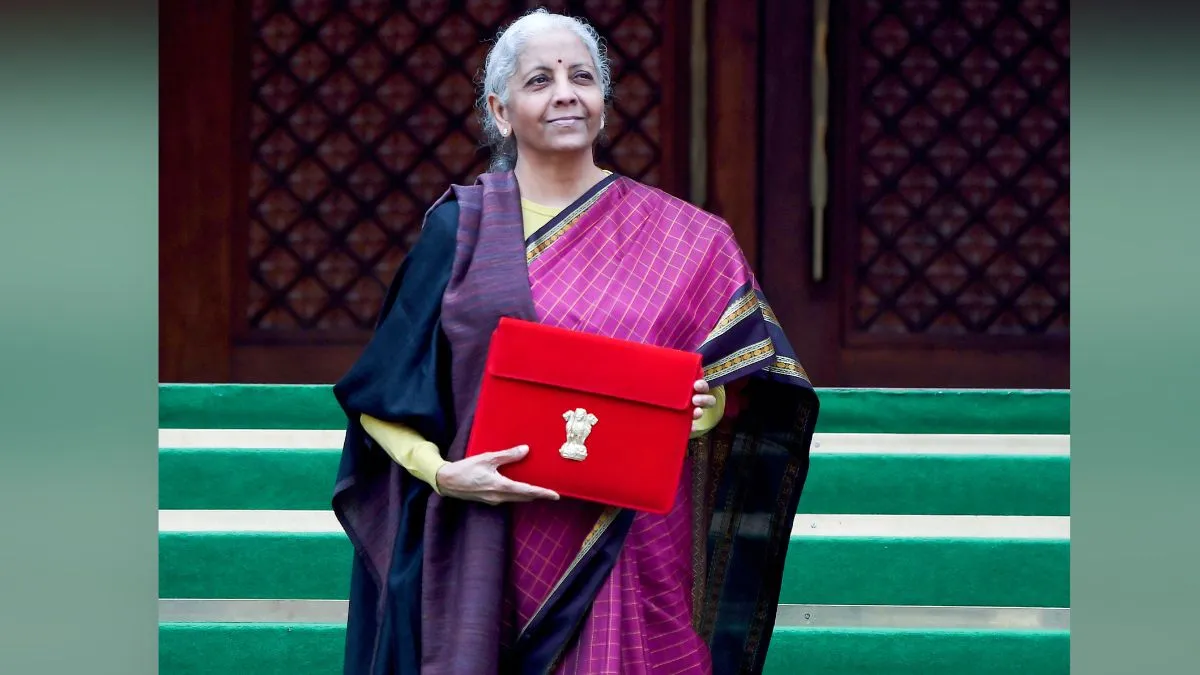
Finance Minister Nirmala Sitharaman is delivering her ninth consecutive Union Budget on Sunday (February). She presented the budget using a digital tablet encased in a traditional 'bahi-khata' style pouch. For the first time in India's independent history, the Union Budget has been presented on a Sunday. She made several announcements related to the Semiconductor Mission, infrastructure, agriculture, banking sector, etc.
Highlighting the economic performance of the NDA government, Sitharaman said India's economic trajectory since 2014 has been marked by stability, fiscal discipline and sustained growth. She asserted that keeping Aatmanirbharta as a guiding principle, the government has strengthened domestic manufacturing capacity, ensured energy security and reduced critical import dependencies. She added that these measures have delivered a high growth rate of around 7 per cent and enabled substantial strides in poverty reduction and improvement in the lives of the people. Here are the key highlights of the Union Budget 2026.
Key highlights of the budget speech:
- The rollout of India Semiconductor Mission 2.0 to boost the country's growing chip ecosystem. The upgraded mission places a strong emphasis on industry-led research, advanced training centres and deeper collaboration with global technology leaders. The government has significantly increased the outlay for the initiative to Rs 40,000 crore.
- This enhanced funding aims to build on the momentum generated by the earlier phase of the semiconductor mission and accelerate domestic manufacturing capabilities.
- Sitharaman also highlighted that mineral-rich states such as Odisha, Kerala, Andhra Pradesh and Tamil Nadu will receive targeted support to strengthen the raw material pipeline essential for chip production.
- Traditional industries will undergo modernisation to improve productivity, enhance global competitiveness and adopt cleaner, technology-driven processes.
- A dedicated push will be given to build globally competitive MSMEs. Policy support, credit facilitation and technology adoption will be central to strengthening India’s MSME backbone.
- Infrastructure development to remain a key driver of economic momentum. The government plans to upgrade transport networks, logistics systems and essential utilities to support rapid growth.
- Measures will focus on building resilient economic systems, strengthening financial stability and ensuring that long-term growth remains sustainable and secure.
- An increase of about 9 per cent in capital expenditure for the coming financial year, raising the allocation to Rs 12.2 lakh crore in the Union Budget 2026-27.
- The capital expenditure has been increased to Rs 11.21 lakh crore, up from the Rs 11.21 lakh crore allocated in the last Union Budget for FY25-26. For FY26, the government had set a capex allocation of Rs 11.21 lakh crore.
- Seven high-speed rail corridors to come up as part of efforts to boost connectivity and infrastructure in India. Key routes include: Mumbai to Pune; Pune to Hyderabad; Hyderabad to Bengaluru; Bengaluru to Chennai.
- A proposal for incentives of Rs 100 crore for single bond issuance by municipal corporations of more than Rs 1,000 crore. Restructuring of REC Ltd (formerly Rural Electrification Corporation) and Power Finance Corporation (PFC) as part of the government's public sector financial institution strengthening.
- The minister proposed setting up a high-level committee on 'Banking for Viksit Bharat'. Proposal to review foreign exchange management non-debt instruments rules. Sitharaman said that close to 25 crore people have come out of multi-dimensional poverty.
- A proposal to set up a Rs 10,000 crore fund to create champion small and medium enterprises (SMEs) to boost the economy. Mega textile parks with a focus on value addition to technical textiles would be set up. The budget also proposed setting up mega textile parks with a focus on value addition to technical textiles and an integrated textile programme with five sub-parts.
- One girls' hostel to be set up in every district of the country. A loan-linked capital subsidy support scheme for veterinary colleges, hospitals, and diagnostics laboratories.
- The upgrading Ayush pharmacies and drug testing labs, the WHO (World Health Organisation) Traditional Medicine Centre at Jamanagar, Gujarat. The Centre to support five university townships in the vicinity of major industrial logistics centres.
Check the PDF of key highlights
Major relief for taxpayers
Sitharaman announced a series of taxpayer-friendly reforms in the Union Budget 2026–27 aimed at simplifying income-tax compliance and reducing procedural hurdles.
She said the Income Tax Act, 2025 will be implemented from April 1 and rules and tax returns forms will be notified shortly. One of the key announcements is the proposal to extend the deadline for filing revised income-tax returns from December 31 to March 31. Taxpayers will be able to make corrections by paying a nominal fee. The minister also confirmed that individuals filing ITR-1 and ITR-2 will continue to have the July 31 deadline. For non-audit business cases and trusts, the window for filing returns has been extended to August 31, offering greater flexibility in meeting annual tax obligations.
Another important change impacts non-resident Indians. TDS on the sale of immovable property by NRIs will now be deducted by the resident buyer. This replaces the earlier requirement where NRIs had to quote a TAN, thereby simplifying the process and reducing administrative burden.
Fiscal deficit lower at 4.3% of GDP
Finance Minister Nirmala Sitharaman also said the government expects the fiscal deficit to be at 4.3 per cent of the GDP in 2026-27, lower than 4.4 per cent projected for the current financial year. In her 2026-27 Budget speech, Sitharaman also said the government will provide Rs 1.4 lakh crore as tax devolution amount to the states in the next financial year, while the net tax receipts is estimated at Rs 28.7 lakh crore. The size of the Budget for 2026-27 is pegged at Rs 53.5 lakh crore.In 2026-27, the fiscal deficit is estimated at 4.3 per cent, the minister said as the government moves on the fiscal prudence path of debt consolidation.
