Scientists solve 60-year mystery behind Venus’s super-fast winds
A new study finally uncovers what powers Venus’s super-fast winds. Scientists found that a daily thermal tide—created by the Sun’s heating—pushes momentum toward the cloud tops, driving the planet’s famous atmospheric superrotation. The findings come from two decades of spacecraft data.
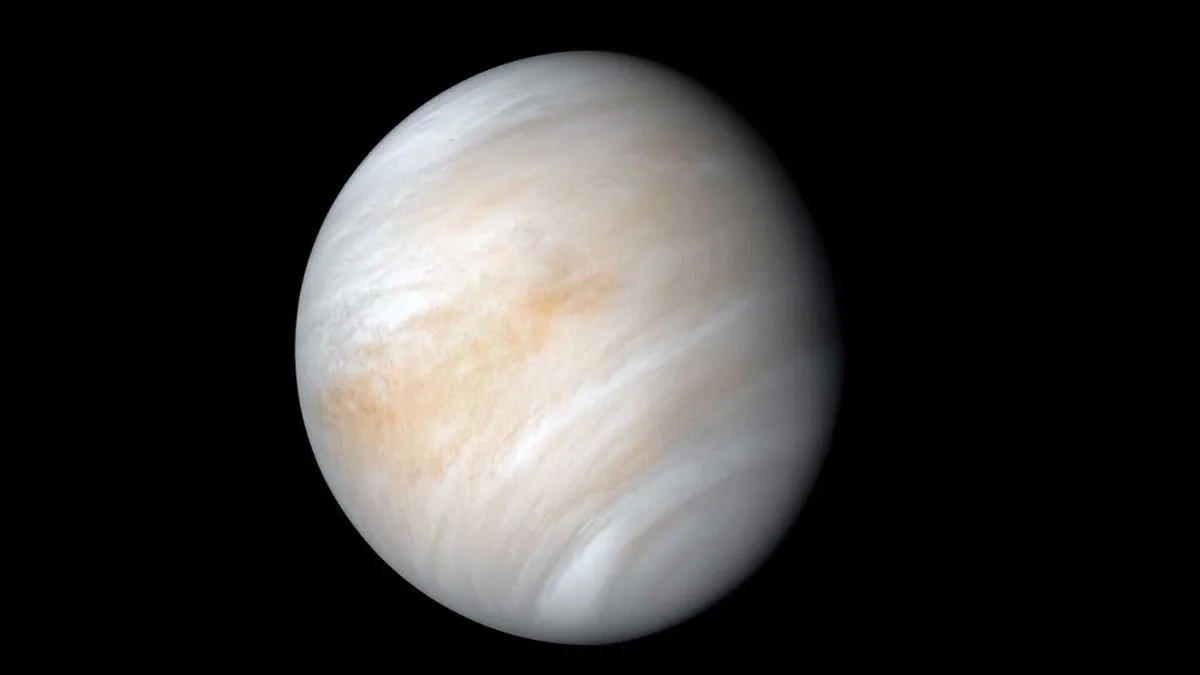
Planet Venus (the second closest planet to the Sun) has long been something of a cosmic paradox, glowing softly in the sky while it hides an atmosphere in full storm mode. Its thick clouds churn around the planet more than 60 times faster than Venus itself spins. Now scientists say they have pinpointed the main force behind this dramatic superrotation: a once-per-day thermal tide generated by the Sun.
A new study, built on almost two decades of observation, finds that diurnal (daily) heating is the main driver behind speeding up the winds over the clouds of Venus. The research team merged data from ESA's Venus Express and JAXA's Akatsuki orbiters, which used radio waves to monitor atmospheric behaviour, with high-resolution simulations of Venus' circulation patterns.
The results they obtained overturn the prior assumptions. Whereas scientists previously thought that the twice-per-day thermal tides were responsible for carrying most of the momentum, new findings have proven the contrary – that the daily tide is much stronger and makes a bigger difference.
Two hemispheres, one mechanism
One of the breakthroughs of this study is its inclusion of Venus's Southern Hemisphere, largely overlooked in earlier datasets. According to the analysis, the daily thermal tide functions consistently across both hemispheres, pushing energy toward the planet's cloud tops and sustaining the extreme wind speeds recorded at altitudes around 70 kilometres.
This discovery strengthens the case for the Sun's heating being directly responsible for the speed of the atmosphere. The thermal tide drags the winds along effectively, creating a momentum pump that keeps the atmosphere racing around the slow-spinning planet.
A long-standing mystery has finally been addressed
Since the 1960s, when the first spacecraft revealed that Venus' atmosphere circles the planet in merely four Earth days, scientists have been trying to decode Venus' wild winds. In the decades since, many theories surfaced: gravity waves, complex circulation cells, and surface-atmosphere interactions, all of which explained the phenomenon.
The new findings do not just identify the primary driver; they also tie together decades of scattered evidence. With clearer insight into Venus's atmospheric engine, researchers are now better equipped to study how superrotation develops on other planets as well.