James Webb Space telescope detects Cosmic Buckyballs in distant Nebula
NASA’s James Webb Space Telescope has revealed detailed images of rare carbon molecules known as buckyballs inside a distant planetary nebula called Tc 1. Located around 10,000 light-years away, the discovery may help scientists better understand how complex organic molecules form in space.
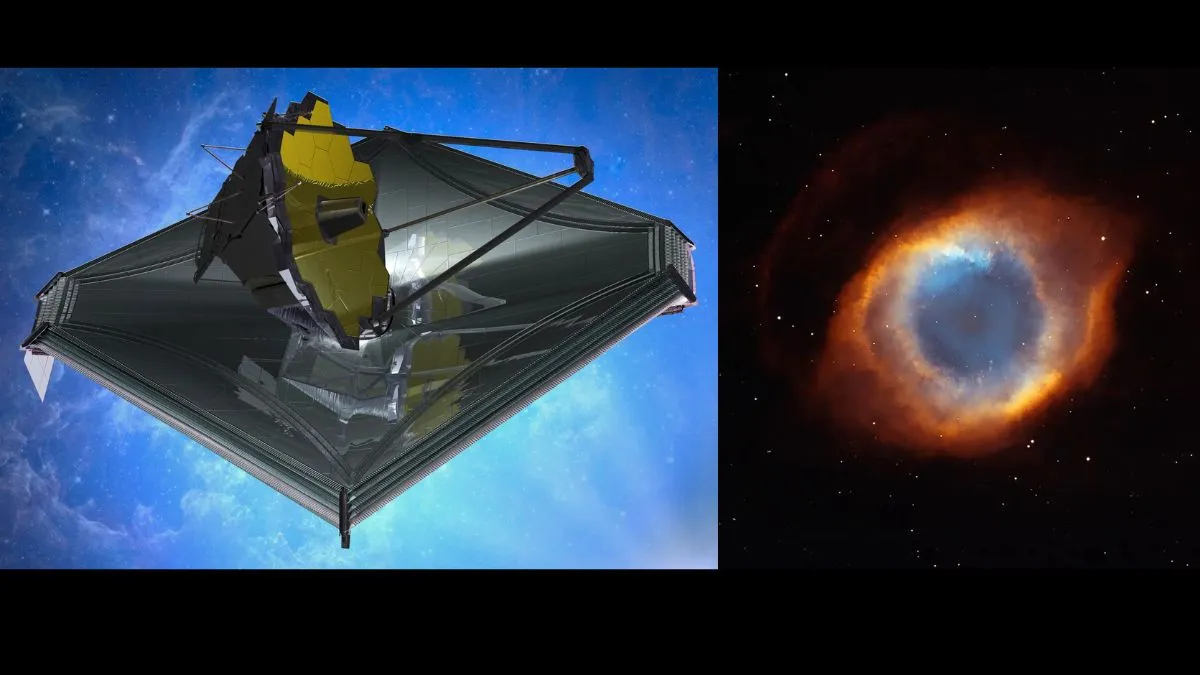
The James Webb Space Telescope (JWST) has come up with some incredible new finds – sharp, detailed images of rare carbon molecules called Buckyballs, which are drifting through a distant planetary nebula called Tc 1, nearly 10,000 light-years away in the constellation Ara.
Why are these Buckyballs such a big deal?
Well, they are not your ordinary molecules. Scientists know them as buckminsterfullerene or just “C60.” Think of them as tiny carbon soccer balls—each sphere has 60 carbon atoms arranged in a pattern of pentagons and hexagons.
They were first cooked up in a lab back in 1985, thanks to Harry Kroto’s team (and yes, that bagged them a Nobel Prize). But now, we know these complex molecules don’t just belong in beakers—they’re out there in space, made by stars.
So, how did JWST spot them?
Tc 1 is not any old gas cloud. It is formed after a star like our Sun has burnt out, puffed off its outer layers, and left behind a hot core. What’s left is a glowing shell—a planetary nebula—surrounding a white dwarf. Tc 1 turns out to be a cosmic goldmine for these buckyballs.
The JWST’s Mid-Infrared Instrument (MIRI) snapped some truly wild images. Picture this: glowing shells, thin threads of gas, and a strange shape that looks like an upside-down question mark. What’s really wild is that those buckyballs are not scattered all over the place.
They are huddled together in a shell around what’s left of the star, almost like they have been carefully arranged.
What is the big picture of JWST state?
As per the photos, Buckyballs are part of a group of carbon molecules, which could help build even more complex chemicals, to figure out if they might lead to life or not. This discovery has further sharpened our understanding of how organic molecules are shaped after the stars die and how they might spread across galaxies. Also, it adds a few pieces to the puzzle of how life could start on Earth.
Of course, space never runs out of mysteries. JWST picked up some bizarre infrared signals that scientists cannot really explain yet—they do not fit the models. So, researchers want even more time on the telescope to snoop around other nebulae and figure out what is going on.
If you are into astronomy (especially in India), then this is one of those “sit up and take notice” results. It proves how space missions like JWST keep pushing the boundaries, and it’s a glimpse of what’s possible for global projects, including what ISRO’s lining up for the future.