Assembly Election Results 2026: Three defining trends emerge across India's political battleground
The 2026 Assembly elections have delivered three major political trends in the country. The BJP is on track to form a government in West Bengal for the first time, Tamil Nadu's long-standing DMK-AIADMK structure has been disrupted by TVK and the Left faces an unprecedented decline in Kerala.
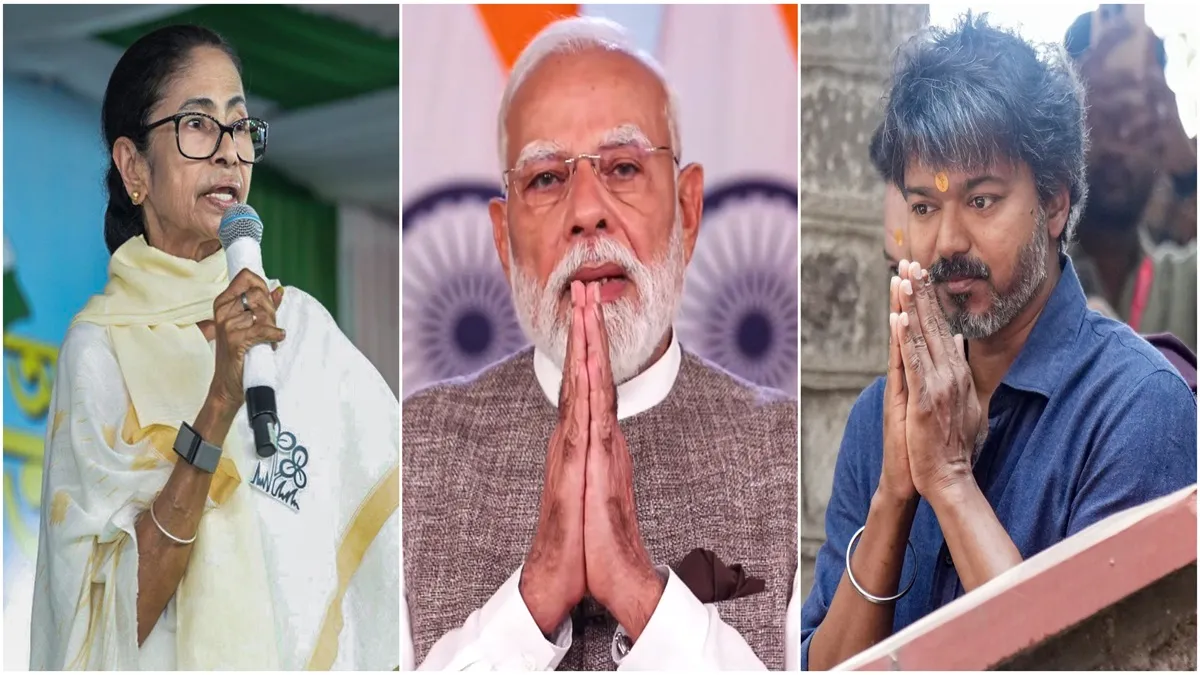
The Assembly election results across West Bengal, Assam, Tamil Nadu, Kerala and Puducherry have triggered an extraordinary churn in the country's political scenario. What was expected to be a straightforward contest in several states has instead unfolded into a moment of sweeping realignments and striking breakthroughs. The results emerging from the Election Commission's trends point to a shifting voter mood that has challenged entrenched leaderships, collapsed long-standing bastions and elevated new political forces into relevance.
This election cycle has not only tested the resilience of traditional parties but has also revealed how swiftly the Indian electorate can pivot when faced with new narratives, fatigue with existing power structures or the rise of disruptive challengers. From a saffron surge in Bengal to a tectonic shakeup in Tamil Nadu and an existential crisis for the Left in Kerala, three standout developments have redefined the 2026 elections and set the stage for a transformed political decade ahead.
BJP set to form govt in Bengal for the first time
The Bharatiya Janata Party (BJP) is on the brink of creating history in West Bengal as it emerges poised to form a government for the first time, thus ending the fifteen-year rule of the Trinamool Congress (TMC) led by Mamata Banerjee. The political identity of Bengal has traditionally been rooted in unwavering loyalty towards dominant forces that enjoyed extended mandates. Over the decades, the state's political life has been defined by eras shaped by powerful ideologies and charismatic leaderships, from Congress rule to the long stretch of Left Front dominance and eventually the TMC's ascent in 2011.
The 2026 elections injected an intensity rarely seen in Bengal's recent history. Chief Minister Mamata Banerjee's long tenure encountered its toughest challenge as the BJP mounted a vigorous grassroots push, leveraging its national leadership and organisational depth. What is unfolding now is not just another transition but the possible end of an entire political era -- one that began with the decline of Congress in the 1960s, strengthened through the ideological determination of the Left under towering figures like Jyoti Basu and later reshaped by the rise of Banerjee's "welfare-driven" appeal.
As counting continues, the BJP's surge has signalled that Bengal's political loyalties may finally be shifting after decades of stability anchored in a single dominant force.
End of the DMK, AIADMK era in Tamil Nadu
Tamil Nadu is witnessing a political turning point as the actor-politician Vijay and his Tamilaga Vettri Kazhagam (TVK) disrupt the six-decade-long dual dominance of the Dravida Munnetra Kazhagam (DMK) and the All India Anna Dravida Munnetra Kazhagam (AIADMK). With TVK leading on over 107 seats in the current trends, the state appears set for its first triangular contest since 1967, a year that had initially marked the fall of the Congress and the rise of Dravidian parties.
After the DMK, under CN Annadurai, ended Congress rule in 1967, the state's politics settled into a rhythm where power alternated between the DMK and AIADMK. Leaders such as M Karunanidhi, J Jayalalithaa and MG Ramachandran shaped Tamil Nadu's modern political fabric which created electoral cycles driven by personality-driven narratives and welfare politics. Even brief deviations, such as the AIADMK retaining power in 2016, did not break the larger binary structure.
The emergence of TVK has altered this entrenched order. For the first time in decades, Tamil Nadu voters appear to be embracing a third alternative, signalling fatigue with legacy politics and a desire for newer representation. The rise of Vijay's party marks one of the most striking turnarounds of the 2026 elections.
Complete wipeout of Left from Indian states
The Left is confronting its most serious political decline in independent India, with trends from the Kerala Assembly elections suggesting that the Left Democratic Front (LDF) is set to lose control of its last surviving stronghold.
The current trends show the United Democratic Front (UDF) leading in more than 100 of the 140 seats, while the LDF trails significantly. If these numbers translate into final results, it would be the first time since 1970 that the Communist parties would be left without control of any state government in the country.
The Left's historical contributions to India's political evolution have been profound. It became the largest Opposition bloc in the Lok Sabha in the first general election of 1951-52, formed the first democratically elected Communist government in a major country in Kerala in 1957 and established one of the longest political tenures in India in West Bengal beginning in 1977. Leaders such as Jyoti Basu and Manik Sarkar became synonymous with stability and policy continuity in their respective states.
However, the downward slide began after 2011 when the TMC swept away the Left Front in West Bengal, slashing its influence from 235 seats to 62 in a single election. In 2018, the Left suffered another blow as it lost Tripura to the BJP which ended decades of uninterrupted governance. Kerala remained its last bastion, with the Pinarayi Vijayan-led LDF retaining power in 2016 and again in 2021.
ALSO READ: