
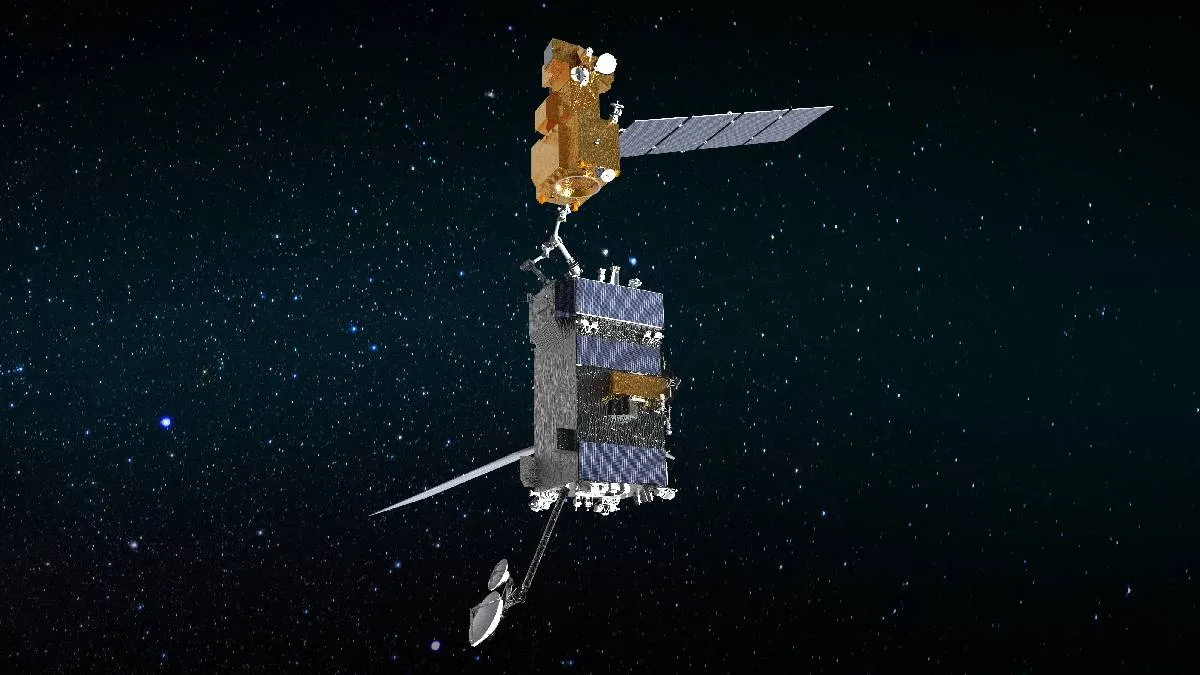
A Chennai-based space startup is poised to demonstrate groundbreaking technology designed to refuel satellites in orbit. This innovation aims to extend the lifespan of orbiting spacecraft while helping to address the growing challenges of space debris.
OrbitAid Aerospace is set to launch AyulSAT, a dedicated tanker satellite, onboard the Polar Satellite Launch Vehicle (PSLV) this Monday. The mission is designed to perform internal propellant, power, and data transfers using the company's proprietary Standard Interface for Docking and Refuelling Port (SIDRP).
"We will first demonstrate transfer of fuel from one tank to another within the satellite," Sakthikumar Ramachandran, founder and CEO of OrbitAID, told reporters. He noted that AyulSAT will be India's first commercial docking and refuelling interface deployed in-orbit.
Pioneering the on-orbit economy
The startup envisions a future where satellites are no longer disposable. "We will soon have fuel stations in orbit that will enable life extension of satellites - both in low earth and geo synchronous orbits," he said.
Later this year, OrbitAID plans to launch a "chaser" satellite that will dock with AyulSAT to demonstrate actual in-orbit refuelling. "AayulSAT will also now serve as the target satellite for our first Rendezvous Proximity Operations and Docking (RPOD) mission, with the launch of our chaser satellite by the end of 2026," Sakthikumar said.
A historic milestone for India
With the success of this mission, India will become the fourth country to demonstrate in-orbit refuelling capabilities. The AyulSAT mission is expected to lay the groundwork for a burgeoning "on-orbit economy," characterised by the active servicing, refuelling, and sustaining of space assets.
According to OrbitAID, AyulSAT will facilitate satellite life extension, reduce orbital debris, and support long-duration commercial and human spaceflight missions. "The mission also directly advances India's Debris-Free Space Mission 2030 and lays the foundation for an on-orbit economy built on servicing, refuelling, and maintenance," the space start-up said.
ALSO READ: ISRO's Aditya-L1 finds how solar storm impact on Earth’s magnetic field
