
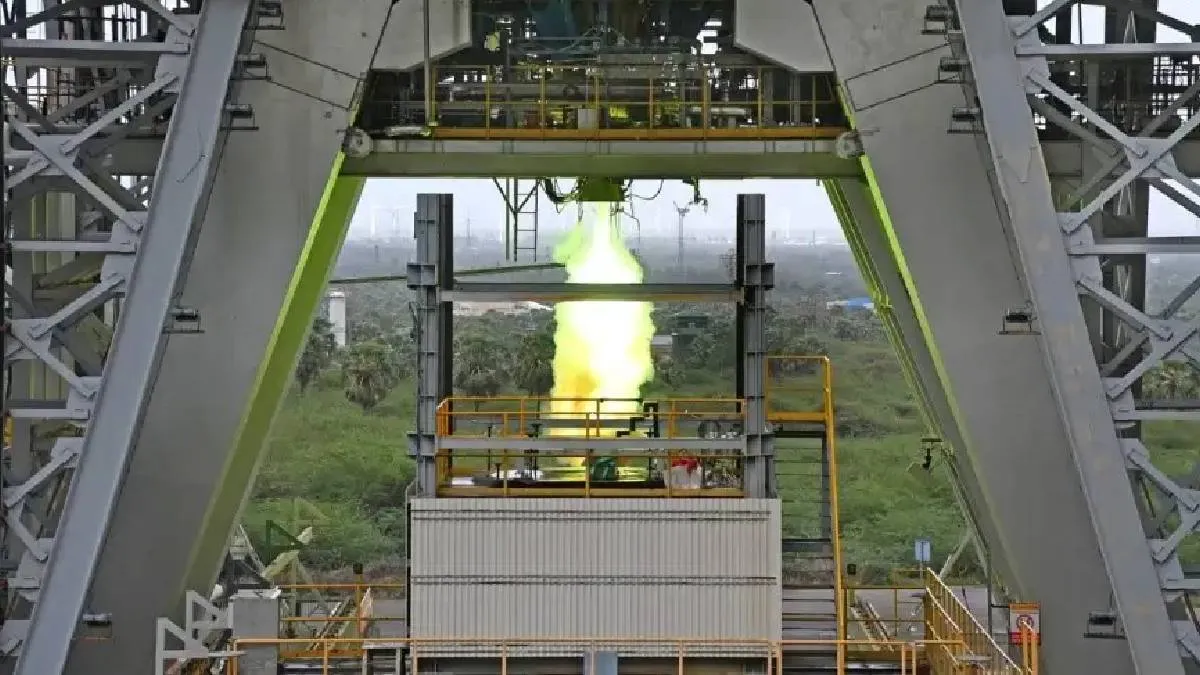
On Monday, the Indian Space Research Organisation (ISRO) announced that it had achieved a significant milestone by successfully completing the third hot test of the Power Head Test Article (PHTA) at the ISRO Propulsion Complex in Mahendragiri, Tamil Nadu. This test is a crucial part of a series of evaluations designed to validate the performance of India’s upcoming semicryogenic engine. ISRO indicated that this was the third in a series of hot tests conducted for the PHTA. The test, which took place on May 28, aimed to validate the engine’s ignition and start-up sequence while optimising the process for integrated engine performance.
During the three-second trial, the engine was successfully ignited and operated at 60 percent of its rated power level, demonstrating stable and controlled performance throughout.
According to ISRO, the series of performance evaluations began in March 2025, focusing on critical components such as low- and high-pressure turbo-pumps, the pre-burner, start-up system, and various control mechanisms. The first test, conducted on March 28, 2025, confirmed smooth ignition and bootstrap operation during a 2.5-second run. The second test, which took place on April 24, concentrated on the start transient build-up and validated the ignition sequence over a duration of 3.5 seconds.
What is the significance of this test
ISRO explained that the Semi-Cryogenic Propulsion Stage, powered by a 2000 kN-class engine, is being developed to replace the current liquid core stage of the LVM3 launch vehicle, with the aim of enhancing its payload capability.
Meanwhile, Shubhanshu Shukla from India is getting ready for his first trip to space. He will be part of Axiom Space's fourth mission to the International Space Station. This exciting journey is set to launch on June 8 from the Kennedy Space Center in Florida, using a SpaceX rocket called Falcon-9. The spacecraft, known as Dragon, is scheduled to take off no earlier than 6:41 pm IST.
ALSO READ: ISRO performs 122 Collision Avoidance Manoeuvres over past 14 years
Inputs from PTI
