
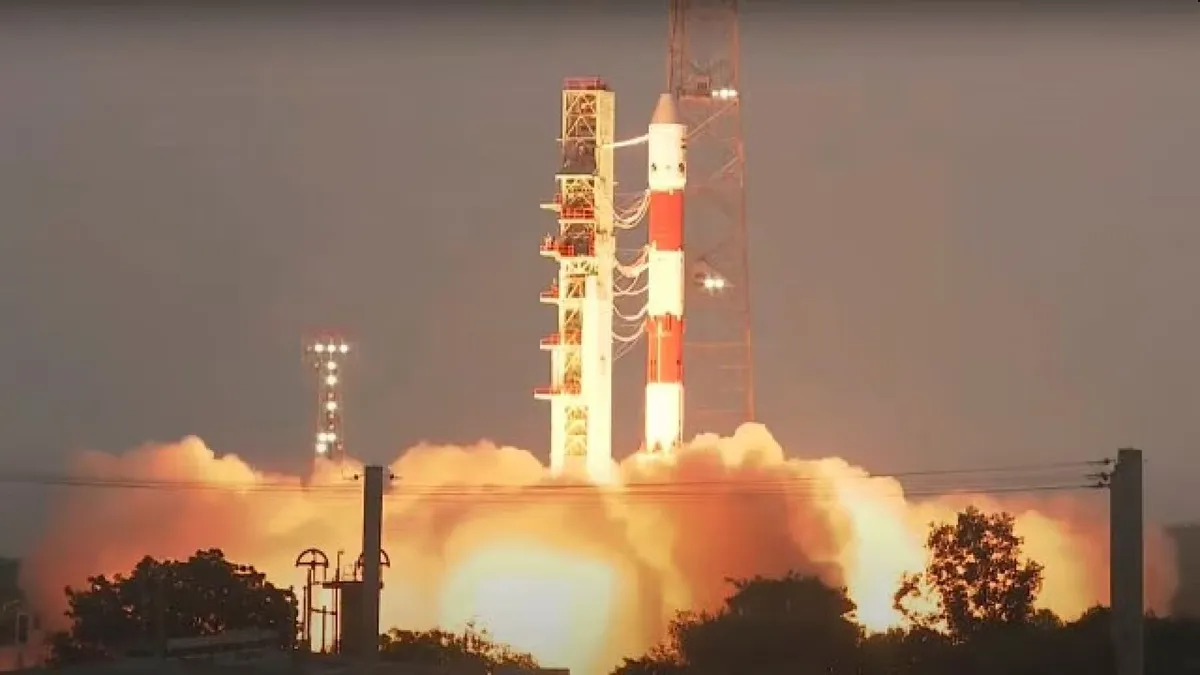
The Indian Space Research Organisation (ISRO) has formed a committee to investigate the incident in which a Polar Satellite Launch Vehicle (PSLV) rocket failed to place an Earth observation satellite (EOS-09) into its intended orbit, Chairman V Narayanan said on Sunday (May 18). The committee has held several rounds of discussions in order to identify the cause. ISRO failed to place its Earth observation satellite in orbit after the trusted PSLV rocket developed a fault minutes after launch from Sriharikota, about 135 km from here.
"Today, we had the 101st mission from Sriharikota. The rocket is a four-stage vehicle. The first stage comprises a 134-tonne solid propulsion system and has six strap-on motors, each holding 12 tonne of propellant. The second stage has a 40-tonne liquid propulsion system, the third stage an 8-tonne solid propulsion system, and the fourth stage again uses liquid propulsion. These four stages must work in tandem to place a satellite into orbit," Narayanan said.
After a 22-hour countdown, the rocket lifted off as planned at 5:59 am on Sunday, and all systems were functioning normally until a point, he told reporters at the airport.
"The first two stages were completed successfully. However, an anomaly was observed in the third stage—a drop in chamber pressure in the motor case. Once we identified the issue, we (ISRO) realised the mission could not be accomplished," said Narayanan, who also serves as Secretary, Department of Space.
"To identify the root cause of the problem, a committee has been formed, and we had a series of discussions today. Once we identify the root cause of the incident, we will inform you of the reason behind it," he said.

He said it was "regrettable" that the mission could not be accomplished. Responding to a query, he said the Bengaluru-headquartered space agency would proceed with its upcoming launches.
"We have planned one mission every month this year," he added.