
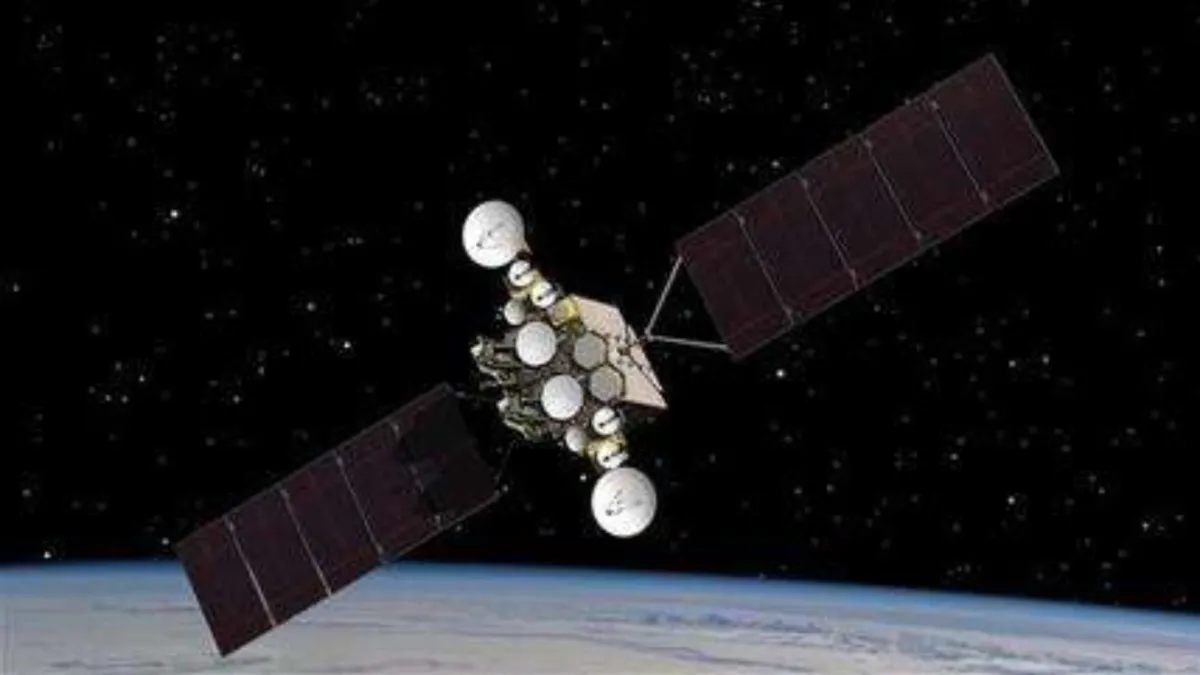
Chinese researchers have developed a powerful synthetic aperture lidar system capable of capturing highly detailed images from over 60 miles (101.8 km) away, a significant leap in surveillance technology. This breakthrough, achieved by scientists at the Chinese Academy of Sciences, could allow China to monitor foreign military assets, including spy satellites, with unprecedented precision.
Extreme long-range imaging achieved
During field tests at Qinghai Lake in northwest China, the system successfully resolved details as small as 1.7 mm at a distance of 101.8 km (63.3 miles), with a range precision of 15.6 mm. The technology, described in a peer-reviewed study in the Chinese Journal of Lasers, surpasses previous imaging records.
By contrast, in 2011, a U.S. defense contractor managed to achieve 2 cm resolution from just 1.6 km away, while previous Chinese efforts had reached 5 cm resolution at 6.9 km.
Advanced laser and AI integration
The researchers enhanced imaging capabilities by integrating cutting-edge laser and AI-based noise-reduction algorithms. Key innovations include:
- Micro-lens array technology to expand the aperture size while maintaining a wide field of view.
- "Chirped" laser signals exceeding 10 GHz bandwidth for extreme range accuracy.
- Advanced noise-reduction algorithms improve signal clarity by a factor of 10,000.
- Real-time digital processing, enabling rapid analysis of massive data streams.
Potential for space-based surveillance
Experts suggested that if deployed in low Earth orbit, this system could potentially distinguish human facial details from space. A Beijing-based researcher quoted by South China Morning Post (SCMP) explained:
"This isn’t just about seeing a satellite—it’s about reading its serial numbers. At these resolutions, you could detect micrometeoroid damage on solar panels or identify specific sensor payloads."
The ability to surpass the 100 km atmospheric transition threshold could also reduce interference, giving China an edge in orbital surveillance and military reconnaissance.
Challenges and future development
Despite its advancements, the technology still faces significant hurdles:
- Weather Dependency – Image clarity is highly affected by cloud cover and atmospheric conditions.
- Tracking Moving Targets – The system has yet to demonstrate effectiveness in monitoring objects in motion, requiring more precise mechanical engineering.
If these challenges are overcome, this laser imaging breakthrough could give China a major strategic advantage in tracking and analyzing foreign defense and space assets.
