
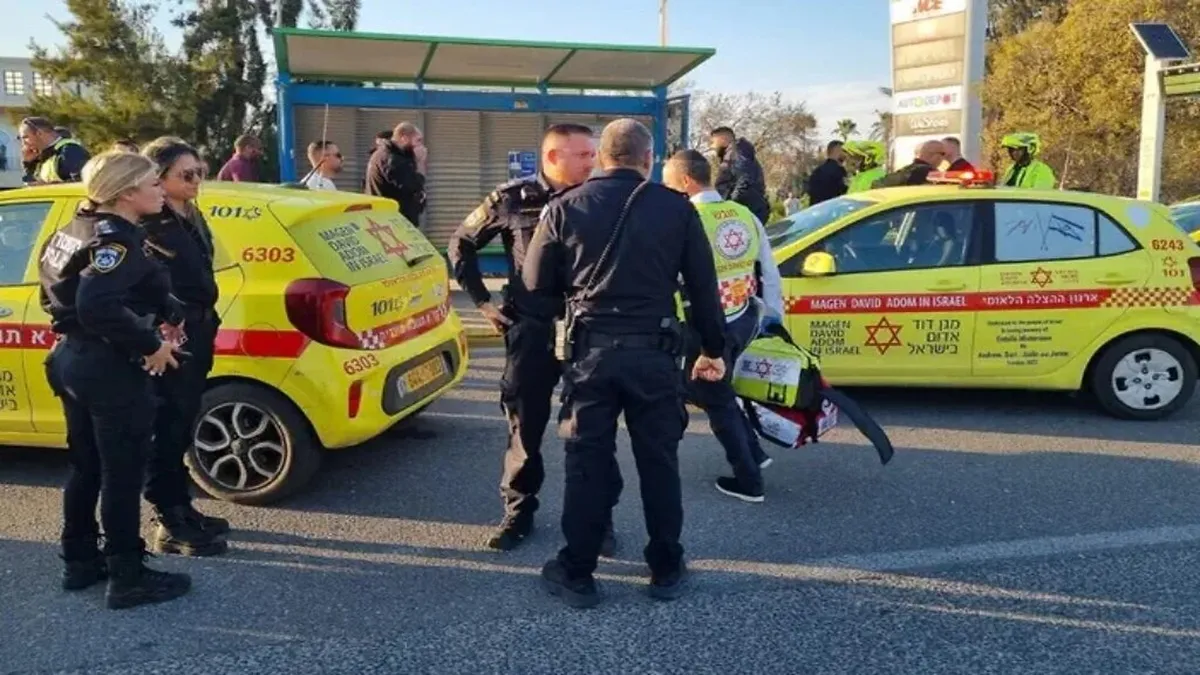
Israeli Police are investigating an episode in which a driver rammed his car into people at a highway bus stop, wounding at least eight, on Thursday (February 27) in what authorities believed was a militant attack. Police said they had neutralised the suspect, who they described as a 53-year-old Palestinian from the northern West Bank who lived in Israel and was married to an Israeli citizen.
Medical workers said the ramming injured at least eight people, two in serious condition, who they evacuated to the hospital. Paramedic Avi Cohen described a chaotic aftermath at the scene in Pardes Hanna-Karkur, a town south of the coastal city of Haifa.
Israeli police officers also examined the body of a man suspected of ramming his car into a highway bus stop, injuring several people in what police described as a potential militant attack. The man was killed near the scene near Gan Shmuel, Israel, on Thursday.
“When we arrived, they were lying on the ground. We immediately began providing medical treatment to all the injured, including stopping bleeding and bandaging wounds,” he said in a statement from Magen David Adom, Israel's emergency rescue service.
Hamas congratulated the attack as a message of defiance but did not claim responsibility.
Israel's army admits failures on October 7, its probe of attack could put pressure on Netanyahu
Meanwhile, an investigation by the Israeli military has determined that Hamas was able to carry out the deadliest attack in Israeli history on October 7, 2023, because the much more powerful Israeli army misjudged the militant group's intentions and underestimated its capabilities.
The findings, released Thursday, could pressure Prime Minister Benjamin Netanyahu to launch a widely demanded broader inquiry to examine the political decision-making that preceded the attack. Many Israelis believe the failures of October 7 extend beyond the military and blame Netanyahu for a failed policy of deterrence and containment in the years leading up to the attack.
That approach included allowing Qatar to send suitcases of cash into Gaza and sidelining Hamas' rival, the internationally recognised Palestinian Authority. The prime minister has not taken responsibility, saying he will answer tough questions only after the war, which has been paused for nearly six weeks by a tenuous ceasefire.
Despite public pressure, including from the families of the roughly 1,200 people killed in the October 7 attack and the 251 taken as hostages into Gaza, Netanyahu has resisted calls for a commission of inquiry.
The military's main findings were that the region's most powerful and sophisticated military misread Hamas' intentions, underestimated its capabilities and was wholly unprepared for the surprise attack by thousands of heavily armed militants in the early morning hours of a major Jewish holiday.
