
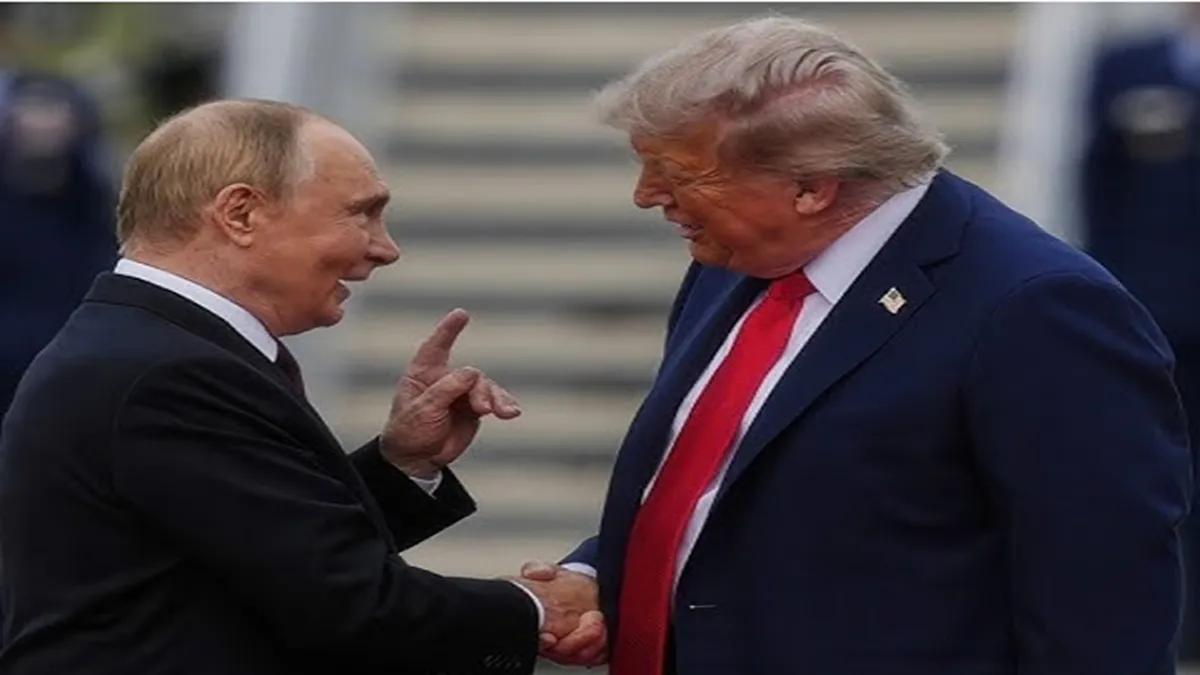
European leaders attending talks in Washington on Monday shed light on the fact that any peace deal must preserve Ukraine’s sovereignty and military capability. French President Emmanuel Macron stated that no part of the discussions involved Ukraine surrendering territory and underlined the need for an “unlimited” Ukrainian army capable of defending itself. German Chancellor Friedrich Merz likened Russia’s demand that Ukraine give away Donbass to asking the United States to give up Florida.
“The Russian demand that Kyiv give up the free parts of Donbass corresponds, to put it bluntly, to a proposal for the United States to have to give up Florida,” he told reporters. Merz reiterated that Europe stands firm against compromising Ukraine’s territorial integrity.
Trump-Putin call sets stage for direct talks with Zelenskyy
US President Donald Trump announced he had spoken with Russian President Vladimir Putin and begun arranging a face-to-face meeting between Putin and Ukrainian President Volodymyr Zelensky. Trump added that a trilateral meeting including himself would follow the bilateral talks. Trump described the development as a “very good, early step” in efforts to end the ongoing conflict, which began in 2020.
The call marks the most significant contact between the Russian and US leadership on the war since tensions peaked.
Putin’s intentions questioned by European leaders
Finnish President Alexander Stubb expressed doubt about Putin’s sincerity, stating, “Putin is rarely to be trusted.”
He questioned whether the Russian president would follow through with attending a trilateral meeting or whether this was another attempt to delay negotiations.
The caution reflects long-standing mistrust over Russia’s diplomatic promises, particularly in light of past actions such as the 2014 Ilovaisk incident, where Russian forces ambushed retreating Ukrainian troops despite assurances of safe passage. According to Trump’s peace envoy, Steve Witkoff, Russia has shown openness to robust Western-style security guarantees for Ukraine. US Secretary of State Marco Rubio called this a significant concession, noting it could be a partial substitute for Ukraine’s blocked NATO membership.
Italian Prime Minister Giorgia Meloni reportedly suggested a “NATO-style guarantees without NATO” framework, which Russia appeared to accept. Putin was also said to have proposed a domestic law committing not to attack Ukraine or other European nations. However, skepticism remains, as previous agreements, such as the 1994 Budapest Memorandum, were ultimately unenforceable. Russia’s history of disregarding legal commitments has prompted calls for more detailed and binding mechanisms.
Moscow may be seeking reciprocal guarantees under the proposed framework. Senior Russian diplomat Mikhail Ulyanov posted on social media that Russia expects to receive “efficient security guarantees” in return, potentially allowing it to justify future actions if it perceives threats from NATO or the West.
Observers caution that this could give Russia a pretext for renewed aggression or enable it to interfere in future Western security initiatives. Ukrainian President Volodymyr Zelenskyy, ahead of meeting with Trump, stated that the proposed deal lacks transparency. He stressed the need for clear terms and practical enforcement mechanisms.
“There are no details how it will work and what America’s role will be, what Europe’s role will be,” Zelensky said. “We need security to work in practice.” European leaders, including UK Prime Minister Sir Keir Starmer, joined Zelensky in Washington in an effort to prevent diplomatic misalignment with the US.
