
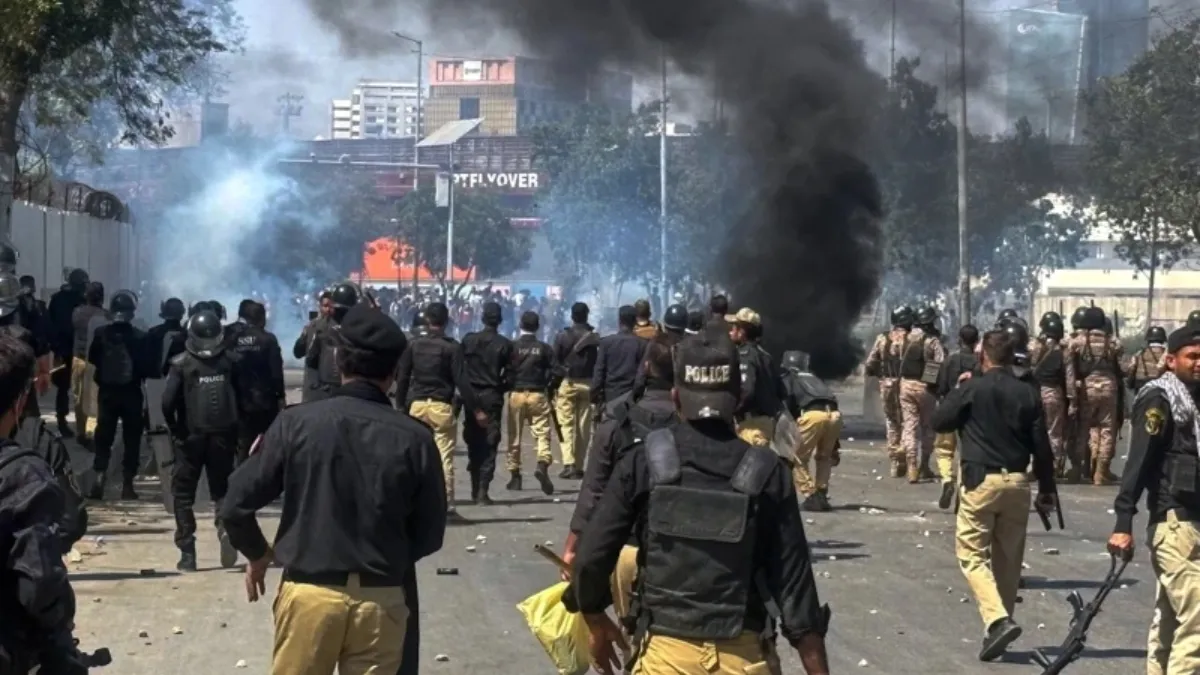
At least 22 people were killed and more than 120 others injured as violent clashes broke out between protesters and security forces in Karachi and parts of northern Pakistan on Sunday, authorities said. The unrest erupted after demonstrators supportive of Iran allegedly attempted to storm a United States Consulate in Karachi.
In the north of the country, demonstrators attacked UN and government offices.
The violence followed coordinated strikes by the US and Israel on Iran, killing Iran's Supreme Leader Ayatollah Ali Khamenei.
50 injured in Karachi alone
Police and hospital officials in Karachi said at least 50 people were injured in the city alone, several of them critically.
Summaiya Syed Tariq, a police surgeon at the city's main government hospital, said six bodies and several injured persons were initially brought to the facility. She added that the death toll later rose to 10 after four critically wounded people succumbed to their injuries.
Separately, at least 12 people were killed and more than 80 injured in clashes with police in the Pakistan-occupied Kashmir (PoK) region, where thousands of protesters, angered by United States and Israel strikes on Iran, attacked offices of the UN Military Observer Group and the UN Development Programme. Local police official Asghar Ali confirmed the casualties.
US Embassy monitoring situation
The US Embassy in Pakistan said in a post on X that it was monitoring reports of ongoing demonstrations at the US Consulates General in Karachi and Lahore, as well as calls for additional protests at the US Embassy in Islamabad and the consulate general in Peshawar.
It advised US citizens in Pakistan to monitor local news, stay aware of their surroundings, avoid large crowds, and keep their travel registration with the US government up to date.
US Consulate windows smashed
In Karachi, the capital of southern Sindh and Pakistan's largest city, senior police official Irfan Baloch said protesters briefly attacked the perimeter of the United States Consulate before being dispersed by security forces.
He dismissed reports that any part of the consulate building was set on fire, but confirmed that protesters torched a nearby police post and smashed windows of the consulate prior to the arrival of reinforcements. Protests in the surrounding area continued for several hours, with dozens of youths, some with their faces covered, pelting stones at law enforcement personnel and vowing to reach the consulate, where hundreds of police and paramilitary forces had been deployed to restore order.
The clashes prompted Interior Minister Mohsin Naqvi to issue an appeal for calm. "Following the martyrdom of Ayatollah Khamenei, every citizen of Pakistan shares in the grief of the people of Iran," Naqvi said in a statement, but urged people not to take the law into their own hands and to express their protests peacefully. The provincial government of Sindh also urged citizens to express their views peacefully and warned against engaging in violence.
In Islamabad, police fired tear gas and swung batons as hundreds of protesters, angered by the killing of Khamenei, tried to march toward the U.S. Embassy. The clashes took place outside the city’s diplomatic enclave, where the embassy is located, and additional police had been deployed.
Meanwhile, in the northwestern city of Peshawar, authorities also used tear gas and batons to disperse thousands of demonstrators attempting to approach the US Consulate to hold a rally and to denounce the killing of the Iranian leader, police said.
Protesters also held a peaceful rally in Multan, a city in Punjab province, chanting slogans against Israel and the United States.
Also Read: 48 Iranian leaders killed in US attack; Tehran wants to hold talks: Trump
Also Read: Ayatollah Arafi named Iran's interim Supreme Leader after Khamenei's death: Report | Who is he?
