
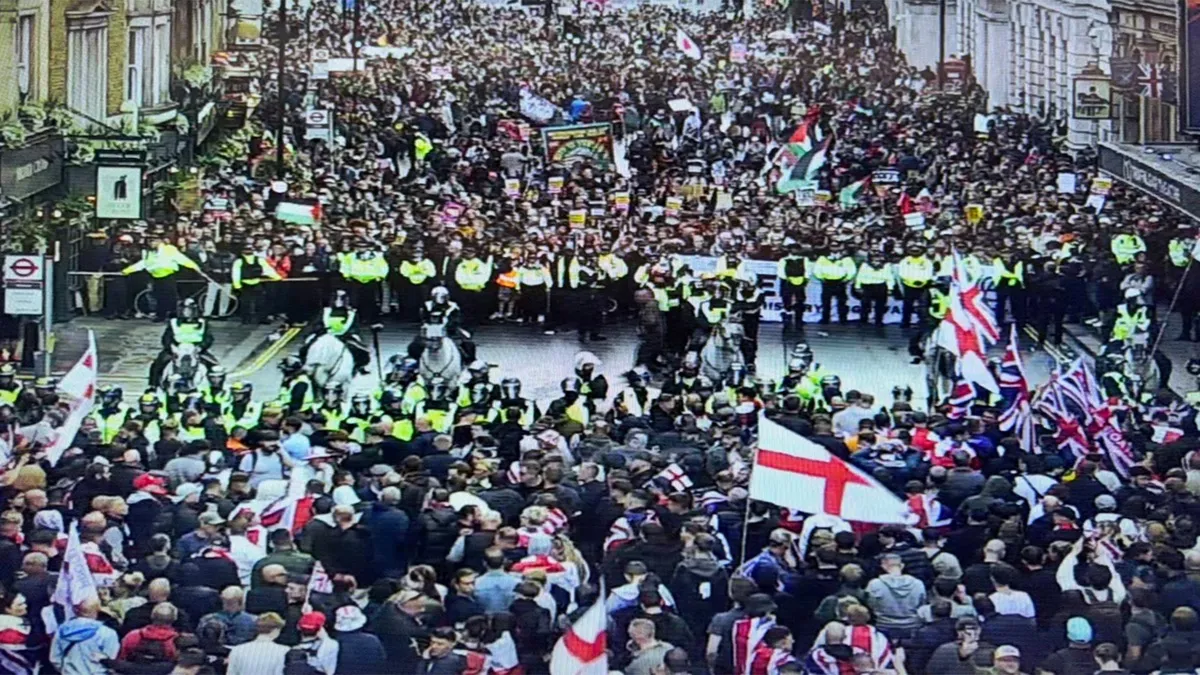
Central London witnessed a massive wave of demonstrators on Saturday (September 13) as far-right activist Tommy Robinson drew an estimated 1,10,000 supporters for his “Unite the Kingdom” rally. Marchers carrying the Union Jack and St. George’s Cross flags flooded the streets, chanting anti-immigration slogans such as “Stop the boats” and “Send them home.” The march coincided with a rival counter-demonstration, the “March Against Fascism” led by Stand Up To Racism, which drew about 5,000 protesters with banners declaring “Refugees Welcome” and “Smash the Far Right.”
Clashes with police and counterprotesters
Although largely peaceful in the beginning, tensions escalated in the late afternoon. Some Robinson supporters threw bottles, flares, and other projectiles toward counterprotesters and attempted to breach police barricades on Whitehall. The Metropolitan Police reported that officers were punched, kicked, and struck as they worked to hold back the crowd.
More than 1,000 police officers were deployed, with reinforcements in riot gear. At least nine arrests were made on the spot, while authorities confirmed that many more offenders had been identified and would be held accountable in the coming days.
Robinson’s message and far-right influence
Robinson, born Stephen Yaxley-Lennon, used the rally to amplify his long-standing anti-migrant and anti-Islam rhetoric, claiming migrants had more rights than the “British public.” He was joined symbolically by far-right politicians from across Europe, including French nationalist Eric Zemmour, who echoed warnings of a so-called “great replacement.”
Adding global weight to the rally, Elon Musk appeared via video message, criticising the UK government and warning against “massive uncontrolled migration” that he claimed was eroding Britain’s identity.
A divisive national debate
The protest underscores the growing divide in Britain over immigration, particularly the ongoing crisis of migrants crossing the English Channel in small boats. Over 28,000 migrants have arrived this year, straining asylum systems and fueling nationalist campaigns outside hotels housing asylum-seekers.
While Robinson’s supporters praised the march as a movement for national pride and free speech, critics branded it a dangerous show of xenophobia and far-right extremism.
Flags, symbols, and polarising rhetoric
The streets were filled with English, British, American, and even Israeli flags, along with MAGA hats referencing Donald Trump. Placards accused Prime Minister Keir Starmer of betrayal, while counterprotesters clashed with Robinson supporters’ chants, shouting “Stand up, fight back.”
The rally also featured a moment of silence for US conservative activist Charlie Kirk, followed by a bagpiper playing “Amazing Grace.”
Scale of protest and aftermath
At its peak, the “Unite the Kingdom” crowd stretched nearly three-quarters of a mile, from Big Ben to Waterloo Station. Despite the large turnout, the rally fell short of last year’s pro-Palestinian march, which saw more than 3,00,000 demonstrators.
Police are continuing to investigate incidents of violence from the rally, vowing further arrests. Meanwhile, the protests have once again highlighted how immigration has overtaken economic concerns as the most divisive political issue in Britain today.
