
The current geopolitical landscape of the Middle East remains tense and deeply complex amid ongoing conflict between Israel and Iran. Under the leadership of Ayatollah Ali Khamenei, Iran's Shia regime is intensifying its efforts to expand regional influence even as tensions with Israel are at their peak. Notably, the United States has always had a strategic interest in this region, driven by its stakes in oil, Israel, and counterterrorism.
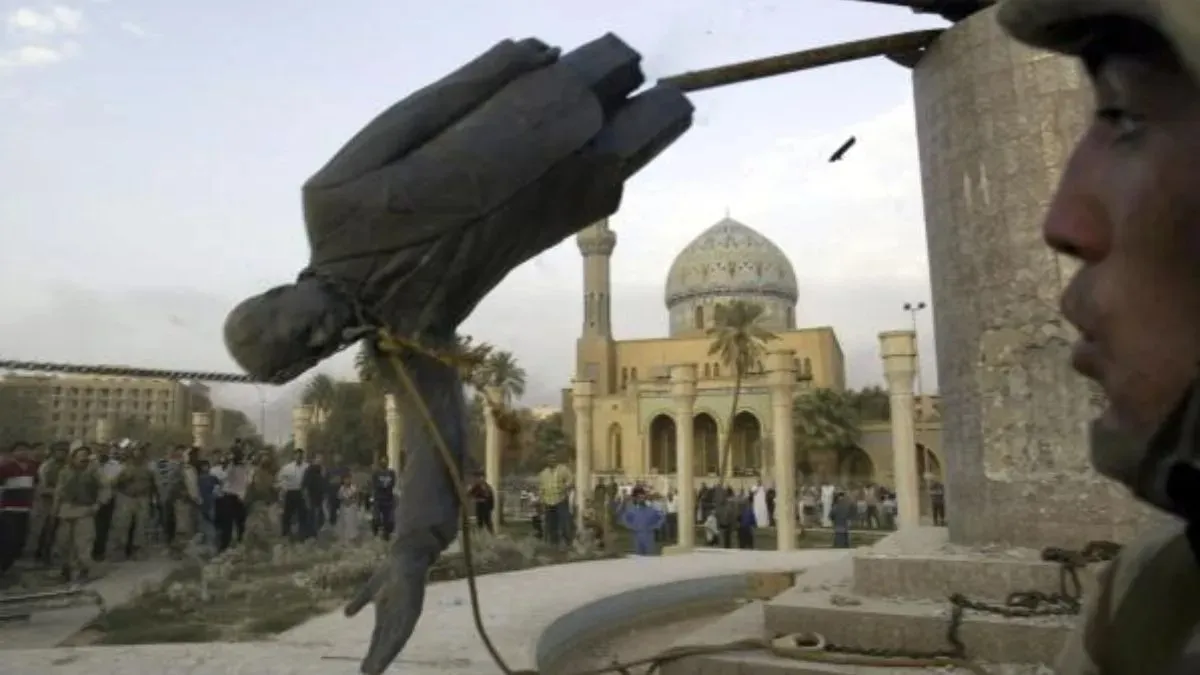
Now, US President Donald Trump seems to have his sights set squarely on Iran's supreme leader Khamenei. In a striking statement, Trump posted on Truth Social, "We know exactly where the so-called supreme leader is hiding. He is an easy target, but is safe there - We are not going to take him out (kill), at least not for now." This bold rhetoric harks back to the early 2000s, when the US led a full-scale assault on Iraq and toppled Saddam Hussein's regime in what became one of the most defining chapters in modern Middle Eastern history.
When America launched its assault on Iraq
Following the horrific terrorist attacks on September 11, 2001, the US declared a global "War on Terror." Then-President George W Bush targeted Iraq, labelling it a "sponsor of terrorism" and a producer of "Weapons of Mass Destruction" WMDs).
Although later investigations revealed that Iraq did not possess WMDs, the wheels of war were already in motion. On March 20, 2003, the US and its allies launched 'Operation Iraqi Freedom' with the immediate goal of overthrowing Saddam Hussein. The mission achieved success, and the dictator's rule came crashing down.

How was Saddam Hussein brought down?
Saddam Hussein, Iraq's President from 1979 to 2003, ruled with a ruthless iron fist. His regime was marked by brutal oppression, particularly against the Kurds and Shia communities. He was responsible for launching the Iran-Iraq War (1980–1988) and invading Kuwait in 1990 — all reflective of his aggressive and autocratic policies. The US invasion in 2003 dismantled Saddam’s regime in record time. After US forces took control of Baghdad in April, Saddam went underground. By December 2003, American troops captured him near Tikrit, where he was hiding in a concealed underground hideout. Images of a dishevelled, bearded Saddam quickly circulated across the globe, making headlines and sending shockwaves through the Arab world.
The trial and execution of Saddam Hussein
The fall from power was just the beginning of Saddam's nightmare. A high-profile trial commenced under the supervision of Iraq's interim government and US authorities. He faced grave charges such as crimes against humanity, war crimes, and genocide, with special emphasis on the 1982 Dujail massacre in which 148 Shia civilians were murdered. In November 2006, Saddam was sentenced to death. The sentence was carried out on December 30, 2006, ending the life of a man who once stood among the most powerful figures in the Middle East.
Saddam's family met a similar fate
The demise of Saddam also spelt doom for many in his inner circle. His two notorious sons, Uday and Qusay Hussein, were killed in a fierce gun battle with US troops in Mosul in July 2003. Qusay’s underage son also died in the encounter. Both Uday and Qusay had reputations soaked in blood. Uday was infamous for crimes including rape and murder, while Qusay was feared as the ruthless head of Iraq's military and intelligence forces. With their deaths and the fall of Saddam, the final vestiges of the Hussein dynasty vanished.
Saddam's wife, Sajida Talfah, fled Iraq and took refuge in Jordan, where she began a life of obscurity with some of her children. His eldest daughter, Raghad Hussein, was not spared either. Iraq's interim government had placed her on a list of 59 most-wanted individuals. Raghad also sought asylum in Jordan and tried unsuccessfully to launch a legal defence for her father. Saddam's other daughters, Rana and Hala Hussein, joined their mother in Jordan and retreated from public life entirely.
What happened to Iraq after Saddam's fall?
The collapse of Saddam's regime created a deep power vacuum in Iraq. Although the US promised to build a democratic system, the reality turned out to be far bloodier. Sectarian strife between Shia and Sunni groups erupted violently. Terrorist organisations like al-Qaeda gained ground and paved the way for the eventual rise of ISIS. The American intervention in Iraq became a major geopolitical turning point, inadvertently enabling Iran to expand its influence in the region. Through proxy Shia militias in Iraq, Iran gradually asserted dominance and challenged both Israeli and American interests. Today, this rising Iranian power has become a formidable concern, making the Middle East a powder keg ready to explode.
NOTE: 'Uncle Sam' is a common personification of the United States and its government, often used in political cartoons and propaganda. The name is said to have originated during the War of 1812, linked to a meat packer named Samuel Wilson who supplied barrels of beef to the army. The barrels were stamped with "U.S.", which soldiers jokingly attributed to "Uncle Sam".