
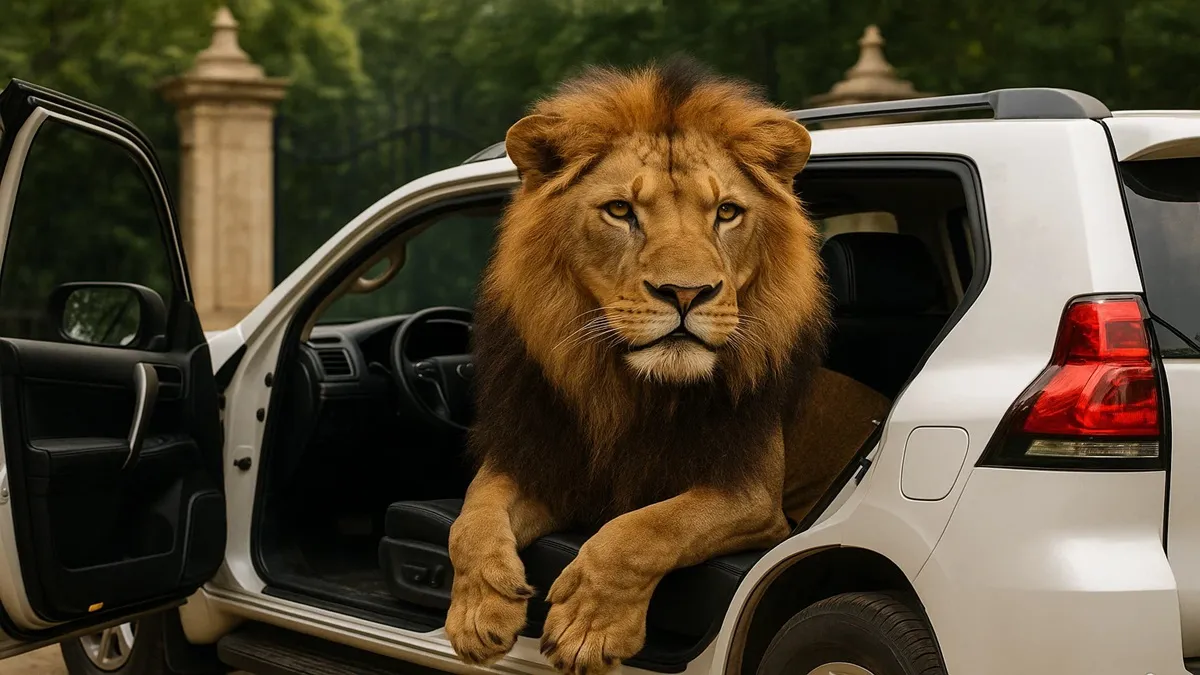
In Pakistan's wealthiest circles, owning a lion or tiger is no longer just a symbol of wealth, it's a power and status symbol. From Karachi to Lahore, exotic cats are being paraded as pets, driven in SUVs, and displayed online even as attacks and escapes grow more frequent.
Following a shocking attack in Lahore last week, when a pet lion escaped its enclosure and mauled a woman and her two children, authorities have launched a rare crackdown. The lion, owned by residents of a farmhouse in Johar Town, leapt over a wall and lunged at the woman while bystanders watched. All three victims survived with injuries. The lion was tranquilised and relocated to a wildlife facility. The owners have been arrested. But beneath the headlines lies a deeper issue: in much of Pakistan, keeping big cats isn't just legal, it's disturbingly normal.
Legal on paper, lethal in practice
Under Punjab's revised Wildlife Act, introduced in January 2025, individuals can legally own lions, tigers, cheetahs and other exotic cats provided they pay a one-time registration fee of PKR 50,000 per animal, house them outside city limits and comply with welfare checks.
The law also prohibits the online showcasing of big cats. But enforcement is weak, especially in elite neighbourhoods. Wildlife officers in Lahore estimate dozens of unregistered lions still roam privately owned properties. In Karachi, conservationists allege that over 100 lions are housed in semi-legal private farms just outside the city.
In practice, these rules are widely flouted. Videos of lions lounging by pools or riding in luxury vehicles remain common online. Despite regulations, the boundary between urban life and dangerous wildlife remains dangerously thin.
Roaring symbol of power
For Pakistan's ultra-rich, big cats are not just pets; they're part of a prestige economy. Just as owning a Rolls-Royce or hiring an entourage signals privilege, lions project dominance and masculinity. Photos of chained lions at weddings or prowling gated compounds are used as literal displays of power.
Anthropologists say this behaviour reflects a global elite trend of exotic pet ownership. But in Pakistan, it combines wealth, masculinity and social media spectacle in unique ways. Lions are not conservation efforts, they're Instagram trophies.
Viral clips, real danger
The public risks are mounting. In December 2024, another lion escaped its enclosure in Lahore and was shot dead by police in a residential area. Earlier that year, a Karachi man was arrested after his tiger entered a school compound. Several owners have been injured while feeding or handling their animals.
Such incidents are no longer isolated. Wildlife officials say the July 2025 attack marked a turning point. In response, the Punjab Wildlife Department seized over a dozen lions in raids across the province, arrested five individuals and opened fresh investigations into several elite estates.
Authorities have also reinforced a ban on social media posts featuring big cats in a bid to dismantle their perceived link to affluence.
Inside the exotic pet industry
Most exotic animals in this industry come from captivity from private breeders who work without much supervision. Some come from countries like South Africa, but it's good to know that Pakistan, for example, has no native lions; the last Asiatic lions there died out more than a century ago.
These animals often end up in cramped, unclean spaces. Poor diet, untreated sickness, and odd behaviours happen a lot. Because rules are so loose, some lions even come from inbreeding or are just to be displayed and then left behind when they're not new or exciting anymore. The Punjab government now says captive lions must be fixed to stop unauthorised breeding, but enforcement remains inconsistent.
Resistance from the Elite
Despite recent efforts to strengthen laws, powerful owners are still pushing back hard against regulations. Many of these individuals have significant political influence, and even enforcement officers admit it's tough to conduct raids on high-profile properties. There's even talk of banning private ownership of big cats entirely. But here's the thing: unless society stops seeing these animals as status symbols and starts recognising them as a public danger, meaningful reform will be an uphill battle.
The issue isn't just about the law; it's deeply cultural. People desire lions because they think it makes them seem above the rules.
Patchy laws, weaker enforcement
Legal protections for exotic animals vary across provinces:
- Punjab (2025): Registration, sterilisation, housing standards, and a social media ban.
- Sindh (2020): Requires DNA records and municipal clearance; bans keeping lions in residential zones.
- Balochistan: Completely prohibits private ownership of big cats.
Yet across all three, implementation is uneven. Smuggling continues across porous borders, and that legal documentation is rarely verified or enforced. The next escape is probably just a matter of time, unless laws are strictly enforced and the social media spectacle loses its appeal.
