
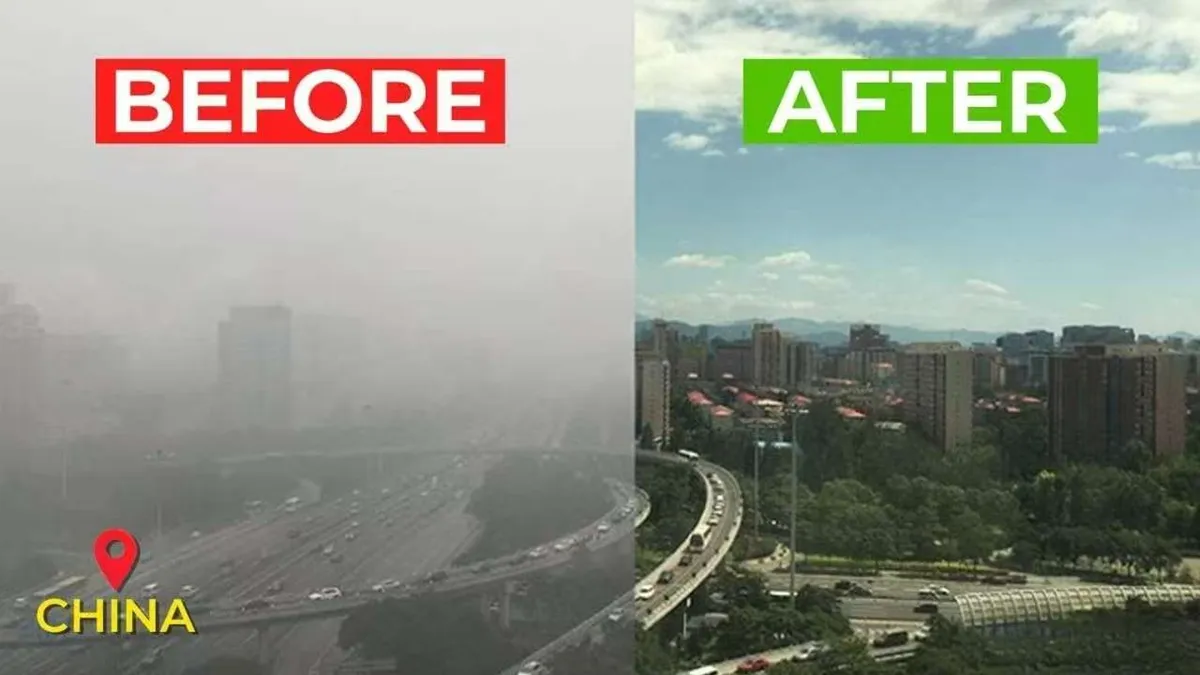
Delhi has once again entered that disturbing phase of winter where thick smog takes over the skyline. Crop residue burning in neighbouring states combined with emissions from vehicles, industries and road dust has pushed pollution levels high once again. This phenomenon has now become almost a seasonal routine. Around a decade ago, China's capital Beijing was also globally infamous for similar toxic air and was often called the smog capital of the world. Satellite data at that time had shown extremely high nitrogen dioxide levels in Beijing which led to serious respiratory disorders and premature deaths.
China launched massive interventions
In order to counter this, China introduced tough corrective measures. These included removing vehicles from roads, shutting factories and enforcing sharper emission norms. In 2013, the Chinese government had announced a five-year action plan to fight pollution. This plan encouraged electric mobility, pushed bike sharing models and diverted heavy truck movement away from thickly populated areas. Media reports had earlier stated that this entire push came with a budget of around 270 billion dollars and was framed to ensure long-term sustainable growth while keeping public health at the centre.
Air quality improved sharply in Beijing
As per the Energy Policy Institute at the University of Chicago, Beijing saw a massive improvement in air quality. The city's pollution levels came down by 42.3 per cent between 2013 and 2021. Experts attribute this success to consistent monitoring, strict policy enforcement and large financial backing. This transformation in Beijing also led to a mild global improvement in pollution levels during this period.
China's green financing move
According to the World Bank, China's Innovative Financing for Air Pollution Control in the Jing Jin Ji region was a landmark model which linked green finance with energy policy. This initiative used the Program for Results format and matched with the Air Pollution Control Action Plan and the 13th Five-Year Plan. Its core aim was to bring down pollution by improving energy efficiency and promoting clean energy.
Regional coordination is key in both Beijing and Delhi
Studies on Beijing have shown that most pollutants blowing into the city travel from surrounding provinces, especially during winter. The pattern is strikingly similar to Delhi. In Delhi, winter smog is largely amplified due to stubble burning in Punjab and Haryana. In summer, the main contributors are urban emissions, traffic and dust. The Supreme Court has repeatedly asked the Centre and states to act strongly on stubble burning. Without coordination between multiple state governments, Delhi’s pollution crisis continues.
What Delhi can learn
Beijing's model shows that strong enforcement and a unified government approach can create change. India also does not have the same massive financial bandwidth that China has deployed. However, India is trying through the National Clean Air Programme launched in 2019. This aims to reduce particulate pollution by 20 to 30 per cent by 2024 compared to 2017 levels.
China offers to share its experience
It should be noted here that China has expressed readiness to help. Chinese Embassy spokesperson in India Yu Jing, wrote on X, "China once struggled with severe smog too. We stand ready to share our journey toward blue ones - and believe India will get there soon." This shows that Beijing is open to sharing its model because China itself had to fight a long battle before bringing visible improvement on the ground.
ALSO READ: Delhi Air Pollution: Air quality improves slightly but remains in 'poor' category | Check AQI here
