
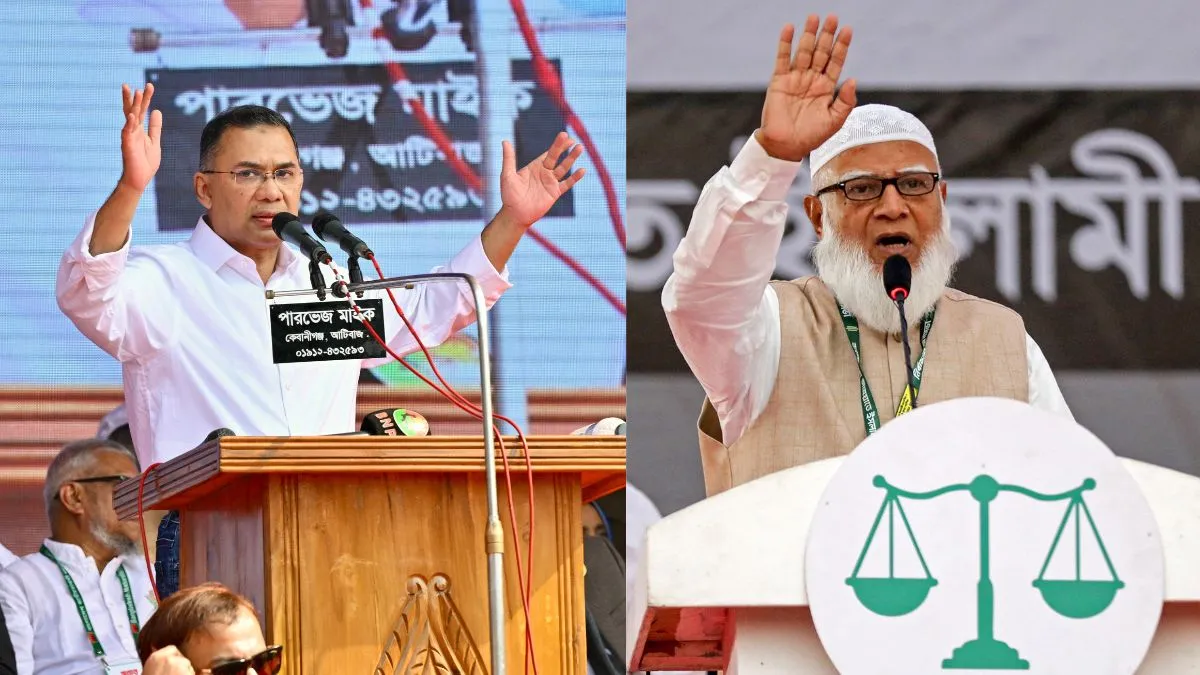
Bangladesh is set to hold a general election on February 12 to elect members of the Jatiya Sangsad (National Parliament). This will be the first national vote since the long-standing government of Sheikh Hasina was ousted in 2024 amid widespread protests.
The interim government, led by Nobel laureate Muhammad Yunus, assumed power in August 2024 after a student-led uprising forced former Prime Minister Sheikh Hasina to step down and escape to India.
Key political parties in election
Bangladesh Nationalist Party (BNP)
The Bangladesh Nationalist Party (BNP) is one of the main contenders in the 2026 elections. Tarique Rahman currently serves as the party’s president following the death of former Prime Minister Khaleda Zia. The BNP is widely seen as the frontrunner in the upcoming polls.
11-party coalition
An 11-party alliance, including Bangladesh Jamaat-e-Islami (JI) and the National Citizen Party (NCP), will also contest the elections. Other members of this coalition include Bangladesh Khelafar Majlis, Amar Bangladesh Party, Khelafat Majlis, Bangladesh Labour Party, Liberal Democratic Party, Nizam-e-Islam Party, Bangladesh Development Party, and Jatiya Ganotantrik Party.
Jatiya Party splinter groups
Several splinter groups of the Jatiya Party, originally founded by former military ruler Hussain Muhammad Ershad, are participating as well. Some have formed the National Democratic Front (NDF) alliance, while others are running independently or with different coalitions.
Sheikh Hasina’s Awami League (AL), historically known for its close ties with India, has been barred from contesting the upcoming election.
Potential impact on India-Bangladesh relations
Relations between India and Bangladesh have worsened over the past year under interim leader Muhammad Yunus, who has occasionally expressed closeness to Pakistan and China. Issues such as border security, trade and regional stability are closely linked to Bangladesh’s domestic political landscape.
Scenario 1: BNP victory
If the BNP wins, it is expected to take a more balanced foreign policy approach. Although the party has historically leaned toward China, Tarique Rahman’s leadership may steer it toward a more pragmatic stance. The BNP manifesto suggests a friendlier engagement with India, which could gradually restore bilateral ties, though improvements are unlikely to be immediate.
Scenario 2: BNP-Jamaat alliance
If the BNP fails to secure a parliamentary majority, it may seek an alliance with Jamaat-e-Islami, as it did in 2001 under Khaleda Zia. While Jamaat has expressed a desire for cooperative relations with India, its historical opposition to Bangladesh’s 1971 liberation could complicate diplomatic engagement.
Scenario 3: Islamist and hardline bloc influence
If major Islamist or hardline parties gain significant influence, Bangladesh could adopt a more confrontational posture on issues such as border security, water-sharing, and the “landlocked Northeast” narrative. In this scenario, India-Bangladesh relations could face further deterioration.
ALSO READ: Bangladesh court sentences Sheikh Hasina to 10 years in jail in two corruption cases
