
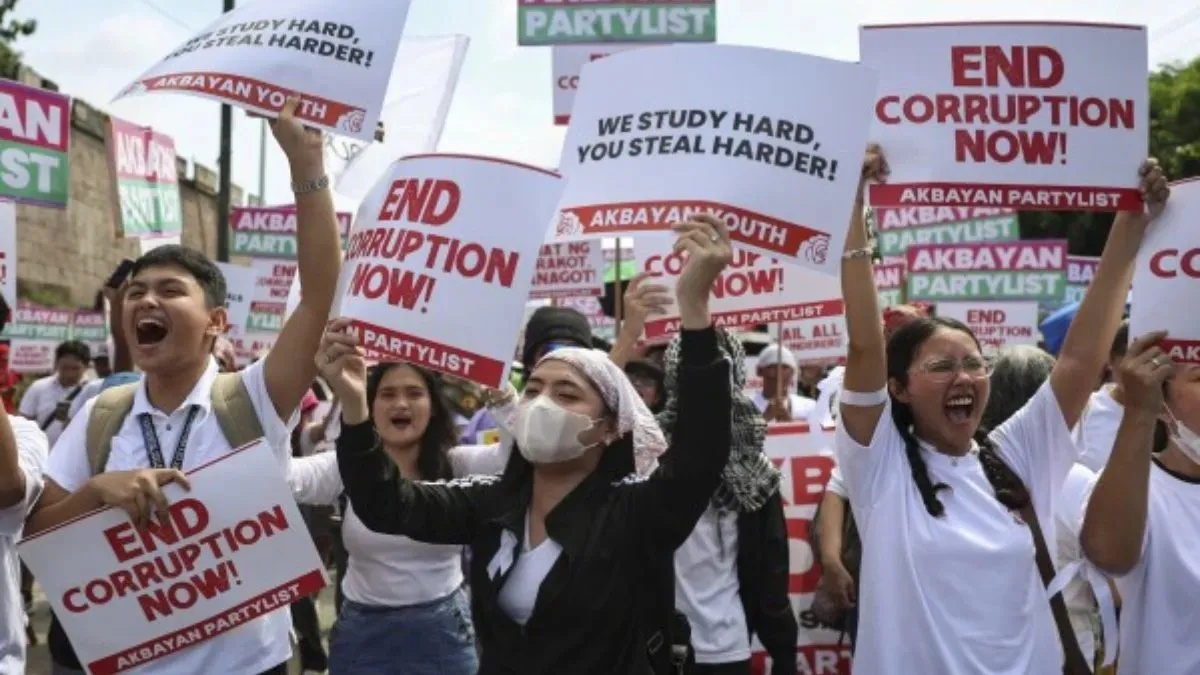
After Nepal, the Philippines has witnessed a massive public outcry against government corruption. On Sunday, thousands of protesters took to the streets of Manila, the capital city, voicing their anger over a major corruption scandal. The sheer size of the demonstrations made it difficult for police to maintain control, forcing authorities to deploy heavy security across the city.
Corruption scandal in flood-control projects
The protests were sparked by allegations that lawmakers, government officials, and business leaders pocketed huge sums of money intended for flood-control projects. In a disaster-prone and impoverished nation, critics argue that funds meant for protection against flooding were either misused, diverted, or funnelled into ghost projects.
Residents of flood-affected Bulacan province claimed that many of the promised projects were either of poor quality or never implemented at all. The scandal has fueled widespread resentment among citizens who continue to suffer devastating floods.
Global warnings and security measures
Given the scale of the demonstrations, the United States and Australian embassies in Manila issued advisories urging their citizens to avoid protest sites. Authorities stationed thousands of police officers near the Democracy Monument on EDSA Highway and in a historic Manila park to prevent violence.
Protesters carried national flags and banners reading, “No more, enough is enough, jail them.” Student leader Althea Trinidad expressed frustration: “It pains me that we live in poverty, while they use our taxes for luxury cars, foreign trips, and business deals.”
Catholic church calls for peaceful protest
Philippines Catholic Bishops’ Conference head, Cardinal Pablo Virgilio David, urged demonstrators to remain peaceful. He emphasised that the movement was not intended to create instability, but rather to strengthen democracy through greater accountability.
Organisers clarified that their focus is on exposing corrupt officials and business elites, not on demanding the resignation of President Ferdinand Marcos Jr.
President Marcos Jr's response
The scandal came to light when President Marcos Jr., in his July State of the Nation address, acknowledged large-scale corruption in flood-control projects. He formed an independent commission to investigate nearly 9,855 projects worth 545 billion pesos (around USD 9.5 billion).
Calling the corruption “horrendous,” the president accepted the resignation of the public works secretary. Despite this move, anger continues to mount as Filipinos demand justice and transparency.
A fight for accountability
As protests spread, the call for accountability grows louder. For many Filipinos, the scandal represents not just financial misconduct, but a betrayal of trust in a country where millions already struggle with poverty and recurring natural disasters.
Whether the government’s actions will satisfy the public remains uncertain, but the movement has clearly signalled that citizens are no longer willing to tolerate corruption in silence.
