
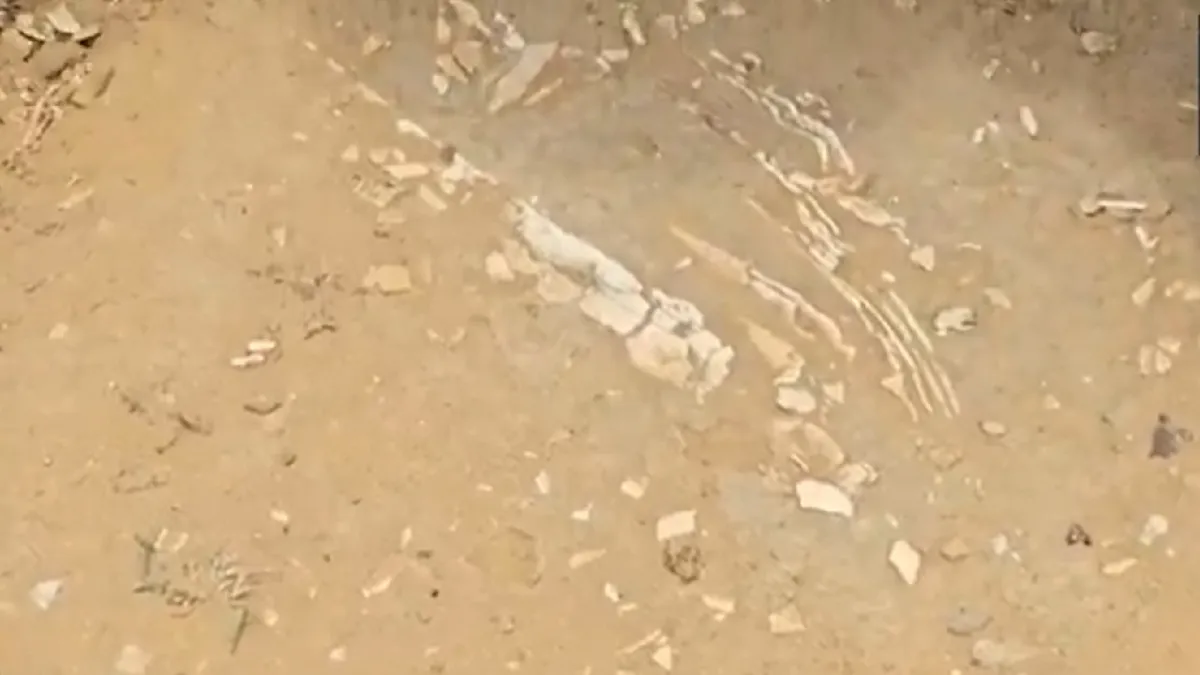
Geologists in Rajasthan's Jaisalmer have unearthed rare vertebrate fossils from the Jurassic era, possibly including dinosaur remains, offering fresh insights into the region’s prehistoric ecology and biodiversity.
Initial studies suggest the fossils belong to a phytosaur, a crocodile-like reptile that lived in forested areas near river systems. This is the first time phytosaur fossils have been found in Jurassic rock formations in India, marking a major milestone in the country’s paleontological record, ANI has reported.
200 millon years old fossils
The fossils, estimated to be around 210 million years old, were embedded in sedimentary rock and may also include remains of other prehistoric reptiles that once inhabited the region.
The partially preserved skeleton measures about 1.5 to 2 metres in length, indicating a medium-sized creature. Notably, an egg was discovered alongside the specimen, positioned on its left side.
Experts say the find holds immense scientific value, as it sheds light on the ancient environment of western Rajasthan and represents vertebrate fossils that are exceptionally rare in India, giving the discovery global significance.
Clues about Jurassic age in Rajasthan
Narayan Das Inikhiya, Geologist and Senior Ground Water Scientist, Rajasthan, who is leading the research, noted, “These fossils provide vital clues about the Jurassic age environment of western Rajasthan. Further studies, including carbon dating, will help determine whether these remains belong to a dinosaur."
Images from the excavation site show large fossilised fragments being carefully analysed and documented. Local authorities and researchers are working to preserve the fossils and plan additional digs.
The discovery has sparked considerable excitement among geologists, historians, and local residents, as Jaisalmer’s desert continues to unveil secrets from its ancient past.
