
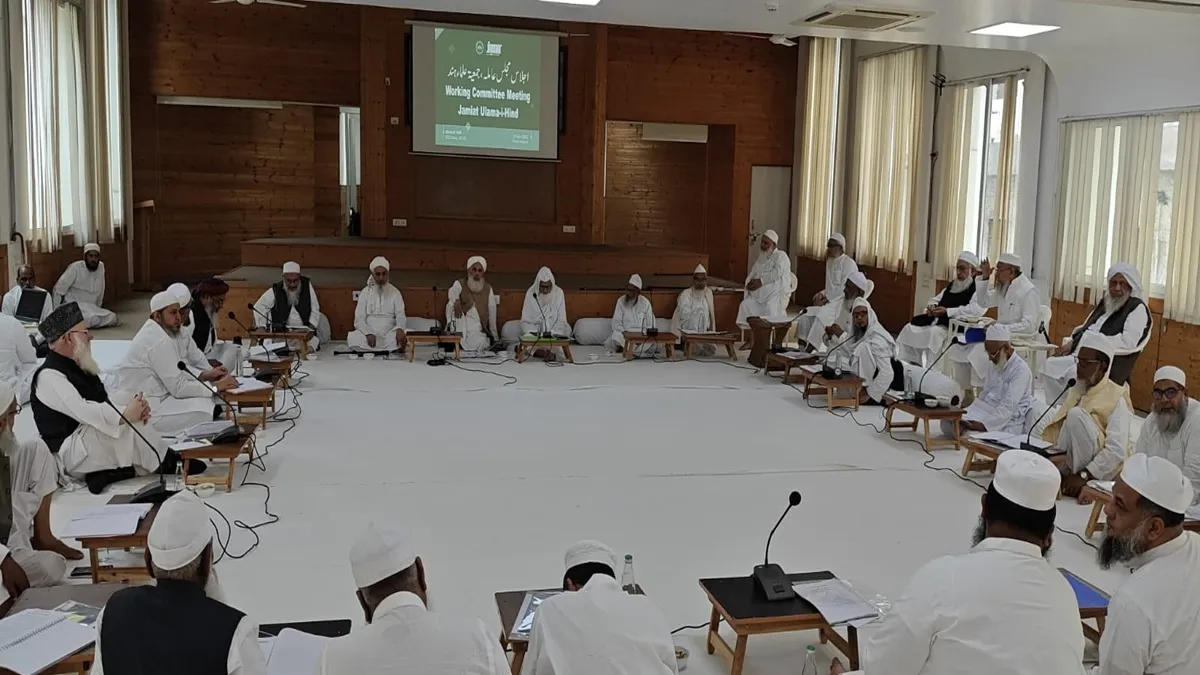
The executive committee of Jamiat Ulama-i-Hind held a significant meeting on Wednesday (October 29) at Madani Hall in New Delhi, chaired by Maulana Mahmood Asad Madani, who was unanimously re-elected as the organisation's president for a second term spanning 2024 to 2027. The session focused on pressing contemporary issues, including the Waqf Amendment Act 2025, allegations of demographic changes and illegal infiltration against Muslims, the Palestine peace agreement, and the increasing pressures on Muslim minorities in India.
Unanimous re-election of Maulana Mahmood Asad Madani
Under Article 52 of the organisation's constitution, Maulana Madani was unanimously chosen to continue as president for the upcoming term. Following his election, he formally took charge, marking the official commencement of his new tenure leading the largest socio-religious body representing Indian Muslims.Addressing accusations and warning government
The committee strongly rejected allegations aimed at Muslims regarding demographic infiltration, calling these claims baseless and harmful to national unity and social harmony. The executive committee emphasised that repeated accusations have been disproven in courts and parliament, underscoring that such divisive narratives unfairly cast suspicion on the entire Muslim community. They urged transparency by the government regarding immigration data and highlighted the continuous contributions of Indian Muslims to the nation.
Opposition to Waqf Amendment Act 2025
The committee expressed grave concerns about the newly passed Waqf Amendments Act 2025, calling it a serious threat to the religious identity and autonomy of Waqf properties. The Jamiat pledged to continue robust legal and democratic opposition and urged all Waqf trustees to register their properties timely on the government portal to avoid legal complications. They also requested an extension of at least two years for the registration deadline.
Support for Palestine and call for international action
The organisation reaffirmed that peace in the Middle East hinges on establishing a sovereign Palestinian state within the 1967 borders, with Jerusalem as its capital, including safeguards for key religious sites like Al-Aqsa Mosque. The committee condemned Israeli actions against Palestinians, including mass killings and blockades, as violations of peace agreements.
They urged international bodies such as the United Nations (UN) and the Organisation of Islamic Cooperation (OIC) to act decisively against illegal settlements and forced displacements while calling for humanitarian aid to afflicted Palestinians. They also appealed to the Indian government to uphold support for Palestine's right to self-determination in alignment with its traditional foreign policy.
Concerns over voter list issues and minority rights
The committee criticised the ongoing voter verification methods in eleven states after Bihar, stating that such approaches could threaten the citizenship rights of poorer and marginal communities. They planned to hold the Jamiat's central management committee meeting in late November to address these concerns further.
Tribute to leaders and members
The meeting honoured the services and memory of several prominent figures, including the late Hafiz Peer Shabbir Ahmad, former general secretary Abdullah Umar Naseef, Saudi Arabia's Mufti Aziz Al-Sheikh, and others, highlighting their lasting impact on the community.
Among those present were Maulana Mahmood Madani, secretary general Maulana Hakimuddin Qasmi, Darul Uloom Deoband's Mufti Abul Qasim Nomani, vice presidents, the treasurer, and various regional leaders – reflecting a wide representation from across India's Muslim leadership spectrum.
Maulana Mahmood Asad Madani, who has been a prominent Islamic scholar and political activist, continues to guide Jamiat Ulama-i-Hind through complex socio-political challenges faced by Indian Muslims. His leadership reinforces the organisation's commitment to democratic values, minority rights, and interfaith harmony amid rising communal tensions in India.
