
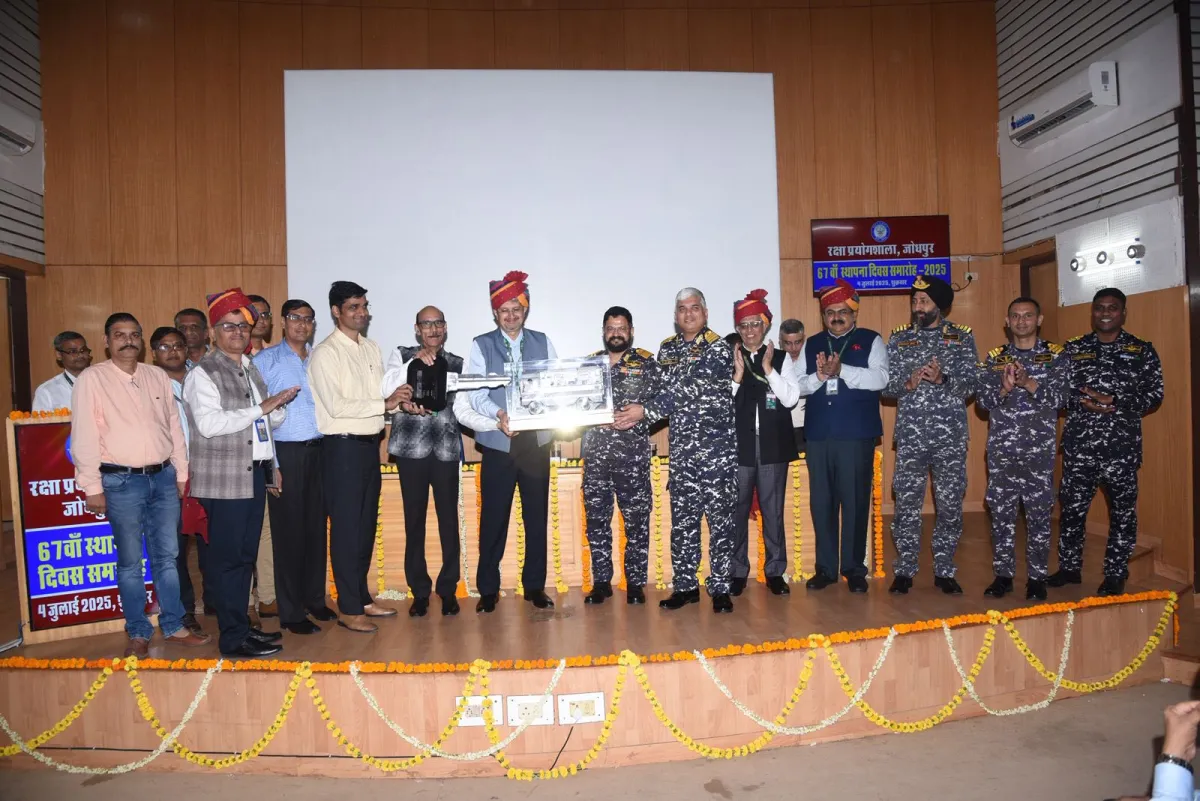
In a significant step toward strengthening India's self-reliance in defence technology, the Defence Research and Development Organisation (DRDO) on Tuesday handed over six strategically important, indigenously developed systems to the Indian Navy. As per information, these products were specifically designed to meet the Naval Staff Qualitative Requirements (NSQR) and mark another leap in India's "Aatmanirbhar Bharat" initiative.
The formal handover took place during a special ceremony held at the Defence Laboratory in Jodhpur. Secretary of the Department of Defence R&D and Chairman of DRDO presented the systems to Rear Admiral Sriram Amur, Assistant Chief of Naval Staff (SSP), Naval Headquarters.
List of six indigenous systems
- Gamma Radiation Aerial Surveillance System (GRASS)
- Environmental Surveillance Vehicle (ESV)
- Vehicle Radiological Contamination Monitoring System (VRCMS)
- Underwater Gamma Radiation Monitoring System (UGRMS)
- Dirt Extractor and Cross Contamination Monitor (DECCOM)
- Organ Radioactivity Detection System(ORDS)
Boost to Navy's monitoring capabilities
All six products have been indigenously conceptualised, designed, and developed by DRDO scientists to enhance the Navy’s capability in radiation detection, environmental monitoring, and nuclear contamination control across various terrains -- land, air, and underwater. "DRDO handed over six strategic indigenously designed and developed products against NSQR to the Indian Navy, namely Gamma Radiation Aerial Surveillance System (GRASS), Environmental Surveillance Vehicle (ESV), Vehicle Radiological Contamination Monitoring System (VRCMS), Underwater Gamma Radiation Monitoring System (UGRMS), Dirt Extractor and Cross Contamination Monitor (DECCOM) and Organ Radioactivity Detection System (ORDS)," DRDO said in a post on X.
Successful test of Astra missile
Earlier, on June 11, Defence Research & Development Organisation (DRDO) and Indian Air Force (IAF) successfully conducted the flight-test of indigenous Beyond Visual Range Air-to-Air missile (BVRAAM) 'Astra' equipped with indigenous Radio Frequency (RF) Seeker from Su-30 Mk-I platform off the coast of Odisha. According to a statement from the Ministry of Defence, during the tests, two launches were carried out against high-speed unmanned aerial targets at different ranges, target aspects and launch platform conditions. In both cases, the missiles destroyed the targets with pinpoint accuracy.
Indigenous RF seeker performs flawlessly
During the tests, all subsystems performed as per expectations, including the RF seeker which has been indigenously designed & developed by DRDO. The flawless performance of the Astra weapon system was validated through flight data captured by Range Tracking instruments deployed by the Integrated Test Range, Chandipur. These successful flight tests have re-established the accuracy and reliable performance of the Astra weapon system with an indigenous seeker, the release emphasised.
Astra BVRAAM has a range exceeding 100 kms and is equipped with an art guidance and navigation system. In addition to various laboratories of DRDO, more than 50 public and private industries, including Hindustan Aeronautics Limited, have contributed towards the successful realisation of the weapon system.
(With inputs from ANI)
