
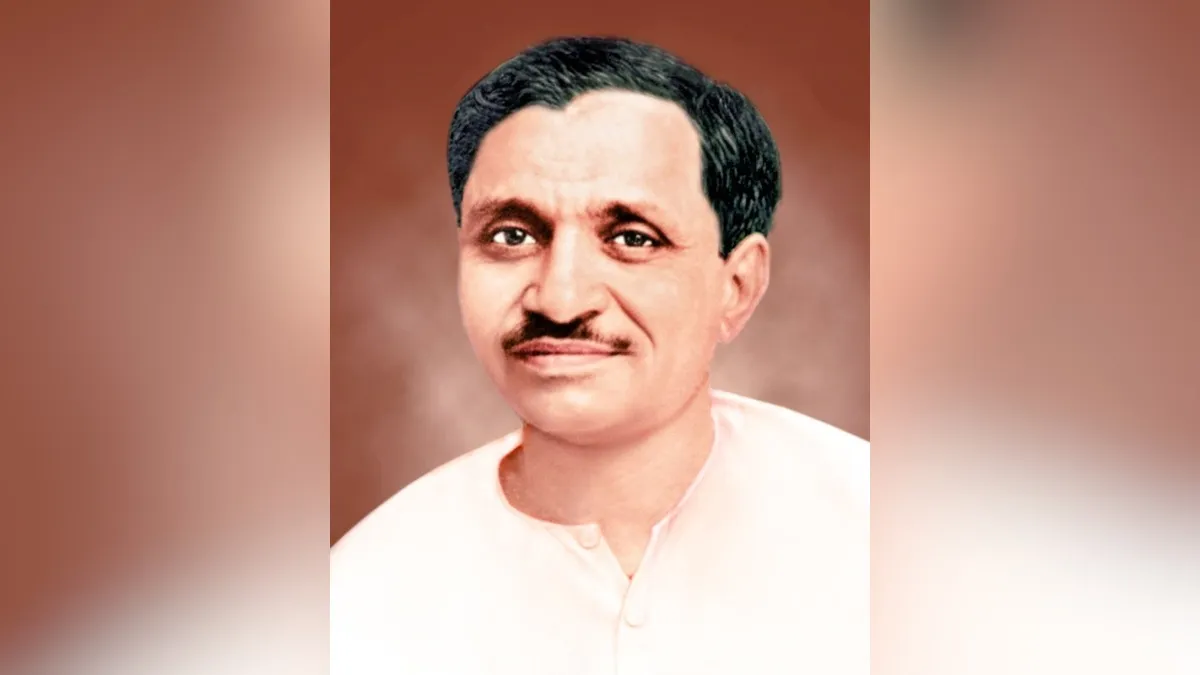
Antyodaya Day is being observed across the country today (September 25) to mark the birth anniversary of Pandit Deendayal Upadhyaya. Celebrated every year, the day commemorates the life and legacy of Upadhyaya, one of the most influential figures in Indian political history. Antyodaya Diwas highlights his vision of upliftment for the poorest and most marginalised sections of society, reflecting his philosophy of serving the "last person" in the social order.
What does 'Antyodaya' mean?
Upadhyaya's birth anniversary observed on Antyodaya, which means 'rising of the last', honours his lifelong efforts to uplift the underprivileged and marginalised.
The term Antyodaya means the "upliftment of the last person" or the "rise of the most disadvantaged." It reflects Pandit Deendayal Upadhyaya's philosophy of serving the "last person" in society, with the day dedicated to promoting awareness and action for the welfare of the most disadvantaged.
His birth anniversary is observed as Antyodaya Diwas, honouring his efforts to improve the lives of the underprivileged and less fortunate. Across the country, government and non-government organisations mark the occasion by organising seminars, workshops, and community service initiatives focused on education, healthcare, and skill development, in line with Upadhyaya’s vision of inclusive growth.
What is the significance of Antyodaya Day?
Antyodaya Day holds deep significance as it reflects the philosophy of Pandit Deendayal Upadhyaya, who coined the term "Antyodaya" to mean the upliftment and development of the poorest and most marginalised members of society. He firmly believed that true national progress could only be achieved by empowering those at the bottom of the social and economic ladder.
Upadhyaya also emphasised the importance of Indian roots, culture, and nationalism, asserting that a nation cannot prosper by disconnecting from its traditions and heritage. To honour this vision, the Government of India declared in 2014, on his 98th birth anniversary, that September 25 would be celebrated annually as Antyodaya Day.
The day serves as a reminder of his mission to ensure inclusive growth and social justice, keeping the welfare of the last person in society at the heart of national development.
When did the day dedicated to it start?
In 2014, Prime Minister Narendra Modi declared September 25 as Antyodaya Day, a national observance to commemorate Pandit Deendayal Upadhyaya’s vision and contributions.
That same year, the Ministry of Rural Development revamped its Aajeevika Skills programme under the National Rural Livelihood Mission (NRLM). In November 2015, it was officially renamed the Deendayal Antyodaya Yojana–NRLM, aimed at enhancing skill development and livelihood opportunities for the poor.
Further honouring his legacy, in 2018, the historic Mughalsarai Junction railway station was renamed Deen Dayal Upadhyaya Junction, marking the place where the leader had passed away in 1968.
Who was Pandit Deendayal Upadhyaya?
Pandit Deendayal Upadhyaya was the co-founder of the Bharatiya Jana Sangh (BJS), the forerunner of the Bharatiya Janata Party (BJP), and was also one of the thinkers of Rashtriya Swayamsevak Sangh (RSS).
He believed that the welfare of even the poorest person should be ensured. He believed that everyone, regardless of their background, should benefit from government schemes and that social equality should be established. The upliftment of the last person was Upadhyaya's mantra.
Pandit Deendayal Upadhyaya was born on September 25, 1916, in Nagla Chandrabhan village in Mathura district. His parents died when he was young. Upadhyaya was a well-known philosopher who worked for the cause of the poor and needy and championed integral humanism, focusing on individual and collective welfare, social justice, economic equality, and self-reliance.
After completing his studies, Deendayal joined the Rashtriya Swayamsevak Sangh (RSS) and spent his entire life as a volunteer for the organisation. He was one of the founding members of the Bharatiya Jana Sangh (BJS). When the BJS held its first convention in Kanpur in 1952, Deendayal Upadhyaya became the party's general secretary. Of the 15 resolutions passed at that convention, 7 were proposed by him. During this period, Dr Shyama Prasad Mukherjee remarked that if he could find two more people like Deendayal Upadhyaya, he could transform the political landscape of India. In December 1967, he also became the president of the BJS. He was assassinated at Mughalsarai railway station on the night of February 10/11, 1968.
