
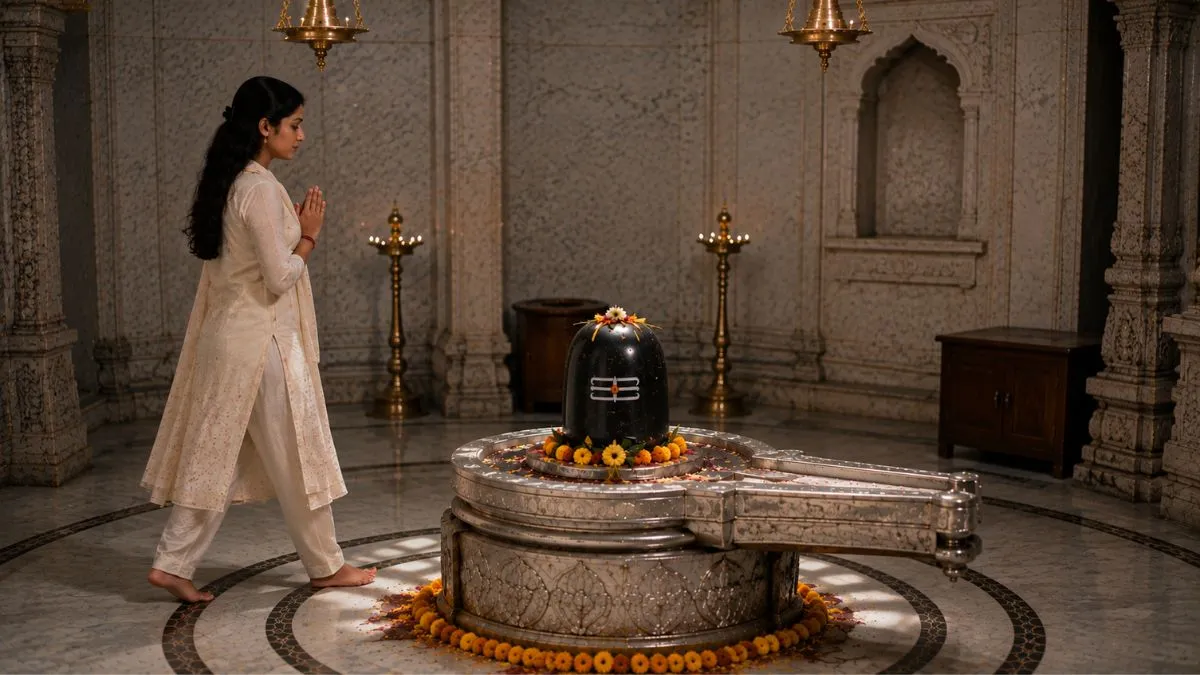
Parikrama, or Pradakshina, is a familiar part of Hindu worship, but the practice is meant to represent much more than simply walking around a deity. The idea is rooted in placing the Divine at the centre, with every step becoming an expression of devotion, surrender and awareness.
Spiritual guide Vaishnavi Jairam recently explored the meaning of Parikrama as part of her 'Sanatan Simplified for All' series on Instagram. Along with explaining why devotees traditionally walk clockwise, she shared a mantra that can be recited while performing Pradakshina and explained the prayer behind it.
What does Parikrama mean?
The word Parikrama comes from the Sanskrit words 'Pari', meaning around, and 'Krama', meaning to walk.
Jairam explains the practice as a symbolic act of placing the Almighty at the centre of one's life. In her video, she describes Parikrama as a form of surrender, where a devotee symbolically offers the responsibilities of life to the Divine with the feeling: I belong to you, now you take care of me.
She also draws a comparison with patterns of movement in the natural world. Electrons move around a nucleus, while the Earth revolves around the Sun. Jairam notes that the Earth's movement around the Sun plays a role in making life on Earth possible. In a similar symbolic sense, she describes Parikrama as placing one's own existence in relation to something greater.
For her, the practice therefore represents both surrender and awareness.
Why is Parikrama performed clockwise?
According to Jairam, Pradakshina is traditionally performed clockwise so that Bhagwan remains on the devotee's right side, which she describes as a symbol of Dharma and auspiciousness.
She compares the idea with planets revolving around the Sun, using it as a spiritual metaphor for keeping the Divine at the centre of one's life.
Rather than rushing through the ritual, she advises devotees to walk slowly, remember the Lord's name and treat each step as an offering of Bhakti.
Mantra to chant while performing Parikrama
Jairam recommends reciting the following prayer while performing Pradakshina:
"यानि कानि च पापानि जन्मान्तरकृतानि च।
तानि तानि विनश्यन्ति प्रदक्षिणे पदे पदे॥"
The prayer asks that sins committed in the present and previous births be destroyed with every step taken during Pradakshina.
In her video, Jairam explains that the mantra essentially expresses a devotee's prayer for the accumulated sins of many births to be removed, step by step, while performing Parikrama.
How many Parikramas are traditionally performed?
Jairam also shares the traditional number of Pradakshinas associated with different deities and the Peepal tree:
- Shri Ganesha: 1 Parikrama
- Surya Dev: 2 Parikramas
- Bhagwan Shiva: 3 Parikramas
- Bhagwan Vishnu and Maa Durga: 4 Parikramas
- Peepal tree: 7 Parikramas
She further cites the Skanda Purana while explaining the spiritual significance attached to the steps of Pradakshina, saying the first step purifies the mind, the second purifies speech and the third purifies actions.
With the sacred month of Shravan underway, Jairam's message is ultimately about looking beyond the physical act of walking around a deity. In her interpretation, every Parikrama is an opportunity to consciously place Mahadev, and the Divine more broadly, at the centre of one's life.
ALSO READ:
What is the best time for Rudrabhishek on Sawan Shivratri 2026? Check all Shubh Muhurats
