
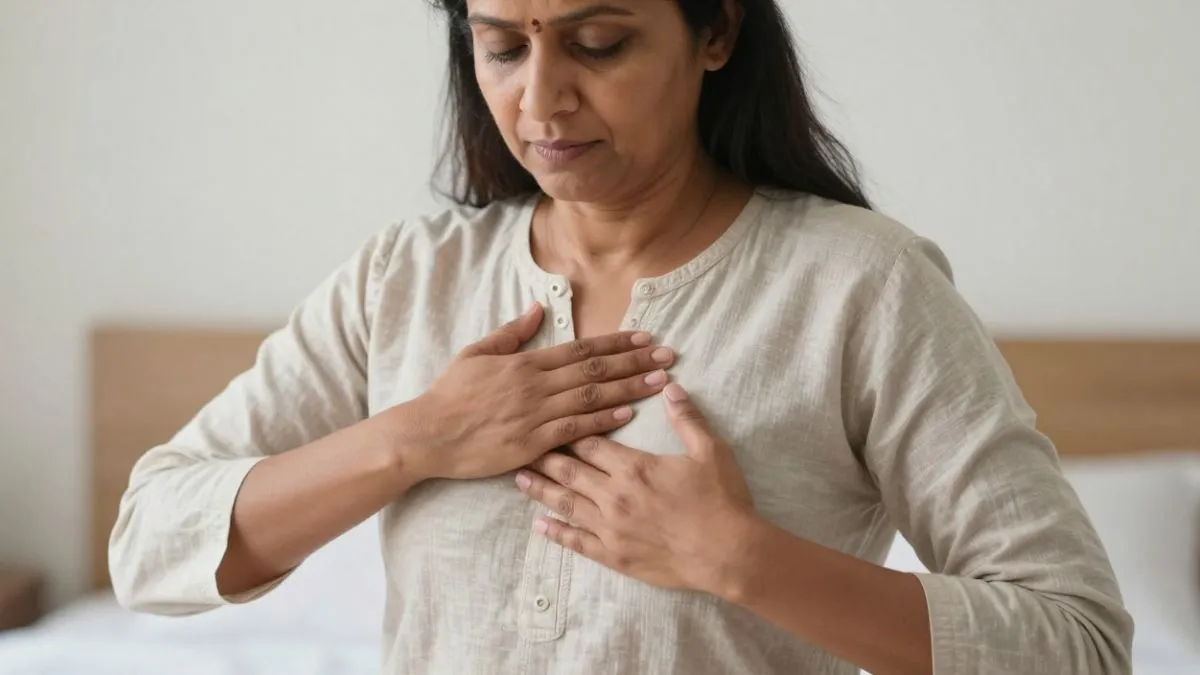
Breast cancer is often spoken about in hushed tones, yet doctors stress that awareness and early detection save lives. Self-breast examination is one of the simplest ways for women and men to stay alert to changes in their bodies and seek help early.
“In my own practice, I see patients who are just 24 or 25 years old,” says Dr Aditya Sarin, Medical Oncology Specialist at Sir Ganga Ram Hospital, in an interaction with India Tv. He further adds, “There is no fixed age. Any unexplained change in the breast needs attention.”
Why self-breast examination matters
Breast cancer often develops silently. In the early stages, it may cause no pain and no obvious discomfort.
“If the body could fix the problem on its own, it already would have,” Dr Sarin explains. “When a lump appears and keeps growing, that history itself tells us it should not be ignored.”
Regular self-examination helps you understand what is normal for your body, making it easier to spot changes early, when treatment is most effective.
How to do a self-breast examination at home
Self-breast examination should be done once a month, ideally a few days after periods end. For those who don’t menstruate, choose a fixed date each month.
Dr Sarin recommends a simple, methodical approach:
1. Look first
Stand in front of a mirror with your arms at your sides and then raised. Notice:
- Any visible lump or swelling
- Changes in breast size or shape
- Skin changes such as dimpling or an orange-peel texture
- Nipple changes or discharge
“Every woman knows the normal symmetry of her breasts,” he says. “Any visible change should prompt closer attention.”
2. Feel the breast tissue
Using the pads of your fingers, gently feel all parts of the breast in small circular motions, from the outer edge to the nipple, covering all quadrants.
This can be done:
- While standing or showering
- Or lying down, which helps spread the tissue evenly
“If a lump persists for several days, feels hard, or keeps increasing in size, it needs medical evaluation,” Dr Sarin says. “This does not automatically mean cancer, but it does mean tests are needed.”
3. Don’t forget the armpit
Check the underarm area for swelling or lumps, as lymph nodes here can be involved.
“When armpit nodes are affected, it is often a sign of more advanced disease,” he cautions.
Warning signs you should never ignore
Doctors urge immediate consultation if you notice:
- A persistent or growing breast lump
- Nipple discharge (white or bloody) that is new
- Skin thickening or orange-peel appearance
- Swelling or lumps in the armpit
- Unexplained pain or changes in breast appearance
“By the time some patients reach us, the cancer has already spread,” Dr Sarin says. “That is what we want to prevent.”
When to see a doctor even without a lump
You should consult a doctor if:
- Any breast change that persists beyond a few days
- You have a family history of breast cancer
- You are pregnant and notice a new breast lump
- You are a man with a lump near the nipple
“Male breast cancer is real,” Dr Sarin adds. “About one per cent of cases occur in men. Any growing lump in men should be checked.”
Breaking common fears that delay diagnosis
Many people delay seeing a doctor due to fear, fear of tests, surgery, or chemotherapy.
“Refusing a biopsy is one of the biggest mistakes,” Dr Sarin stresses. “Without a biopsy, we cannot diagnose cancer accurately. Mammography and biopsy do not spread cancer; that is a dangerous myth.”
He also reassures patients about treatment. “Breast cancer surgery is among the safest surgeries today, with recovery often within three weeks. Chemotherapy is far more manageable now, and newer treatments have fewer side effects.”
Self-breast examination is not about panic; it’s about familiarity and awareness. “Cancer is not shameful,” Dr Sarin says. “Breast cancer is treatable and often curable when detected early. Listen to your body, and don’t hesitate to seek help.”
Early attention doesn’t just save lives, it preserves choices, confidence, and quality of life.
Disclaimer: Tips and suggestions mentioned in the article are for general information purposes only and should not be construed as professional medical advice. Always consult your doctor or a dietician before starting any fitness programme or making any changes to your di
Also read: From hormones to fertility: Key women’s health check-ups in 2026
