
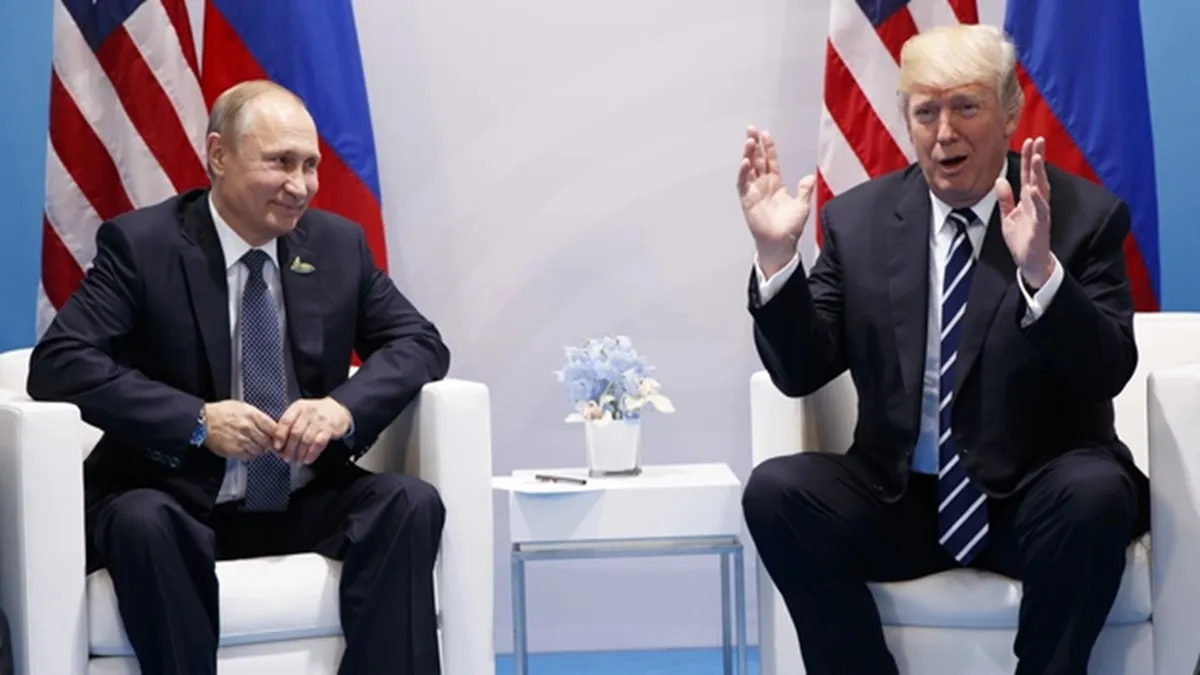
US President Donald Trump is poised to hold a face-to-face summit with Russian President Vladimir Putin in Alaska on Friday. Experts believe that the meeting could reshape the course of the war in Ukraine and redefine the future of European security. The talks are scheduled to take place at Elmendorf Air Force Base, a strategic military facility long tasked with monitoring threats to North America and notably active during the Cold War in tracking Soviet activity. The selection of Alaska -- once part of the Russian Empire before its sale to the United States in 1867 -- adds symbolic weight to the event as it will bring the two leaders together on land that carries deep historic resonance.
What makes the summit even more remarkable is Putin's presence on American soil despite being under indictment by the International Criminal Court (ICC). This will mark the first time he has set foot in a Western nation since Russia launched its invasion of Ukraine in February 2022. As the much-anticipated meeting is set to take place in Alaska, many are pausing to reflect on the extraordinary historical irony of this high-stakes diplomacy and at a place that once belonged to Russia. Why, then, did Russia decide to sell Alaska to the United States in 1867? And how is this legacy shaping today’s geopolitical theatre?
From Tsars to superpowers: The 1867 Alaska sale
Back in the mid-19th century, Russia was an imperial power with vast territory but limited resources to govern its far-flung lands. Alaska -- a remote, icy wilderness over 7,000 kilometres from St Petersburg was seen as strategically vulnerable. The Russian Empire had just suffered a crippling defeat in the Crimean War against Britain and feared losing Alaska without compensation should another conflict break out.
At the same time, the territory had become an economic burden. The once-profitable fur trade was declining and there were no obvious natural riches (gold and oil would only be discovered decades later). Russia's leaders concluded that selling the territory made more sense than trying to defend or develop it.
A strategic partnership with Washington
Meanwhile, America was rapidly expanding westward under the doctrine of "Manifest Destiny". The then US Secretary of State William H Seward was a fierce advocate for purchasing Alaska, envisioning its potential as a gateway to the Pacific. In 1867, the United States agreed to buy the territory for USD 7.2 million, about two cents an acre, in what critics derided as "Seward’s Folly." Yet history proved him right. Gold, oil and natural gas transformed Alaska into a strategic and economic powerhouse. During the Cold War, it became a frontline listening post between the US and the Soviet Union with only the Bering Strait separating them by 55 miles at their closest point.
Fast forward to 2025: Diplomacy on former Russian soil
Today, that Cold War chessboard is once again in focus as Donald Trump and Vladimir Putin prepare to meet in Alaska. While full details of the agenda remain under wraps, officials on both sides hint that security in the Arctic, the Russia-Ukraine war, trade ties, and nuclear arms agreements are likely to dominate the conversation. The choice of venue is no coincidence. Strategists say hosting the talks in Alaska is a symbolic message: America is welcoming Russia to a land it once owned, signalling openness to dialogue while reinforcing US control over this critical region. For Putin, a summit with Trump offers a long-sought opportunity to try to negotiate a deal that would cement Russia's gains, block Kyiv's bid to join the NATO military alliance and eventually pull Ukraine back into Moscow's orbit.
ALSO READ
|
Trump-Putin's historic meeting in Alaska: What's on agenda and what's at stake for India |
|
Trump warns Putin of 'very severe consequences' if Russia does not halt Ukraine war |
