
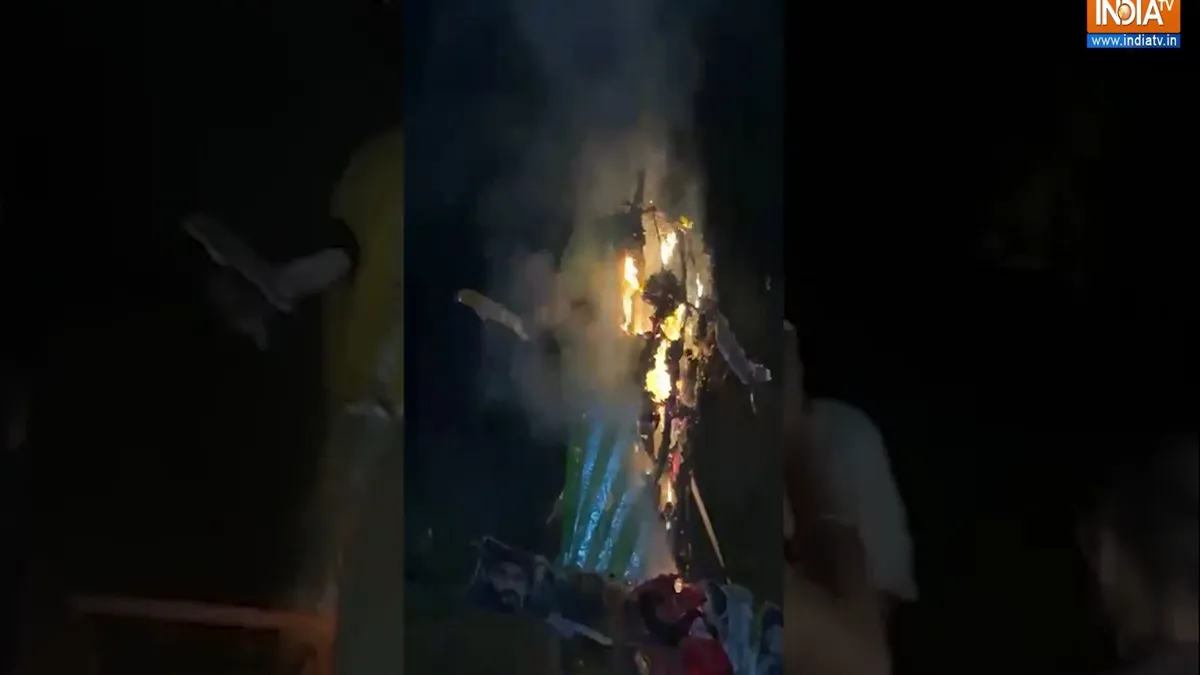
A violent confrontation broke out at Jawaharlal Nehru University (JNU) on Friday (October 2) during a 'Visarjan Shobha Yatra' held to mark Vijayadashami, leaving the campus tense and divided along ideological lines. The clash stemmed from competing symbolic demonstrations by student groups, each accusing the other of provocation.
The Shobha Yatra and 'Ravan Dahan'
According to JNUSU Joint Secretary Vaibhav Meena, the university’s Students’ Union had organised a symbolic ‘Ravan Dahan’ at Sabarmati Dhaba as part of the Vijayadashami celebrations. Effigies and posters of individuals associated with Naxal or Left movements, including Afzal Guru, Umar Khalid, Sharjeel Imam, G Sai Baba, and Charu Majumdar, were burned during the ritual.
Meena said this act was intended as a symbolic rejection of what he described as “Naxal-like forces” on campus. Following the effigy burning, a ‘Visarjan Shobha Yatra’ with Durga idols and students was taken across the campus.
Left groups stage counter protest
Left-affiliated student groups, however, described the act as deeply provocative. They accused the organizers of misrepresenting former JNU students Umar Khalid and Sharjeel Imam, known for their political activism, as figures of evil.
JNUSU President Nitish Kumar alleged that trouble began after posters circulated online highlighting a ‘Ravan Dahan’ that included effigies of Khalid and Imam. “They are not burning Godse’s effigy, but instead trying to burn those who stood up for democracy and human rights,” he said.
Left student groups had assembled at Sabarmati Tea Point for their own protest, accusing the opposing faction of targeting activists who advocated for constitutional rights.
Clash during procession
Tensions escalated when the Durga Visarjan procession passed by the protest site. Meena claimed that members of Left groups hurled slippers and shoes at students participating in the Yatra, injuring some. He stated that the students’ union would file a police complaint regarding the incident.
Nitish Kumar, however, maintained that it was the Yatra participants who first attempted to provoke violence. “They stopped their DJ, shouted slogans of ‘Jai Shri Ram’ and ‘bulldozer justice,’ and tried to incite a clash. We formed a human chain to prevent violence,” he said.
Competing narratives and rising tensions
Both sides accused each other of initiating the violence, with one group alleging obstruction of a religious procession and the other claiming defamation of former students and activists. The confrontation highlights deep-rooted ideological divisions at JNU, where campus politics frequently mirrors national debates.
Police intervention is likely to follow as complaints are filed, with students accusing each other of inciting violence and disrupting cultural events. The incident underscored how even religious festivities at JNU can quickly transform into flashpoints of ideological conflict.
