
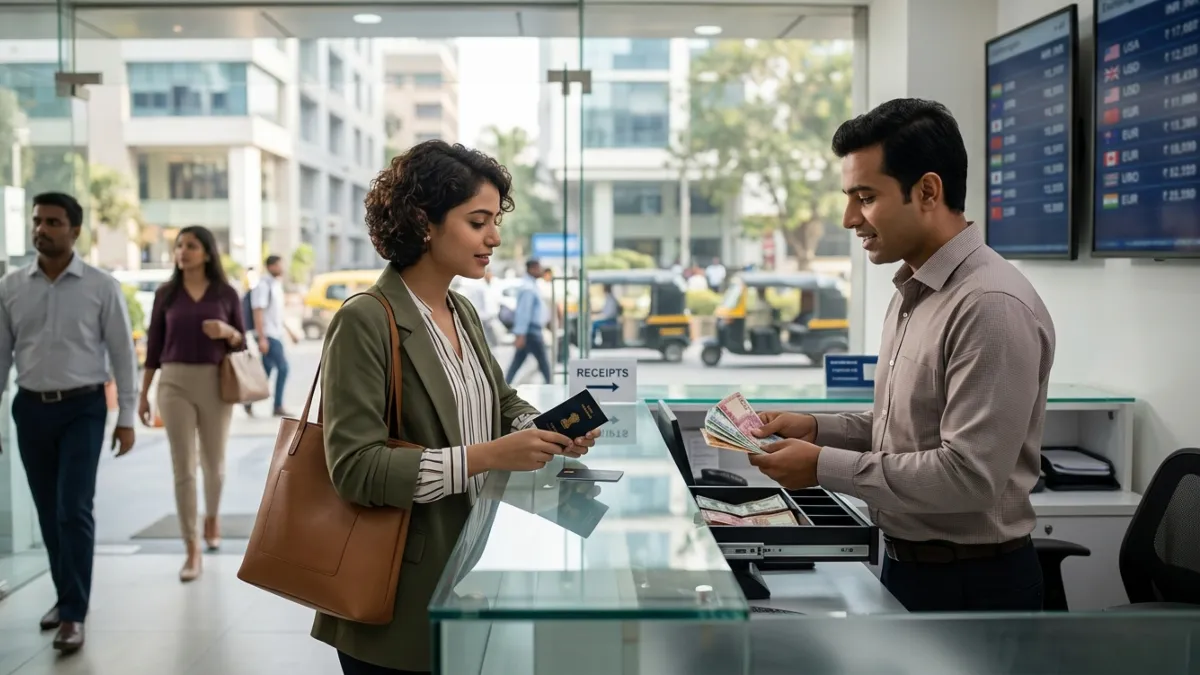
Planning an international trip is exciting, with tasks like booking flights, securing hotels, and shortlisting restaurants. But between the visa appointment and packing, most travellers leave one task for the last minute: currency exchange. That last-minute rush almost always costs more than it should.
India's international travel spending rose 25% in FY24 to $31.7 billion, and outbound travel is projected to exceed $55 billion by 2034. With millions of Indians travelling abroad every year, over 6.52 million in January 2024 alone, a 17% jump from the previous year, getting a good foreign exchange rate has never mattered more.
So, where do you go to exchange currency in India's top cities? Let's break it down and then discuss why a smarter option might already be in your pocket. Here's a breakdown of your main options and why the most convenient one might not be the most cost-effective.
Airport forex counters
The most visible currency exchange option for most travellers is right at the departure terminal. Whether it's Mumbai's T2, Delhi's IGI, or Bengaluru's Kempegowda International, airport counters from operators are hard to miss. The catch? Convenience comes at a steep price. You can expect to pay a 3–5% premium over the interbank rate at airport counters, and that's before any flat handling fees. On a ₹1 lakh exchange, that's ₹3,000–₹5,000 quietly drained from your travel budget before you've even boarded.
Bank branches
Most nationalised and private banks are authorised to carry out currency exchange transactions. They're RBI-regulated, the rates are published, and the process is above board. However, banks typically limit forex services to account holders, require advance appointment at many branches, and may not stock less common currencies like Thai Baht, Indonesian Rupiah, or Vietnamese Dong. The foreign exchange rate offered is also usually less competitive than the live mid-market rate, with a spread baked in quietly.
Digital platforms
Digital platforms like Niyo are gaining traction in the retail currency exchange market. They operate physical outlets in major cities and offer online ordering with store pickup or home delivery. Rates are more transparent than airport counters, and many have a reputation for rate-lock guarantees. However, delivery can take 2–3 days, coverage in Tier II cities is patchy, and fees vary by transaction size and currency.
Local RBI-authorised money changers
A large network of smaller, RBI-licensed Full Fledged Money Changers (FFMCs) and Restricted Money Changers (RMCs) operates across cities. They can offer competitive exchange rates, especially for high-volume transactions. However, the experience is inconsistent: rates are not always displayed upfront, customer service quality varies, and buyback of unused currency is often at a significant discount.
What to look for in a good currency exchange service?
Before you hand over your rupees, here's what actually matters:
-
Rate transparency: The foreign exchange rate you're quoted should be close to the live interbank (XE) rate. Any deviation is essentially the provider's margin.
-
Zero or low fees: Some providers offer a "good rate" but charge a fixed processing or handling fee on top. Always calculate the all-in cost.
-
RBI authorisation: Only deal with RBI-authorised entities, either Authorised Dealer Category I (AD-I, typically banks) or AD Category II (money changers and fintech platforms). This protects you legally and ensures compliance with FEMA guidelines.
-
Convenience: Do you want to make a midweek trip to a forex store, carry your passport and PAN card, wait in line, and hope the rate hasn't changed by the time you reach the counter? Online platforms eliminate this hassle.
Why Niyo's online currency exchange is a better option?
Niyo's currency exchange service offers zero forex markup on live XE rates, so the rate you see is the actual mid-market rate with no hidden spread. Any fees charged are refunded as Niyo Coins, redeemable on future transactions, making the effective exchange cost zero.
Compare that to airport counters or most local forex stores, where the markup can eat 3–5% of your money.
A few things that make the experience stand out:
-
One-day doorstep delivery to Mumbai, Pune, Bengaluru, Gurugram, and Hyderabad. Your forex cash arrives at home with no queuing required.
-
30+ currencies covered, from USD and EUR to Thai Baht, Indonesian Rupiah, Japanese Yen, and UAE Dirham.
-
Buyback guarantee to sell unused foreign notes back at the live XE rate, with zero forex markup on the return.
-
100% digital process. You can select your currency, upload documents (passport, PAN, travel tickets), and pay after verification.
-
Niyo's forex operations run through Kanji Forex Private Limited, an RBI-authorised AD Category II entity.
The platform also supports ordering multiple currencies in a single transaction, which is useful for multi-destination trips, and has 24/7 in-app chat support.
The Bottom Line
Physical currency exchange stores in India's metros have served travellers for decades, and many are legitimate, RBI-authorised, and reasonably competitive. But "reasonably competitive" is no longer enough when a digital platform delivers better rates, greater transparency, and doorstep convenience, all at zero effective cost.
Traditional currency exchange stores across India’s top cities still play an important role, especially for travellers who prefer in-person assistance. But digital-first platforms like Niyo are reshaping the experience by combining transparent pricing, doorstep convenience, and zero forex markup in a way that fits how modern travellers manage money.
As India's outbound travel economy expands, the cost of a poor forex decision will only grow. In 2026, the smartest thing you can pack for an international trip is the right card or the right platform.
(Disclaimer: This is sponsored content. The liability for the article solely rests with the provider. The content has not been verified by the India TV channel and IndiaTVNews.com).
