Scientists may have detected Dark Matter for the first time using NASA’s Fermi Telescope: Breakthrough claim
A team of Japanese astronomers may have detected the first-ever direct signature of dark matter using NASA’s Fermi gamma-ray space telescope. The team found a unique 20 GeV gamma-ray glow near the Milky Way’s centre, matching predictions of dark matter particle annihilation.
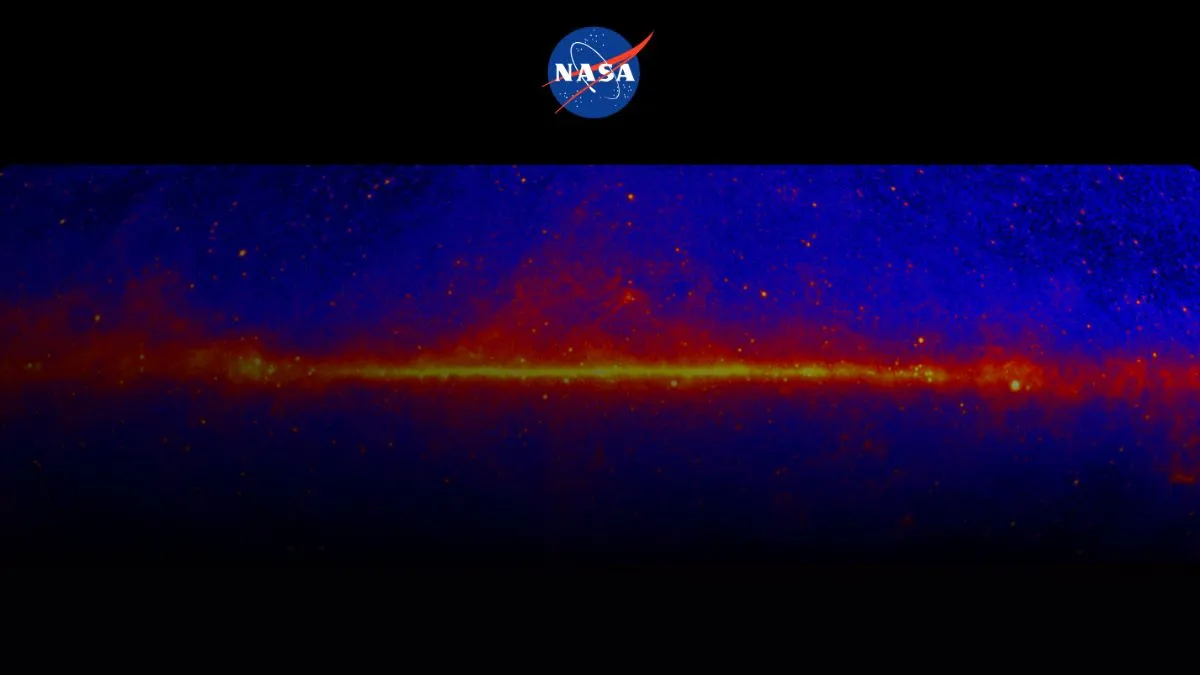
In what could be a breakthrough that rewrites physics textbooks, scientists using NASA's Fermi Gamma-Ray Space Telescope may have directly detected dark the invisible substance believed to comprise 85 per cent of the universe's matter. If confirmed, this would be one of the biggest scientific discoveries of this century.
What led to the Dark Matter mystery?
The concept of dark matter was first proposed in the 1930s, when astronomer Fritz Zwicky realised galaxies were moving too fast to be held together by visible matter alone. Later, in the 1970s, Vera Rubin's observations of galaxy rotation patterns strengthened the theory. Ever since, the majority of astronomers have believed that every major galaxy, including the Milky Way, is enveloped by a huge, invisible halo composed of dark matter.
Dark matter was undetectable for decades because it does not emit, absorb, or reflect light. Until now, scientists were able to infer its presence only through gravitational effects.
The new gamma-ray signal that changes everything
A team led by the University of Tokyo's Tomonori Totani has identified a halo-shaped gamma-ray glow emanating from close to the Milky Way's central region. The 20-gigaelectronvolt radiation was exactly what researchers had predicted would result from the annihilation of WIMPs-one of the leading candidates for dark matter.
The shape and energy signature of the signal agree strongly with the theoretical modelling of dark matter clustering and interacting, according to Totani.
He thinks that no known astronomical object or physical process can easily explain this pattern of gamma-ray emission.
Still early, but scientists are excited
While the results seem promising, the global scientific community remains cautious. According to the researchers, more data and cross-verification are essential before declaring a historic discovery. This would constitute, if confirmed, the first direct detection of dark matter and would point toward new physics beyond the Standard Model.
These results were published on November 25 in the Journal of Cosmology and Astroparticle Physics.