
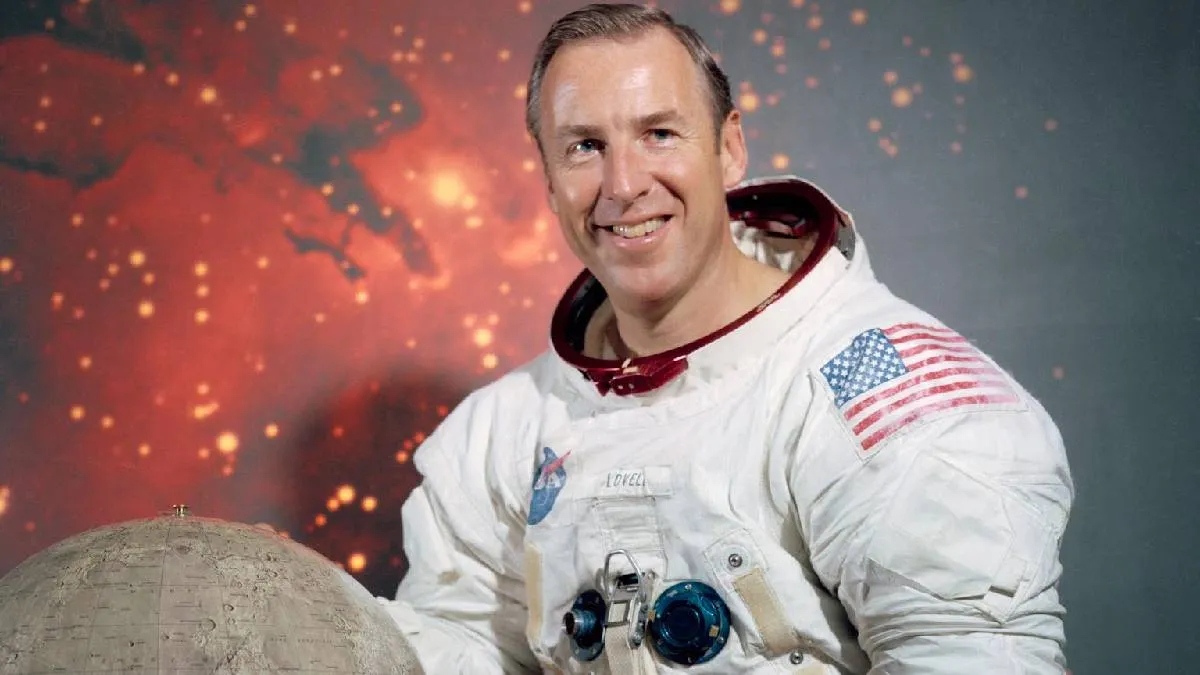
James Lovell, the commander of Apollo 13 who helped turn a failed moon mission into a triumph of on-the-fly engineering, has died at the age of 97. Lovell passed away on Thursday in Lake Forest, Illinois, according to a NASA statement released on Friday.
"Jim's character and steadfast courage helped our nation reach the Moon and turned a potential tragedy into a success from which we learned an enormous amount," NASA said. "We mourn his passing even as we celebrate his achievements.”
Lovell was one of NASA's most experienced astronauts in its first decade, flying four times: on Gemini 7, Gemini 12, Apollo 8, and Apollo 13. The two Apollo flights, in particular, captivated the public. In 1968, the Apollo 8 crew—Lovell, Frank Borman, and William Anders—became the first to leave Earth's orbit and the first to fly to and circle the moon. Though they could not land, they gave the U.S. a critical lead in the space race. Their stunning photo of Earth from the moon, a world first, and their Christmas Eve reading from Genesis were widely credited with lifting the spirits of a nation navigating a tumultuous 1968.
The Apollo 13 mission
The most significant rescue mission of Lovell's career was still to come during the harrowing Apollo 13 flight in April 1970. Lovell was supposed to be the fifth person to walk on the moon, but an oxygen tank exploded on the way there. The astronauts barely survived, spending four cold and cramped days in the lunar module, which served as their lifeboat.
"The thing that I want most people to remember is [that] in some sense it was very much of a success," Lovell said in a 1994 interview. "Not that we accomplished anything, but a success in that we demonstrated the capability of [NASA] personnel".
A retired Navy captain known for his calm demeanor, Lovell told a NASA historian that the near-death experience profoundly affected him. "I don't worry about crises any longer,” he said in 1999. Whenever a problem arose, he would simply say, "I could have been gone back in 1970. I'm still here. I'm still breathing. So, I don't worry about crises".
The mission's retelling in the popular 1995 movie Apollo 13 brought Lovell, Fred Haise, and Jack Swigert renewed fame—thanks in part to the movie's version of Lovell reporting, "Houston, we have a problem," a phrase he didn't exactly utter. According to Smithsonian Institution historian Roger Launius, Lovell possessed a quiet confidence rather than the swagger some other astronauts displayed. Launius called him "a very personable, very down-to-earth type of person, who says 'This is what I do. Yes, there's risk involved. I measure risk".
A storied career
In all, Lovell logged 715 hours, 4 minutes, and 57 seconds in space, holding the world record for the longest time in space until the mid-1970s. Aboard Apollo 8, Lovell's description of Earth's oceans and landmasses was famously poignant: "What I keep imagining, is if I am some lonely traveler from another planet, what I would think about the Earth at this altitude, whether I think it would be inhabited or not," he remarked.
The Apollo 8 mission may be as important as the historic Apollo 11 moon landing it made possible, Launius said. "I think in the history of space flight, I would say that Jim was one of the pillars of the early space flight program," legendary NASA flight director Gene Kranz once said.
But it was his final mission—immortalized by the film starring Tom Hanks as Lovell—that cemented his public image as a cool, decisive astronaut. The Apollo 13 crew was on its way to the moon when an oxygen tank exploded 200,000 miles from Earth. That, Lovell recalled, was "the most frightening moment in this whole thing".
What followed was a furious, four-day rescue plan led by Kranz and hundreds of flight controllers and engineers. The astronauts moved into the cramped lunar lander, using it as a lifeboat to swing around the moon and return home while rationing dwindling resources. By coolly solving problems under unimaginable pressure, the astronauts and ground crew became heroes. They demonstrated their ability to handle "truly horrific problems and bring them back alive," as Launius put it.
Despite not walking on the moon, Lovell gained something more important. "While you may have lost the moon... you gained something that is far more important perhaps: the abiding respect and gratitude of the American people," President Bill Clinton said when he awarded Lovell the Congressional Space Medal of Honor in 1995.
"The mission itself and the fact that we triumphed over certain catastrophe does give me a deep sense of satisfaction," Lovell said, explaining that a failed mission could be more revealing than a successful one. "Going to the moon, if everything works right, it's like following a cookbook. It's not that big a deal," he told the AP in 2004. "If something goes wrong, that's what separates the men from the boys".
Personal life
James A. Lovell was born on March 25, 1928, in Cleveland. He attended the University of Wisconsin before transferring to the U.S. Naval Academy, where he graduated in 1952. He married his wife, Marilynn, on the same day. Lovell, a test pilot, was selected as an astronaut in 1962. After retiring from the Navy and NASA in 1973, he went into private business. In 1994, he and Jeff Kluger wrote Lost Moon, the story of the Apollo 13 mission that became the basis for the film. In one of the movie's final scenes, Lovell appeared as a Navy captain, the rank he held in real life. His wife, Marilynn, died in 2023. He is survived by their four children.
ALSO READ: Meteorite older than Earth hits home in Georgia, traveling faster than the speed of sound
