
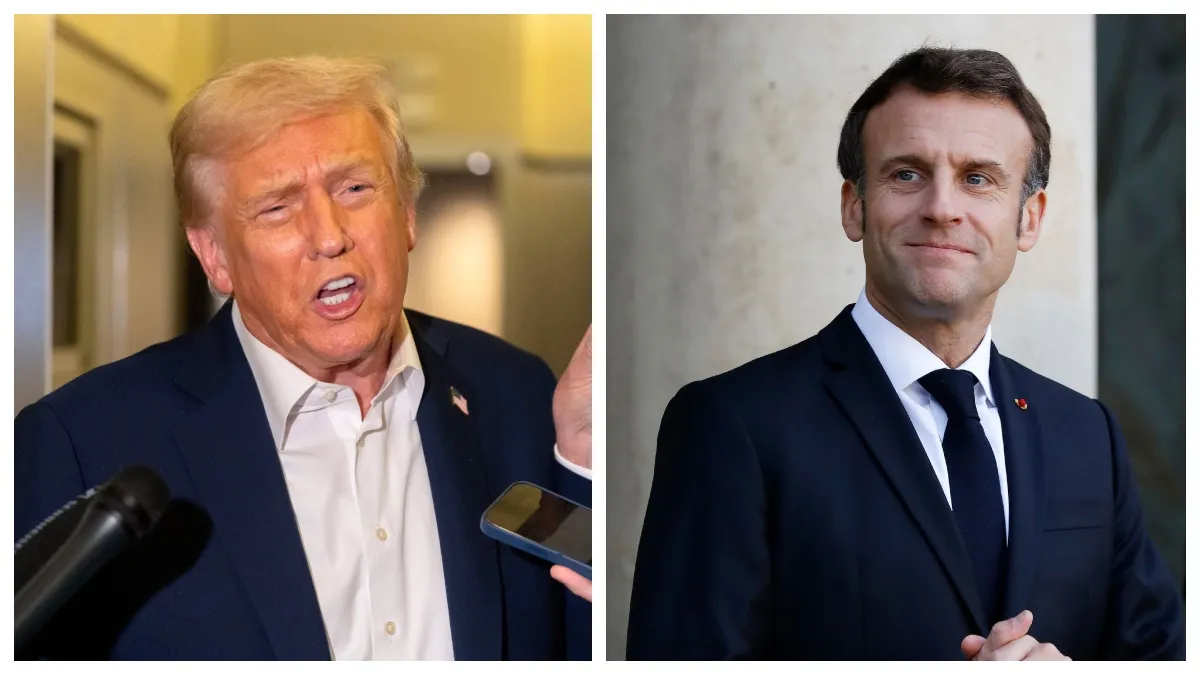
US President Donald Trump on Tuesday threatened 200 per cent tariffs on French wine and champagne over Paris's intentions to decline his invitation to join his "Board of Peace". He also shared in a Truth Social post a private message he received from French President Emmanuel Macron regarding Greenland.
The US President’s all-out attack on France came after Macron derided Washington by mocking US Treasury Secretary Scott Bessent's justification of why Trump is fixated on the Arctic territory, part of Denmark.
Here’s what Trump said on France
"I'll put a 200 per cent tariff on his wines and champagnes. And he'll join. But he doesn't have to join," Trump said, referring to French President Emmanuel Macron. The US-proposed board was originally conceived to oversee the rebuilding of war-torn Gaza, but the charter does not appear to limit its role to the occupied Palestinian territory,” he said.
The US President later posted a private message from Macron, where the French President told Trump that the two agree on the issues of Iran and Syria but told him he did not "understand" what Trump was "doing on Greenland?"
Macron offers to meet Trump in Davos
However, Macron offered to meet Trump and other G7 leaders on the sidelines of the World Economic Forum in Davos, noting he could also invite Ukrainians, Danes, Syrians and Russians.
Earlier, Trump said that he would charge a 10 per cent import tax starting in February on goods from eight European nations because of their opposition to American control of Greenland. Trump said in a social media post that Denmark, Norway, Sweden, France, Germany, the United Kingdom, the Netherlands, and Finland would face the tariff and that it would climb to 25 per cent on June 1 if a deal is not in place for “the Complete and Total purchase of Greenland” by the United States.
Trump repeatedly tried to use trade penalties to bend allies
The threat of tariffs was a drastic and potentially dangerous escalation of a showdown between Trump and NATO allies, further straining an alliance that dates to 1949 and provides a collective degree of security to Europe and North America.
The Republican president has repeatedly tried to use trade penalties to bend allies and rivals alike to his will, generating investment commitments from some nations and pushback from others such as China, Brazil and India.
It was unclear how Trump could impose the tariffs under US law, though he could cite economic emergency powers that are currently subject to a US Supreme Court challenge. Trump said in his Truth Social post that his tariffs were retaliation for recent trips to Greenland by representatives from Britain, the Netherlands and Finland and for general opposition to his efforts to purchase the semiautonomous territory of NATO ally Denmark.
