
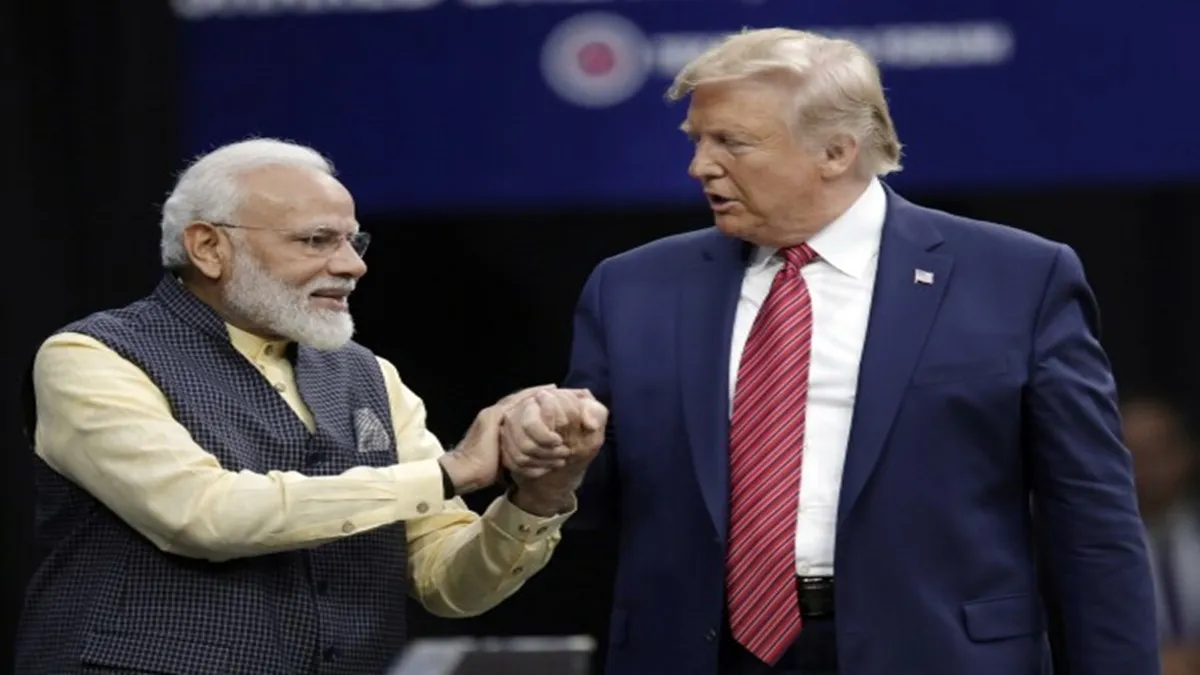
A top aide to US President Donald Trump has sparked controversy by claiming that a much-anticipated trade agreement between India and the United States collapsed because Prime Minister Narendra Modi failed to make a decisive phone call to seal the deal. US Commerce Secretary Howard Lutnick's revelation intensifies an already strained economic relationship, marked by steep US tariffs on India over its Russian oil purchases and looming threats of even harsher penalties. As negotiations drag on, Lutnick's remarks expose the high-level diplomatic friction at play.
Lutnick’s podcast bombshell: Deal ready, but Modi didn’t dial
In a candid podcast with entrepreneur Chamath Palihapitiya, Lutnick asserted he had meticulously arranged the India-US trade pact, positioning it ahead of similar deals with Southeast Asian nations. However, he said the final hurdle, a direct call from Modi to Trump, never materialised. "It's all set up, but I gotta have Modi call the President... they were uncomfortable doing it, so Modi didn't call," Lutnick recounted, lamenting that India ended up "on the wrong side of the see-saw."
He emphasised the near-miss, noting the two sides were "very close" to inking the agreement, with Lutnick personally negotiating "at a higher rate" for India, implying superior concessions, before pivoting to pacts with Indonesia, Vietnam, and the Philippines.
Trump’s direct warning: Tariffs to enforce ‘Russian Oil’ compliance
The comments follow Trump's pointed remarks linking trade concessions to India's energy ties with Russia. Praising Modi as "a very good guy" who "wanted to make me happy," Trump warned of swift tariff hikes if New Delhi persisted. This echoes the 50% duties imposed on Indian imports in August 2025, explicitly tied to India's discounted Russian oil purchases amid the Ukraine conflict.
Washington views these trades as propping up Moscow's war chest, using tariffs as leverage to force a rethink. Lutnick's disclosure frames the stalled deal as a missed chance for India to ease this pressure through bilateral goodwill.
India’s firm stance: No rush, no coercion
India has steadfastly resisted rushed capitulation. Commerce Minister Piyush Goyal articulated this in October 2025, affirming openness to US dialogue but rejecting deadlines or duress: "We don’t do deals in a hurry, and we don’t do deals with deadlines or with a gun on our head." New Delhi prioritizes market-driven energy security for its consumers, dismissing political arm-twisting while navigating global oil dynamics.
500 per cent tariff threat looms via Russia sanctions bill
Escalation risks mount with the 'Sanctioning Russia Act of 2025,' championed by Senator Lindsey Graham and reportedly greenlit by Trump. This legislation mandates Trump to slap at least 500 per cent tariffs on all goods and services from nations, including India, knowingly trading Russian uranium or petroleum. Aimed at strangling Russia's revenues to halt its Ukraine offensive, the bill could devastate Indian exports if enforced.
India now faces a precarious balancing act: preserving strategic autonomy on energy without triggering economic retaliation from its largest trading partner. As Trump’s administration flexes tariff muscles, the absence of that pivotal Modi-Trump call underscores deeper trust gaps in bilateral ties.
