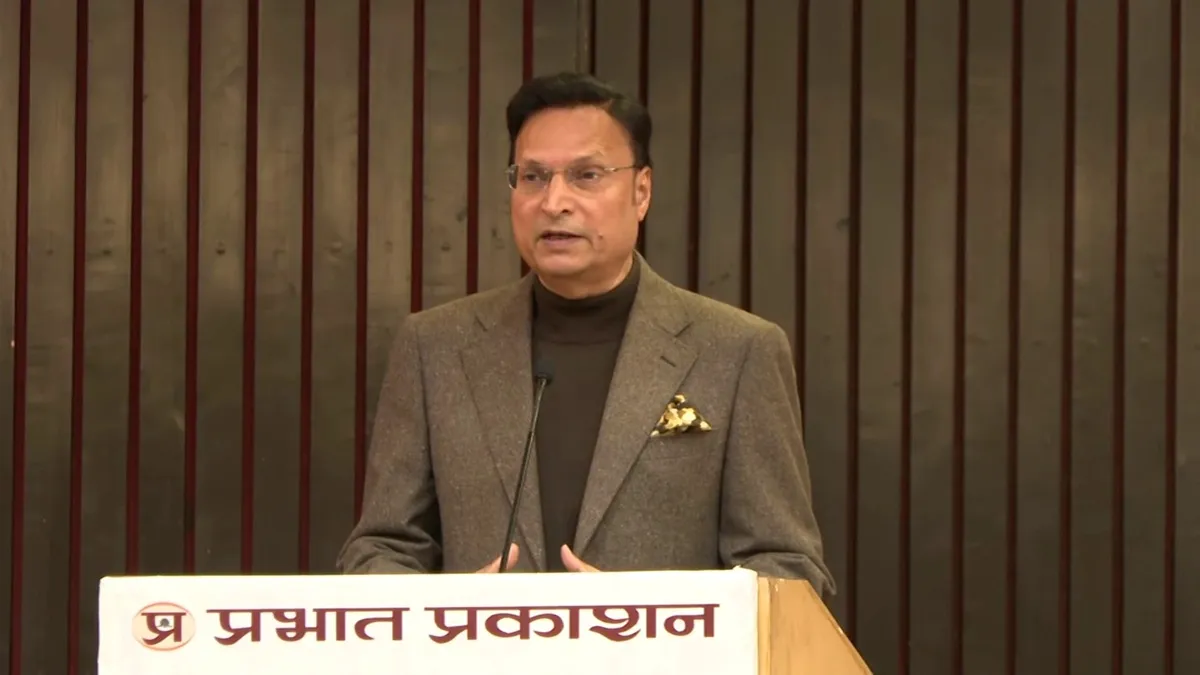
Rajat Sharma called the 'Aap Ki Adalat' episode with Vajpayee the ultimate display of Atal ji's generosity and big-heartedness. Convincing him to appear was a huge challenge, but once he did, the show exploded in popularity.
India TV Chairman and Editor-in-Chief Rajat Sharma.Image Source : Reporter
New Delhi:
At a book launch event in New Delhi, India TV Chairman and Editor-in-Chief Rajat Sharma delivered a deeply personal and evocative speech on former Prime Minister Atal Bihari Vajpayee at the India International Centre. The occasion was the launch of the book 'Atal Sansmaran' by senior journalist Ashok Tandon. Union Minister Nitin Gadkari also attended the event. Rajat Sharma’s address was less a formal speech and more a heartfelt remembrance, filled with intimate anecdotes that showcased Vajpayee’s humour, humility and large-heartedness.
Our good fortune to sit with two of Atal ji’s favourites: Rajat Sharma
India TV Chairman Rajat Sharma began by calling it a privilege to be on a stage shared by two people who were extremely close to Atal ji- Nitin Gadkari and Ashok Tandon. He said he could see many faces in the auditorium who loved Atal ji and were loved by him in return. Describing Atal Vajpayee’s multi-faceted life, Rajat Sharma noted that it was almost impossible to capture his personality fully in a single book, a film or even a long interview. Yet, he praised Ashok Tandon for attempting this challenging task, pointing out that Ashok Tandon had the rare opportunity to see and know Atal ji up close. Rajat Sharma then said he would share a few personal memories that, for him, defined Vajpayee’s character.
First encounter as a student leader: A lesson in wit
Rajat Sharma recalled that he first met Atal Bihari Vajpayee during his student days at Delhi University (DU). At the time, Rajat Sharma was the General Secretary of the Delhi University Students’ Union (DUSU) and Vijay Goel was the President. They would often meet Atal ji and interact with him. One memorable incident occurred at Daulat Ram College, where Vajpayee had been invited to inaugurate the students’ union. Vajpayee’s daughter, Namita Bhattacharya, was then General Secretary of the college union, and Rajat Sharma had been invited to preside over the function.
Before the programme, Vajpayee asked Rajat Sharma what kind of college Daulat Ram was. Rajat Sharma, in a light-hearted way, replied that it was known as a “behenjiyon ka college”. In his speech, Rajat Sharma also criticised the then foreign minister, saying that India’s talented engineers and doctors were not getting enough opportunities in the country and were going abroad, and that the foreign minister should do something about it.
When Vajpayee rose to speak, Rajat Sharma’s casual comments came back to haunt him. Atal ji addressed the principal and the audience, starting with “Principal sahiba, bhaiyon aur behnon…” and then paused, playfully adding that the students’ union General Secretary had just called it a “behenjiyon ka college.” Rajat Sharma said you can imagine his embarrassment in a college where he was popular and had won votes.
Vajpayee then responded to Rajat Sharma’s remark about brain drain: he said, “The General Secretary says our engineers and doctors are going abroad. I want to tell him- don’t worry, there are some people who are working hard to fill this country with people.” Rajat Sharma said that day he realised Vajpayee never needed preparation; “Saraswati sat on his tongue.”
Aap Ki Adalat and Atal ji’s generosity: “Our PM journey began there”
Rajat Sharma said he saw the greatest example of Vajpayee’s generosity and largeness of heart when he recorded the 'Aap Ki Adalat' episode with him. Bringing Atal ji to the show was very difficult, but once he came, the episode became a sensation. Shortly after, Vajpayee became Prime Minister for 13 days. The show was widely discussed because of Atal ji’s unmatched wit and his style of answering tough questions.
Rajat Sharma recalled his opening question on the show, “Atal ji, you are a poet, you are in politics, you are unmarried but live with a family. There are so many contradictions.” Vajpayee replied, “Our parents gave us a name with contradictions- hum Atal bhi hain, Bihari bhi hain. Jab naam mein virodhabhas hai, to kaam mein bhi hoga hi.”
India TV Chairman Rajat Sharma said the real surprise came later, when Vajpayee was no longer Prime Minister. At a dinner hosted by then Prime Minister HD Deve Gowda for the visiting Prime Minister of Mauritius, Vajpayee saw Rajat Sharma and said, “Aap hazir hoiyega”. India TV Editor-in-Chief got worried as he might get a scolding for some sharp questions on the show and he went to meet him later.
Vajpayee told him, “Today you will not speak. You will only listen. There are three things I want to tell you, there is a burden on my heart.”
The first one stunned him, “Our process of becoming Prime Minister began with your 'Aap Ki Adalat' programme.” Rajat Sharma said he was shaken and responded that it was the result of Vajpayee’s 50 years of 'tapasya' (penance). But Vajpayee insisted that after that episode, he saw a change in the eyes of people.
The second thing Vajpayee said, “We are sorry that we were Prime Minister for 13 days and did not meet you.” Then, extending his hand, he added that we want to be friends with you. Sharma said that for 3–4 days after that, he could not sleep. Those words kept echoing in his ears. Because it was a private, face-to-face conversation, he could not share it with anyone and carried it in his heart for years.
He finally spoke of it publicly only in 2014, when he went to Ahmedabad to invite Narendra Modi for 'Aap Ki Adalat'. Modi told him, “Pandit ji, Aap Ki Adalat mein to aana padega.” When Rajat Sharma asked “Padega kyun? That word doesn’t exist in your dictionary,” Modi replied that he had heard Vajpayee say that his journey to the Prime Minister’s Office (PMO) began from 'Aap Ki Adalat', and that he too had seen a change in people’s eyes after that program. Modi repeated almost the exact same lines Vajpayee had once told Rajat Sharma- after that, India TV Chairman felt he had “permission” to share the story publicly.
Personal closeness: Holidays, walks and everyday lessons
Rajat Sharma described how, once a bond was formed, Vajpayee treated him and his family with great warmth. When Vajpayee went to Manali for holidays as Prime Minister, Rajat Sharma and his family would often accompany him. In the evenings they would go for walks together; no one else usually joined.
One evening, Rajat Sharma told Vajpayee he would not be able to walk with him because filmmaker Hrishikesh Mukherjee was shooting a film nearby and he wanted to meet him. Vajpayee said, “We will also come,” but Rajat Sharma insisted he would go alone first and inform the director. When Rajat Sharma told Hrishikesh Mukherjee that the Prime Minister was here and wanted to meet him, Mukherjee replied, “No, he won’t come here. I will go to him.”
Rajat Sharma narrated to Vajpayee later what Hrishikesh Mukherjee had said, “I wish I had the strength of Lord Shankar. I would hold Atal ji in my arms, take all his problems and poison upon myself, and let all the nectar go to Atal ji.” Vajpayee listened and simply remarked: “So he thinks I’m a good man.” Rajat Sharma added, “From this you can imagine at what level a person can interpret his own praise. That was the peak of his modesty and humour.”
(Image Source : REPORTER. )India TV Chairman and Editor-in-Chief Rajat Sharma with Nitin Gadkari at a book launch event in Delhi.
The greatest lesson: “Don’t learn to speak, learn when to be silent”
Towards the end of his speech, Rajat Sharma recounted a small but life-changing lesson he learnt from Vajpayee. One day he told Atal ji, “I want to learn the art of speaking from you. In this century, there is no orator greater than you.”
Vajpayee replied, “If you want to learn something from me, don’t learn the art of speaking. Learn where to remain silent.” Rajat Sharma said this one sentence helped him immensely in life and career-learning when to stay quiet became a key to moving forward and succeeding. For this, he said, he remains eternally grateful to Atal ji.
Rajat Sharma concluded by saying there are countless such incidents, and even if he spoke day and night, the memories would never end. For him, the biggest fortune of his life was to be able to sit close to Atal Bihari Vajpayee, hear his small, meaningful remarks, and keep learning from his humility and generosity.
He (Rajat Sharma) ended with an emotional line capturing his feelings for Atal Bihari Vajpayee, “Tere jaisa koi mila hi nahin, kaise milta, tere jaisa koi tha hi nahin”.
Nitin Gadkari's tribute at 'Atal Sansmaran' book launch
Union Minister Nitin Gadkari praised the book Atal Sansmaran, published to mark Atal Bihari Vajpayee's birth centenary. He commended author Ashok Tandon for sharing his personal experiences with the former Prime Minister.
Atal ji is the ideal politician in democracy
Gadkari described Vajpayee as the perfect example of a politician in a democracy. His political legacy encompassed not just his achievements and leadership, but also his exemplary personal conduct.
Inspiration for future generations
Gadkari noted that Tandon's recounted experiences in the book will serve as political guidance and inspiration for generations to come.
Ashok Tandon's anecdotes from 'Atal Sansmaran' launch
Ashok Tandon recounted how a programme for towering Sharad Pawar was held in Maharashtra. Pramod Mahajan advised Atal ji not to attend, but on the day, Vajpayee insisted, "I will go to the programme." He stayed for 30 minutes but did not deliver a speech.
Respecting collective decision-making
During a working committee meeting in Hyderabad, amid summer heat, the decision was made to hold early elections in 2004. Atal ji later reflected: "I could have refused, but if we lost, people would say we didn't hold elections just to extend my 6-month PM tenure by a few months." Tandon emphasised that while some believe democracy is in danger, India's parliamentary system is safe and resilient.