
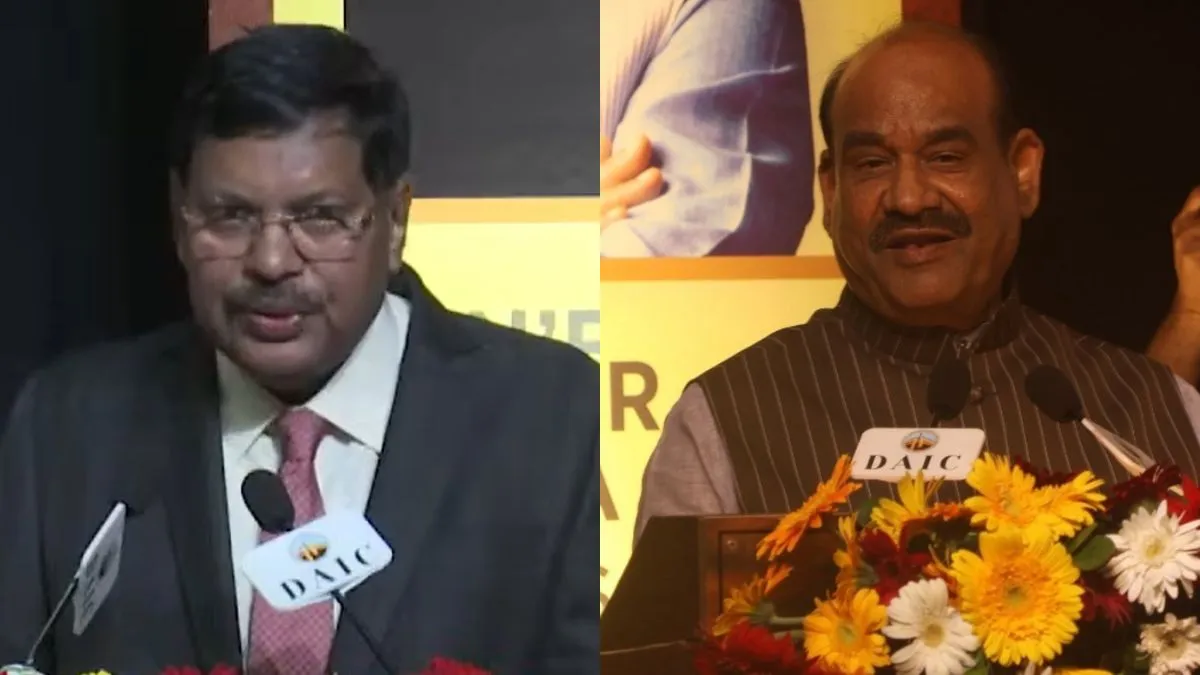
Lok Sabha Speaker Om Birla on Wednesday said 75 years after Independence, a significant need remains to reform the institutions to remove legal and executive hurdles and ensure swift justice and dignity for all. He also emphasised the urgent need for public discourse and dialogue among various stakeholders to uphold the primacy of human dignity through timely justice.
Birla highlights legal obstacles that delay justice
While addressing the LM Singhvi Memorial Lecture in the presence of Chief Justice of India (CJI) BR Gavai, the Lok Sabha Speaker acknowledged that numerous obstacles within the legal and administrative systems continue to delay justice.
He also called upon citizens and thinkers to reflect upon the crucial question of ensuring prompt and fair justice for all. Moreover, Om Birla highlighted that the framers of the Constitution, led by BR Ambedkar, deeply embedded the principles of humanity, equality, justice, socio-economic rights and freedoms within the Constitution.
Birla stresses importance of judiciary to ensure speedy justice
He pointed out that special emphasis was placed on human dignity in both the constitutional articles and the Constituent Assembly debates and stressed the importance of the judiciary, executive and legislature working collaboratively to enhance their functioning and ensure speedy justice for all.
During the event, CJI Gavai traced the evolution of human dignity in the Indian constitutional law, calling it the “pervasive principle that underlies the very spirit of the Constitution”.
Supreme Court consistently interprets dignity as a core value: Gavai
CJI Gavai further explained how the Supreme Court has consistently interpreted dignity as a core value, expanding the scope of fundamental rights, particularly the right to life under Article 21.
The CJI referred to two of his recent judgments — 2024 ruling that laid down guidelines against illegal demolition of homes, noting that “having a house or a roof over one’s head gives a sense of dignity”, and the judgment from last month which termed the practice of hand-pulled rickshaws “inhuman” and directed the state to create a rehabilitation scheme for the pullers.
