
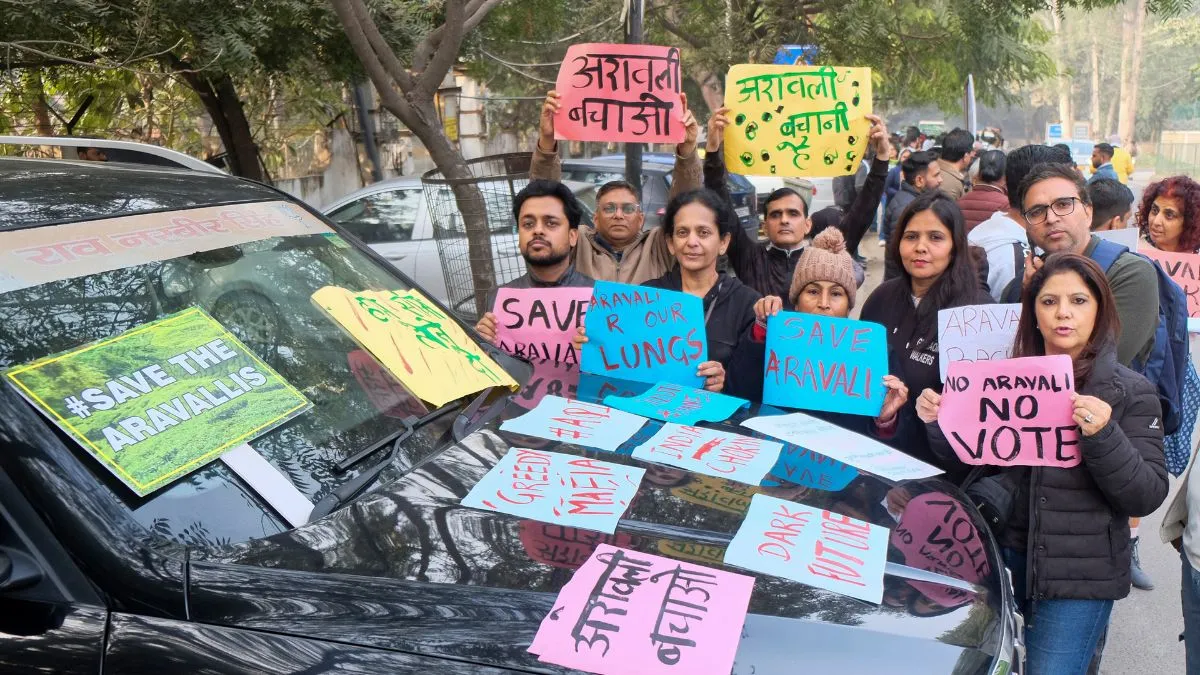
The central government has rejected reports that claimed the definition of the Aravalli hills has been changed to allow mining and said that a Supreme Court order has placed a freeze on new mining leases in the region unless a comprehensive management plan if finalised. In a statement issued on Sunday, it said the apex court has directed uniform criteria to safeguard the Aravallis as uncontrolled mining can pose a "great threat to the ecology" of the country.
In May last year, the Supreme Court had also constituted a committee to recommend a "uniform definition" for the Aravalli hills because of the different criteria followed by different states, the government said. The committee was chaired by the Environment Ministry secretary and included representatives of state governments of Delhi, Rajasthan, Haryana and Gujarat.
The government said the committee proposed several improvements over the definition. It said the Aravalli hills should marked on survey of India maps before any mining activity is considered. Additionally, there should clear identification of core or inviolate areas where mining is strictly prohibited.
"A clear, objective, and scientifically robust criterion for determining local relief, enabling uniform application across all States and ensuring full protection of the entire hill landform up to its base," it said. "The Committee recommended that hills within 500 metres of each other constitute a range and must be protected accordingly."
"Detailed guidance for enabling sustainable mining and effective measures to prevent illegal mining," the government added.
The government said district-level analysis across Rajasthan, Haryana and Gujarat shows that legally approved mining currently covers only a very small fraction of the Aravalli region, amounting to about 0.19 per cent of the total geographical area of 37 Aravalli districts. Delhi, which has five Aravalli districts, does not permit any mining.
The government said the primary threat to the Aravallis remains illegal and unregulated mining, and the committee has recommended stronger monitoring, enforcement and use of technology such as drones and surveillance to address this issue.
