
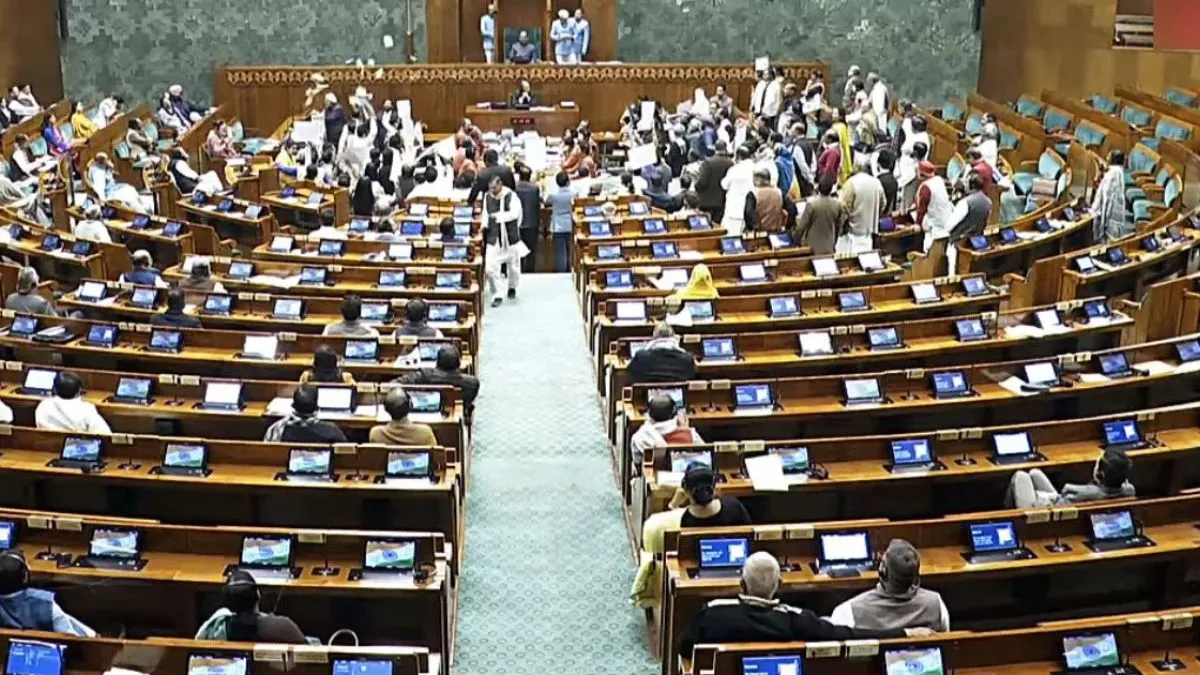
An all-party meeting was held on Tuesday to discuss how Parliament can function smoothly during the upcoming Budget Session. The meeting was chaired by Defence Minister Rajnath Singh and attended by leaders from across political parties.
Union Parliamentary Affairs Minister Kiren Rijiju, senior BJP leaders, and several opposition representatives took part. Congress leader Jairam Ramesh was among the opposition leaders present.
Key dates of the Budget Session
The Budget Session will begin on Wednesday with President Droupadi Murmu’s address to a joint sitting of the Lok Sabha and the Rajya Sabha. The Economic Survey will be tabled on January 29, while the Union Budget will be presented on February 1, which falls on a Sunday. This will be Finance Minister Nirmala Sitharaman’s ninth consecutive Budget.
The first phase of the session will continue till February 13, during which the Motion of Thanks on the President’s address will be debated and passed, along with discussions on the Budget. Parliament will reconvene on March 9 after a break, and the session will conclude on April 2.
Congress flags lack of transparency
The Congress criticised the Centre for not sharing its proposed legislative agenda ahead of the session. Speaking after the meeting, Congress leader K Suresh said opposition parties were unhappy that no list of Bills to be introduced was shared.
He added that ministers said the agenda would be circulated later, but the Congress found this explanation unsatisfactory and accused the government of lacking transparency.
After the meeting, Kiren Rijiju made it clear that the government will not withdraw the newly introduced VB–GRAM–G law, which seeks to replace MGNREGA. “Once a law is placed before the nation, we cannot reverse gear,” Rijiju said, stressing that Parliament must move forward rather than go back on legislation already introduced.
Rijiju said the government’s main priority during the session would be budget-related work. He urged all parties to cooperate and ensure smooth functioning of Parliament. While responding to opposition demands for discussions on multiple issues, including new UGC guidelines, he said the government was open to debate but reminded parties of their constitutional responsibility to pass the Budget.
Trinamool Congress MP Sagarika Ghose said her party strongly demanded a discussion on the Special Intensive Revision (SIR) process in West Bengal. She alleged that the exercise lacked transparency and claimed that serious discrepancies had affected around 1.5 crore people. She also raised concerns over reported deaths linked to the process.
Ghose further accused the Centre of unfairly withholding funds meant for opposition-ruled states and alleged misuse of central agencies in poll-bound states. IUML MP ET Mohammed Basheer said Parliament had become a “mockery” and stressed that issues like SIR must be discussed seriously.
BJD MP Sasmit Patra said his party would raise concerns related to farmers’ distress, law and order in Odisha, youth unemployment, and limited job opportunities under the new GRAM–G law.
VB–GRAM–G bill at the centre of debate
The opposition’s remarks come amid criticism of the government’s move to repeal MGNREGA and replace it with the Viksit Bharat Guarantee for Rozgar and Ajeevika Mission (Gramin) or VB–GRAM–G Bill, 2025. The proposed law aims to increase guaranteed rural employment from 100 to 125 days and align rural development programmes with the government’s Viksit Bharat 2047 vision.
