
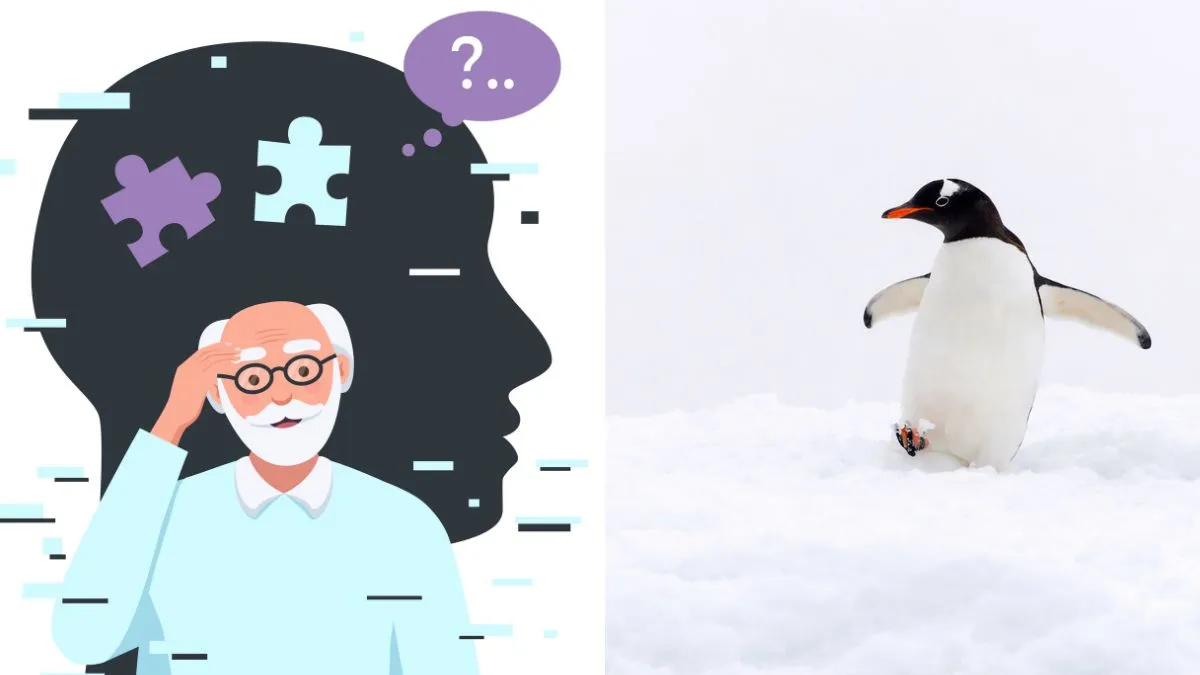
A short clip from a 2007 documentary by Werner Herzog recently resurfaced online, leaving viewers intrigued. In it, an Adelie penguin abruptly breaks away from its group for no particular reason. While the rest head towards the ocean in search of food, this lone penguin turns inland, walking steadily towards distant mountains, nearly 70 kilometres away, where survival is impossible.
Herzog described the moment as mysterious, even existential. But according to Dr Rahul Chawla, an AIIMS-trained neurologist, the behaviour may feel far less abstract and painfully familiar. “It closely mirrors what we see in people with Alzheimer’s disease,” he explains.
When the brain’s navigation system fails
In a recent Instagram reel, Dr Chawla broke down what the penguin’s behaviour might symbolise from a neurological perspective. The key lies in something called visuo-spatial dysfunction.
“Inside our brain, there is a navigation system,” he explains. “It tells us where we are, who our people are, and how to find our way back home.” This system relies on complex networks involving the hippocampus and surrounding brain regions. In Alzheimer’s disease, these areas are among the earliest to deteriorate.
“As Alzheimer’s progresses, it’s not just recent memory that is lost,” Dr Chawla says. “The brain’s internal GPS also becomes impaired.”
Why does home stop feeling like home
This neurological breakdown has devastating consequences. Familiar places begin to feel unfamiliar. Faces that once brought comfort no longer register as known. Even one’s own house can start feeling strange. “When patients leave their homes, it’s not because they want to escape or because they’re depressed,” Dr Chawla clarifies. “They leave because home no longer feels like home.”
This phenomenon is often referred to as wandering, a common but deeply misunderstood symptom of Alzheimer’s disease. Out of anxiety and confusion, patients step outside, not with the awareness that they are “leaving”, but driven by a vague urge to find something that feels familiar.
“They don’t recognise that they’re going somewhere else,” he explains. “And they don’t remember how to come back.”
Searching for something that feels right
What guides them, if not logic or memory? “In their minds,” Dr Chawla says, “there are only faint, old memories, fragments of familiarity they are trying to reach.” It’s not a conscious decision. It’s not rebellion. It’s not emotional withdrawal. It’s the brain grasping for safety using outdated internal maps.
Rethinking the penguin and our assumptions
Dr Chawla offers a reframing of Herzog’s penguin that is both unsettling and compassionate. “Perhaps that penguin wasn’t having an existential crisis,” he says. “Perhaps its own group had started feeling unfamiliar to it as well.” Just as in Alzheimer’s, the drive wasn’t to leave, it was to recognise.
The larger message for caregivers and society
Wandering behaviour in Alzheimer’s patients is often met with frustration, fear, or even blame. Families may assume the person is unhappy, restless, or intentionally leaving. “The truth is far gentler and far sadder,” Dr Chawla says. “They are not running away from their lives. They are searching for something that feels safe.” Understanding this changes how we respond, from restraint to reassurance, from correction to compassion.
The viral penguin clip resonates because it taps into a deep human fear: losing our sense of belonging. But for people with Alzheimer’s, this loss isn’t symbolic; it’s neurological.
“They don’t leave because they are troubled,” Dr Chawla emphasises. “They leave because familiarity itself begins to disappear.” And in that disappearance, both penguins and people walk, not away from home, but towards a memory of it.
Disclaimer: Tips and suggestions mentioned in the article are for general information purposes only and should not be construed as professional medical advice. Always consult your doctor or a dietician before starting any fitness programme or making any changes to your diet.
Also read: Why emotional outbursts are part of ADHD, a neurologist explains
