WATCH: China's maglev train hits 700 kmph speed in just 2 seconds, creates world record
The train floats above the track using superconducting magnets, which both lift the vehicle and propel it forward without any physical contact with the rails.
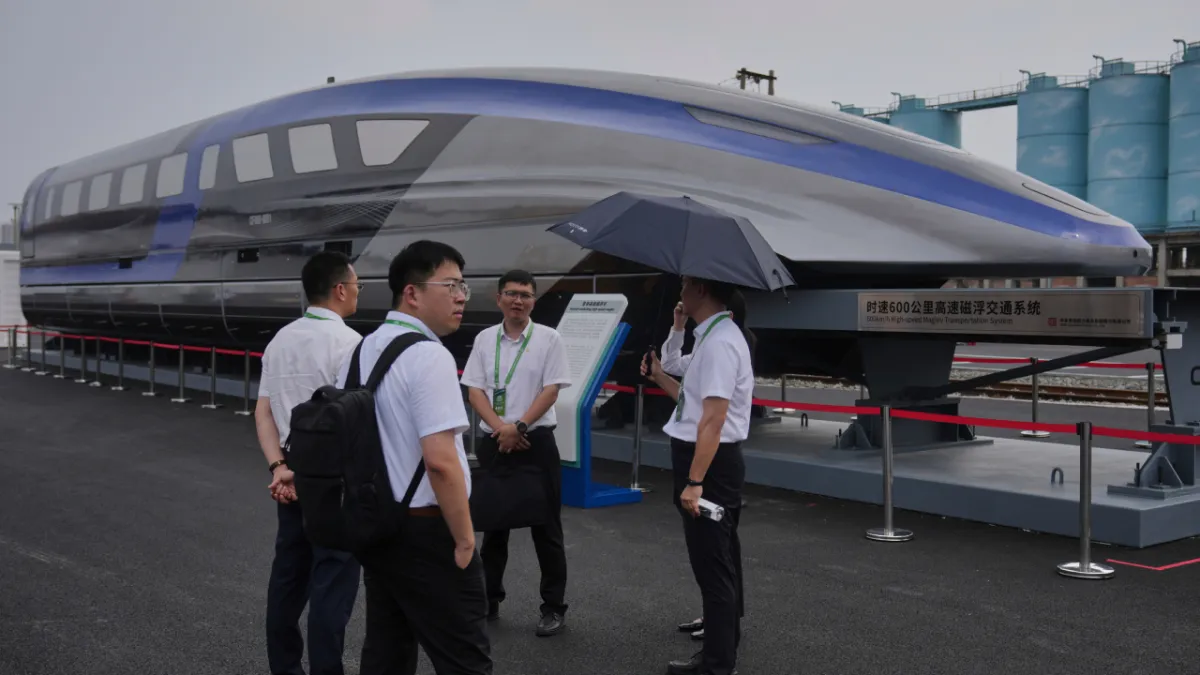
China has set a new world record by testing its fastest maglev train, which reached a speed of 700 km per hour in just 2 seconds, moving so quickly that it is almost impossible to track with the naked eye.
The test was conducted by researchers at China’s National University of Defence Technology, who accelerated a magnetic levitation vehicle weighing about 1,000 kg to the record speed. The experiment took place on a 400 metre maglev track, where the train was also brought safely to a stop after the run, making it the fastest superconducting electric maglev train ever tested.
A video of the trial shows the train shooting past like a flash of silver, leaving behind a faint misty trail and resembling a scene from a sic-fi film. The train floats above the track using superconducting magnets, which both lift the vehicle and propel it forward without any physical contact with the rails.
The acceleration achieved during the test is so powerful that it could even be used to launch rockets. At such speeds, maglev systems could connect distant cities in a matter of minutes.
The breakthrough also highlights the potential of future transport concepts such as the hyperloop, in which vehicles travel through vacuum sealed tubes at extremely high speeds.
“It resolves core technical challenges including ultra high speed electromagnetic propulsion, electric suspension guidance, transient high power energy storage inversion, and high field superconducting magnets,” the South China Morning Post reported.
Researchers said the electromagnetic acceleration technology used in the test could also be applied in the space and aviation sectors. Rockets and aircraft could use similar systems for faster and smoother take offs, while reducing fuel consumption and overall costs.
How maglev technology works in trains
Maglev trains do not run on conventional rails. Instead, they float above a guideway using powerful magnets. Because there is no physical contact between the train and the track, friction is almost eliminated. This allows trains to travel at very high speeds with less noise and wear. Electromagnets installed on the train and the guideway repel or attract each other. This lifts the train a few centimetres above the track, removing wheel rail contact.
Additional magnets keep the train stable and centred on the guideway, preventing side to side movement even at high speeds. The train is pushed forward using a linear motor. Instead of a rotating engine, electric currents are switched on and off in the guideway magnets, creating a moving magnetic field that pulls the train forward and pushes it from behind.
China mainly uses two types of maglev systems.
Electromagnetic suspension: The train wraps around the guideway and is pulled upward by electromagnets. Sensors continuously adjust the magnetic force to maintain a stable gap.
Electrodynamic suspension: Used mainly in experimental systems, this relies on repulsive forces created by superconducting magnets and requires very high speeds to achieve stable levitation.
China operates the Shanghai maglev, which connects the city to Pudong International Airport. It reaches speeds of about 430 km per hour, making it one of the fastest commercial trains in the world. China has also tested new high speed maglev prototypes capable of speeds up to 600 km per hour.
Also read: Indian Railways beats China, Japan in this key sector - Check full details here