- News
- Technology
- How three scientists awarded Nobel Prize in Physics reacted to the announcement
How three scientists awarded Nobel Prize in Physics reacted to the announcement
Conducted in the mid-1980s, their research demonstrated that quantum mechanics can have practical applications on a human scale. The official award ceremony will be held on December 10.
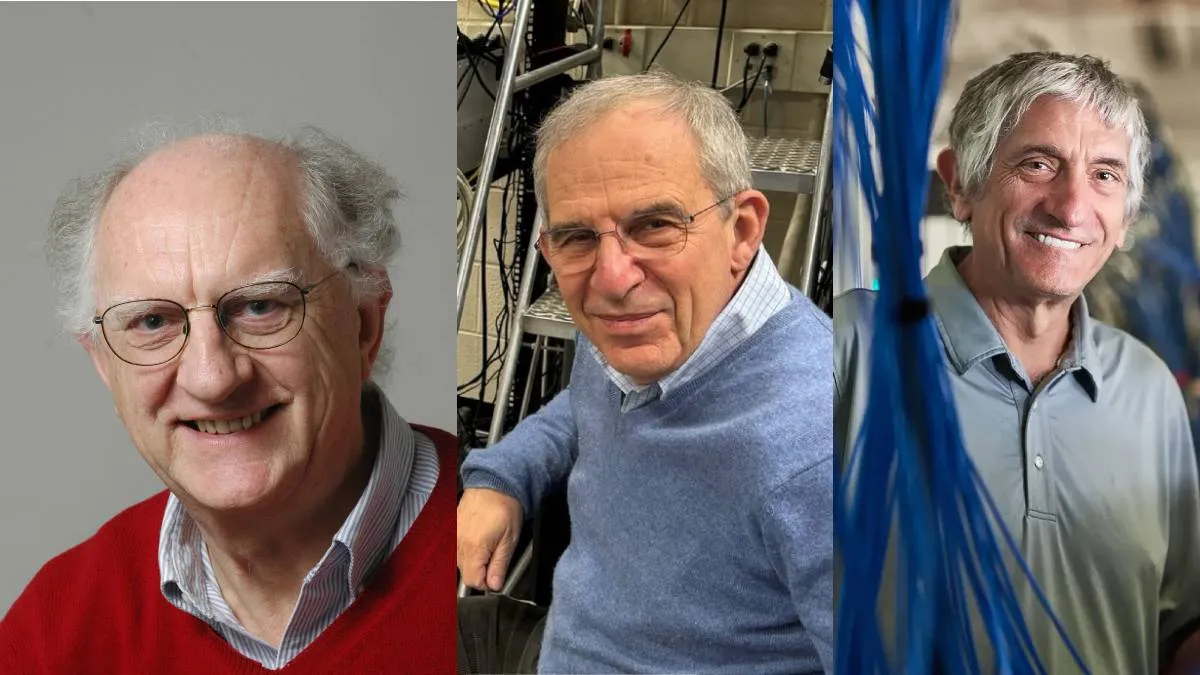
John Clarke, Michel H. Devoret, and John M. Martinis won the Nobel Prize in Physics on Tuesday for their research into the strange world of subatomic quantum tunneling, work that significantly advances the power of everyday digital communications and computing.
Speaking from his cellphone, winner Clarke, 83, noted that quantum mechanics research is already integral to modern communications. “One of the underlying reasons that cellphones work is because of all this work," he said.
Clarke conducted his research at the University of California, Berkeley; Martinis, 67, at the University of California, Santa Barbara; and Devoret, 72, is affiliated with Yale and the University of California, Santa Barbara. Clarke, who spearheaded the research team, told The Associated Press he was "pleased to receive this prize" alongside his two colleagues.
How the winners reacted
Martinis' wife, Jean, told Associated Press reporters who called his home about two-and-a-half hours after the announcement that he was still asleep and unaware of the win. She mentioned that while they had stayed up for the physics award announcement in the past, they had eventually decided that sleep was more important. AP reporters were later able to speak with Martinis after his wife decided it was late enough to wake him. Devoret could not immediately be contacted.
Clarke told the AP he was stunned and overwhelmed to hear the news. His daughter called him early in the morning to congratulate him, and he found hundreds of emails in his inbox. "It had never occurred to me, ever, that I would win the Nobel Prize," Clarke said. "To put it mildly, it was the surprise of my life".
The significance of the quantum research
The prize-winning research, conducted in the mid-1980s, took the subatomic "weirdness of quantum mechanics" and demonstrated how those tiny interactions can have real-world applications on a human scale, explained Jonathan Bagger, CEO of the American Physical Society. Their work has the potential to supercharge computing and communications.
The 100-year-old field of quantum mechanics deals with the seemingly impossible subatomic world where switches can be both on-and-off at the same time, and parts of atoms can "tunnel" through seemingly impenetrable barriers.
What the three physicists did "is taking the scale of something that we can't see, we can't touch, we can't feel and bringing it up to the scale of something recognisable and making it something you can build upon,” said Richard Fitzgerald, editor-in-chief of Physics Today, who worked in the field during the 1990s.
The work is a crucial building block in the fast-developing world of quantum technology. Mark Pearce, a professor of astrophysics and Nobel Physics Committee member, told the AP that one "very obvious use" is quantum computers. He added that the work also applies to "quantum sensors, so to be able to make very sensitive measurements of, for example, magnetic fields, and perhaps also for cryptography".
While fully realised quantum computing would be a huge leap from current technology, Clarke acknowledged, the research "in some ways is the basis of quantum computing. Exactly at this moment where this fits in is not entirely clear to me".
Both Bagger and Fitzgerald suggest it's a stretch to say everyday cellphones now use the specific breakthrough made by Clarke and his colleagues. However, ultra-sensitive measuring devices do rely on that team's work. Bagger noted that while we could have magnetic resonance imaging (MRIs) without their research, it makes the technology far more sensitive and useful.
“It is wonderful to be able to celebrate the way that century-old quantum mechanics continually offers new surprises. It is also enormously useful, as quantum mechanics is the foundation of all digital technology,” said Olle Eriksson, Chair of the Nobel Committee for Physics.
The 2025 Nobel announcements
This year marks the 119th time the Physics prize has been awarded. Last year, artificial intelligence pioneers John Hopfield and Geoffrey Hinton won the physics prize.
The prize announcements continue this week:
- Monday: Mary E. Brunkow, Fred Ramsdell, and Dr. Shimon Sakaguchi won the Nobel Prize in Medicine.
- Wednesday: Chemistry Prize.
- Thursday: Literature Prize.
- Friday: Nobel Peace Prize.
- October 13: Nobel Memorial Prize in Economic Sciences.
The awards carry priceless prestige and a cash prize of 11 million Swedish kronor (nearly $1.2 million). The official ceremony will be held on December 10, the anniversary of the 1896 death of Alfred Nobel.
ALSO READ: UPI payments are now possible using wearable smart glasses without needing PIN: Here's how