- News
- Technology
- National Post Day: How can you decode the bar code of postal services? Explained
National Post Day: How can you decode the bar code of postal services? Explained
India celebrates National Post Day on October 10. If you have ever sent a document or merchandise through India Post, you may have noticed the barcode on your receipt. Here is how you can decode the hidden information.
National Post Day is observed annually on October 10, serving as an extension of World Post Day on October 9. This day honors the vital role played by all employees of India Post in keeping the nation connected.
Despite the rise of smartphones and the internet, the importance of India Post remains strong. With an expansive network of 1,64,999 post offices, it retains its role as a crucial communications link. Even at places where mobile networks cannot reach, people can reliably connect with others through postal services.
The Indian postal service, the most widely distributed postal system globally, was established by the British and officially founded in 1854 by Lord Dalhousie. It currently operates under the Ministry of Communications.
Decoding the bar code of India Post
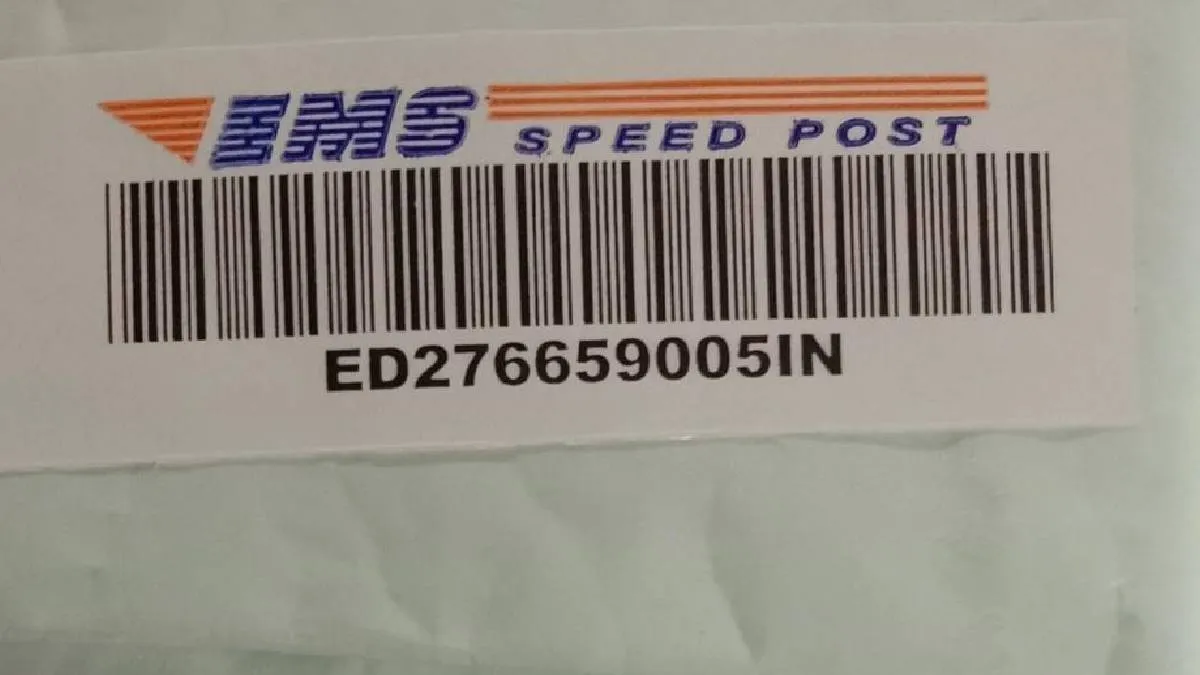
If you've ever sent a package or document via India Post, you may have noticed a barcode and a unique tracking number. This system allows the department to identify the origin, service type, and destination of the article. While the black and white barcode lines require a scanner to read, you can easily decode key information from the accompanying 13-digit alphanumeric "consignment number" which is regulated by Universal Postal Union (UPU). The UPU is the specialised agency of the United Nations responsible for regulating the universal postal service. The postal systems of its 192 member countries collectively form the world's largest physical distribution network.
Express Mail Service (EMS)
EMS (Express Mail Service) is a global brand for the postal product designed for the fastest delivery. Posts in approximately 200 countries and territories worldwide offer this premium, end-to-end service for both documents and merchandise.
The UPU Tracking Standard (S10)
To meet the requirement for unique identification, the UPU developed a 13-character postal item identifier. This system, defined by the UPU S10 standard, ensures that a single authority in each member country controls the allocation of unique identifiers for tracking specific categories of mail.
The consignment number structure
The consignment number for most common India Post services follows a 13-character pattern: AA00000000#IN
- AA: Two letters indicating the service type and the postal circle (state) of origin.
- 00000000: Eight digit unique, computer-generated digits assigned to your specific parcel.
- #- Single check digit which is calculated by using a formula.
- IN: Two letters representing the country of origin, India.
Decoding the first two letters (AA)
The initial letters reveal the service used and the state where the item was booked:
| First Letter (Service Type) | Description |
| E | Speed Post (Express Mail Service) |
| R | Registered Letter |
| C | Registered Parcel |
| P | Passport Letter |
| A | Speed Post booked by a bulk sender (e.g., banks) |
The second letter specifies the postal circle (state) of origin (e.g., ED means Speed Post booked in Delhi; RM means Registered Letter booked in Maharashtra).
What you can and cannot decipher
- You can: Determine the article type (like Speed Post or Registered Parcel) and the state of origin by examining the first two letters of the consignment number.
- You cannot: Manually interpret the nine unique digits. This is a computer-generated identifier that requires the official tracking tool to provide real-time location updates.
ALSO READ: Google Gemini retro AI image for girls: Top prompts to create polaroid-style portraits