- News
- Tamil Nadu
- How Vijay broke into the rigid Dravidian ideology to rise up as 'people's leader' in Tamil Nadu
How Vijay broke into the rigid Dravidian ideology to rise up as 'people's leader' in Tamil Nadu
Vijay stood out by creating a post-Dravidian political space, leveraging his fan network as a ready grassroots cadre and adopting a flexible ideological stance that attracted voters across divides.
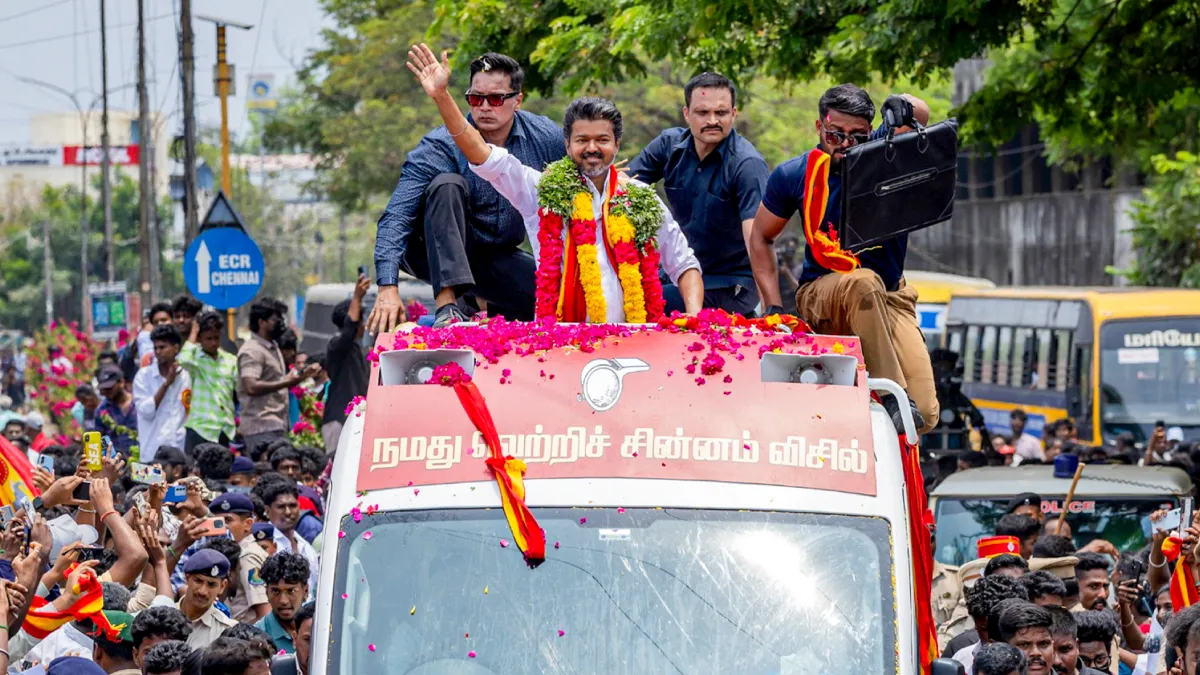
Actor-politician Vijay’s electoral debut has been marked by high drama, much like his film appearances, though it was overshadowed by the tragic stampede in Karur that claimed 41 lives on September 27, 2025.
Vijay did not rely on the traditional Dravidian parties' narratives of identity and having a stance showcasing the population as different from the heartland or the Hindi-speaking masses.
Instead, he chose to be a leader of the people, driving out votes from these parties' support base.
Among his key poll promises is the provision of 8 gm of gold for marriage, with gold priced at around Rs 14,000 per gram for 22 carat.
His party manifesto also includes assurances such as Rs 2,500 monthly assistance for women below 60 years, 8 gm gold for marriage, and 6 free cooking gas cylinders per family each year.
The 51-year-old leader of Tamilaga Vettri Kazhagam made a significant impact in his maiden electoral debut and proved that the electoral battle was a straight contest between the TVK and DMK.
How Vijay stood out in Tamil Nadu
Since 1967, every challenger (Vaiko, Vijayakanth, Kamal Haasan) has tried to be a better version of a Dravidian leader. Vijay did the opposite by creating a post-Dravidian vacuum.
Unlike Kamal Haasan, who appealed to the urban elite, or Seeman, who relied on Tamil ethno nationalism, Vijay leveraged his fan base (the Makkal Iyakkam) as a pre-built grassroots cadre. He didn't build a party; he activated a sleeping network and neutralised cine politics fatigue.
Ideological blank slate, which was considered a weakness, has turned out to be an advantage for Vijay, as by avoiding the rigid atheism of the DMK or the reactionary populism of the AIADMK, he allowed voters from both sides to migrate to him without feeling like traitors to their core identity.
For decades, the DMK and AIADMK stayed in power by convincing the electorate that they were the only barrier against Delhi’s interference, but the increasingly restless youth considered the anti-Hindi or state autonomy rhetoric as legacy software.
AIADMK’s failure stems from its struggle to find a singular charismatic face post Jayalalithaa. The rebel vote that used to go to them has found a more energetic, contemporary home in TVK.
Vijay’s digital campaigning strategy
While the DMK and AIADMK control massive TV networks, TVK’s campaign lived almost entirely on short-form video and localised WhatsApp clusters.
TVK micro-targeted first-time voters, particularly in rural pockets where traditional party flags still fly; the actual conversation shifted to mobile screens. Vijay’s team treated the election like a pan india mega movie release, creating a sense of inevitability that traditional party machinery couldn't dampen.
Also read: How MGR, NTR and Vijay formed parties and won on debut