India's space startup boom: Meet the private players collaborating with ISRO to rule the cosmos
India’s private space sector is witnessing unprecedented growth, driven by a wave of innovative startups following the success of Chandrayaan-3. On National Space Day, here's a deep dive into some of the startups that are pushing the Indian space economy to new heights.
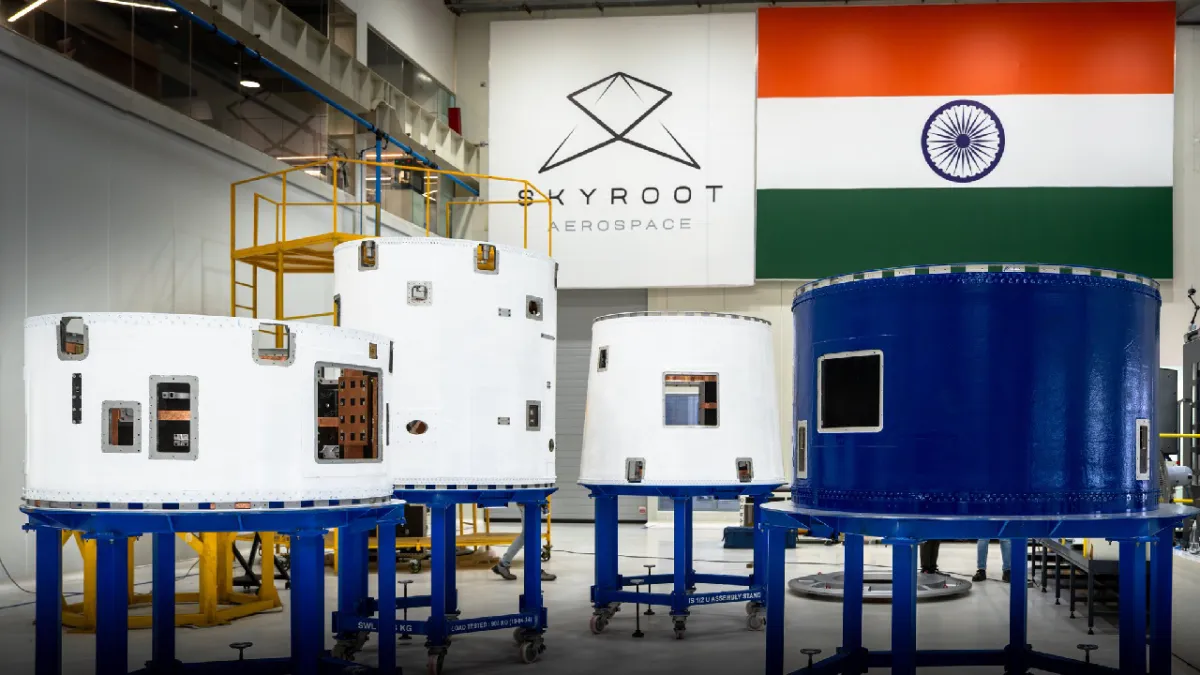
After the success of the Chandrayaan-3 mission in 2023, India has actively shifted towards a private-sector-driven space ecosystem. The government, through its Indian National Space Promotion and Authorisation Center or IN-SPACe, is promoting private companies for small satellite launches and building Earth observation constellations, aiming to boost annual space revenue to USD 44 billion by 2033.
The Union Cabinet, led by Prime Minister Narendra Modi, has approved the creation of a Rs 1,000 crore venture capital fund to boost India’s space sector.
The initiative, launched under IN-SPACe is designed to accelerate the growth of space startups, enhance the country's space economy, and reinforce India’s position as a global leader in space technology. Homegrown startups are playing a key role in boosting the Indian space economy and aiding the Indian Space Research Organisation (ISRO) in realising its future projects.
Collaborations in the Gaganyaan mission
For the Gaganyaan mission, a project to send astronauts into space using an indigenous launch vehicle, ISRO is collaborating with startups such as Agnikul Cosmos and Skyroot Aerospace for developing launch vehicles, while firms like Pixxel are working on satellite manufacturing, propulsion systems, and other space technologies that strengthen the wider private space ecosystem.
Startups fueling off India's private space sector
Skyroot Aerospace
Founded in 2018 by ex-ISRO scientists Pawan Kumar Chandana and Naga Bharath Daka, Skyroot Aerospace aims to democratise space through frequent, affordable satellite launches. In November 2022, Skyroot made history with Vikram-S, India's first private suborbital rocket, reaching space in the Prarambh mission.
In August 2025, the Hyderabad-based startup successfully test-fired the Kalam-1200 first-stage solid booster, India's largest privately-developed rocket stage, and is now preparing for the Vikram-1 orbital launch slated for later this year.
Vikram-1, India’s first privately developed orbital launch vehicle, is named in honour of Dr Vikram Sarabhai, the father of the country’s space programme. The three-stage rocket incorporates advanced propulsion systems designed by Skyroot, featuring state-of-the-art avionics and launch control technologies.
Infrastructure and partnerships
Skyroot unveiled an integrated private rocket facility in Hyderabad, a 60,000 sq ft "MAX-Q" campus, for design, manufacturing, and testing. It was also the first Indian startup to sign an MoU with ISRO, granting access to its facilities and expertise.
The startup has raised a total of USD 95 million, including a substantial USD 27.5 million pre-Series C round led by Temasek in 2023, the largest for an Indian space-tech firm. In June 2025, Skyroot partnered with Axiom Space to jointly expand global access to low-Earth orbit—underscoring growing international recognition.
Agnikul Cosmos
Founded in 2017 by a team from IIT Madras, Agnikul Cosmos is developing Agnibaan, a small-lift, customizable orbital launch vehicle based on 3D-printed semi-cryogenic engines. On 30 May 2024, Agnikul successfully launched Agnibaan SOrTeD, a suborbital technological demonstrator, marking the world’s first flight of a single-piece 3D-printed engine and India’s first from a private launch pad.
It holds patents for this 3D-printed engine, developed at its facilities in IIT Madras Research Park. As of 2023, the company had raised USD 40 million, including a notable Series B USD 26.7 million round.
Strategic move
In 2025, Agnikul announced a Rs 121 crore investment to build a rocket manufacturing and testing facility in Tuticorin, Tamil Nadu, generating 525 jobs and strengthening India's space tech corridor near the upcoming ISRO spaceport.
Pixxel
Pixxel was founded in 2019 by Awais Ahmed and Kshitij Khandelwa, alumni of BITS Pilani. The company is building a constellation of hyperspectral Earth-imaging satellites to monitor invisible surface threats, ideal for agriculture, environment, mining, and infrastructure. In January, it launched three of its six hyperspectral imaging satellites as part of its Firefly Constellation project.
Pixxel achieved significant funding milestones over the years. It raised USD 8 million in seed funding in 2020, followed by USD 27 million in Series A funding in 2022, which was the largest funding round for an Indian space company at the time. The company later secured USD 60 million in Series B funding, including a USD 24 million extension, positioning Pixxel among the highest-funded space-tech startups in India.
Key projects with Indian government
The Bengaluru-based startup is developing and deploying hyperspectral satellites to monitor the planet's health and has received an iDEX Spark grant to design payloads for the Indian Air Force. This collaboration underscores India's focus on advancing AatmaNirbhar Bharat (self-reliant India) in space technology through strong public-private partnerships.