Mini-Neptunes likely have hard surfaces, not magma oceans: James Webb telescope reveals
A new study using data from NASA’s James Webb Space Telescope (JWST) has overturned long-held beliefs about mini-Neptune exoplanets. Earlier, scientists assumed these planets—smaller than Neptune but wrapped in thick hydrogen-helium atmospheres—were covered in global magma oceans.
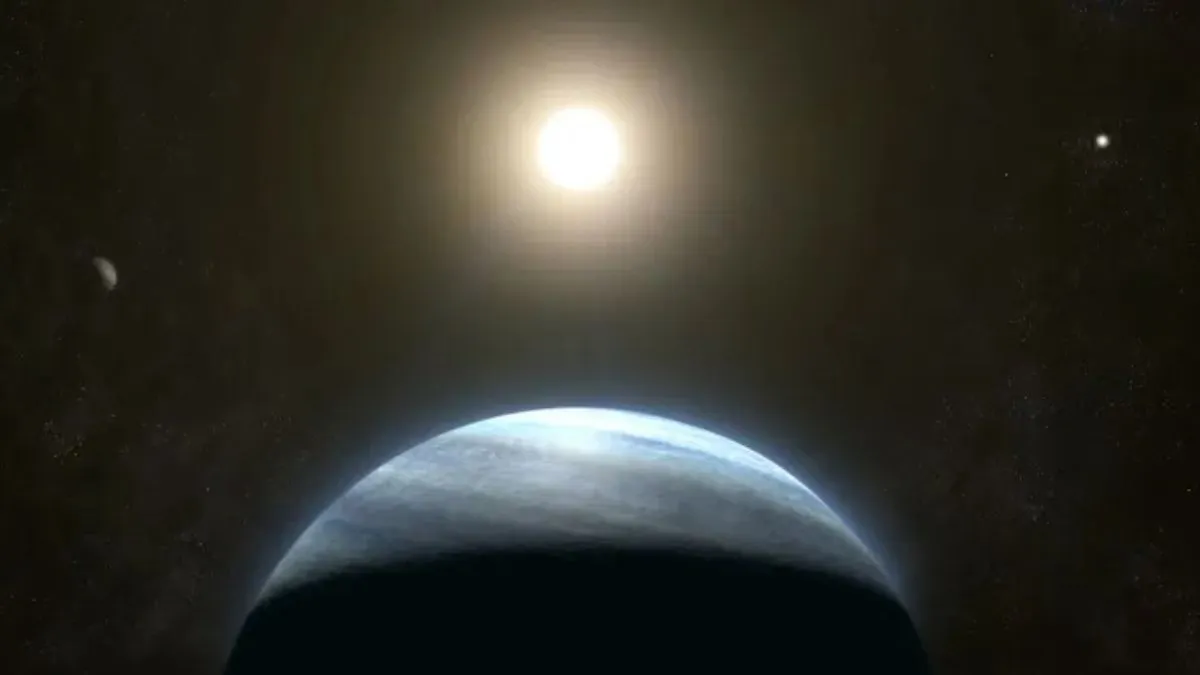
The mini-Neptunes are planets with a radius less than that of Neptune yet larger than Earth, owing to their dense hydrogen-helium atmospheres. They are believed to be the most abundant kind of planet based on the exoplanet discoveries by NASA missions.
Because of the intense heat and thick layers of gas, the prediction by astronomers long has been that their rocky crusts would melt into global oceans of magma. Thus, these worlds were thought to be the fiery, molten “lava planets”.
But new Webb data tells a very different story.
JWST data suggests solid surfaces, not magma oceans
Using the James Webb Space Telescope, in a study published today, researchers investigated the atmospheric composition of one such mini-Neptune. But instead of detecting only light gases, the telescope found heavier molecules in the upper atmosphere—a sign that the atmosphere may be far thicker and far more pressurised than thought.
What the new models suggest:
- High atmospheres create enormous surface pressure.
- Pressure high enough to force molten rock into its solid form.
- The crust would behave like carbon turning into diamond under the pressure.
- These planets likely have solid rock "floors" rather than oceans of lava.
- It overturned earlier assumptions that all mini-Neptunes necessarily had to be magma-covered.
Theories of planet formation got clarity
Mini-Neptunes are incredibly common in the galaxy. If many of them have solid surfaces, it could challenge several models of planetary formation.
Why this discovery matters:
- This discovery helps to challenge the thought that other solar systems would resemble our own.
- It helps scientists to better understand how rocky versus molten planets evolve.
- It provides clues about how Earth-like planets could emerge.
- It could change where astronomers search for potentially habitable worlds.
Another important point is the determination of whether planets are solid or molten, which will help in interpreting their surface chemistry, atmosphere behaviour, and internal structure.
By explaining what lies beneath the thick cloud layers of a mini-Neptune, for the first time, scientists could make more specific categorisations of exoplanets and narrow their search for Earth-like planets.
The JWST study further showcases how next-generation telescopes rewrite cosmic theories once considered settled.