ISRO's Aditya-L1 finds how solar storm impact on Earth’s magnetic field
How do solar storms impact Earth? ISRO's Aditya-L1 mission finds major breakthroughs in space weather, from magnetic field compression to atmospheric heating.
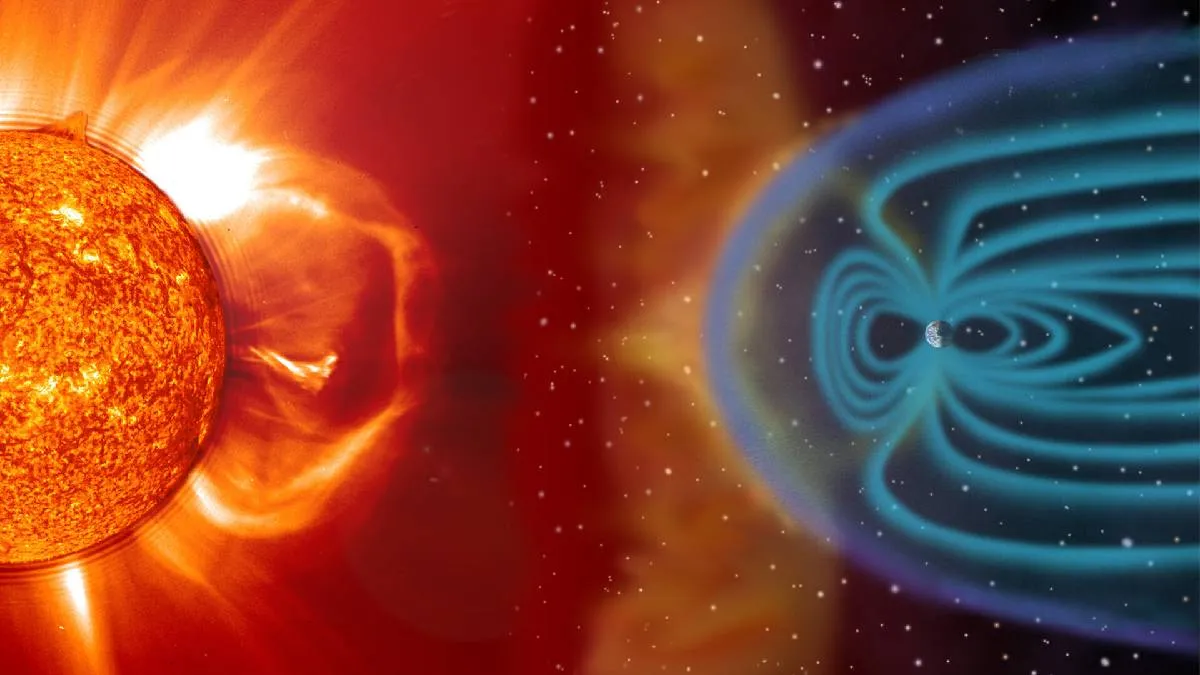
ISRO announced on Saturday that its Aditya-L1 solar mission has yielded new insights into how powerful solar storms impact Earth’s magnetic shield. "The most severe effects occurred during the impact of the turbulent region of the solar storm,” the space agency said in a statement.
In a breakthrough study published in the Astrophysical Journal in December 2025, ISRO scientists and research students analysed a major space weather event that struck Earth in October 2024. The study utilised observations from Aditya-L1, India’s first dedicated solar observatory, alongside data from international space missions to decode the impact of a massive solar plasma eruption.
“Space weather refers to conditions in space caused by transient activity on the Sun, such as solar plasma eruptions, which can affect satellites, communication and navigation services, and power grid infrastructure on Earth,” the statement explained.
What ISRO found
According to ISRO, the turbulent region of the solar storm “strongly compressed Earth’s magnetic field, pushing it unusually close to the Earth and briefly exposing some satellites in geostationary orbit to harsh space conditions.” The agency noted that this rare phenomenon occurs only during the most severe space weather events.
The study further revealed that during this turbulent phase, currents in the auroral regions (high latitudes) became super-intensified. This process can significantly heat the upper atmosphere, potentially leading to enhanced atmospheric escape.
ISRO stated that these findings reinforce the necessity for the continuous monitoring of solar activity. The study highlights the critical importance of understanding space weather phenomena and performing real-time assessments to safeguard vital space assets.
ISRO upcoming launch
ISRO is set to launch the PSLV-C62 mission on January 12, carrying the EOS-N1 satellite into a polar sun-synchronous orbit.
The 25-hour countdown commenced on January 11, for what will be the 64th flight of the Polar Satellite Launch Vehicle (PSLV). To date, the PSLV has successfully completed 63 missions, including India’s landmark projects such as Chandrayaan-1, the Mars Orbiter Mission (MOM), and the Aditya-L1 solar observatory.
For this mission, the primary payload, an Earth observation satellite co-developed by Thailand and the United Kingdom, will fly alongside several co-passenger satellites. The entire payload is scheduled to be deployed into its intended orbit approximately 17 minutes after liftoff.