ISRO successfully completes static test for improved SSLV third stage
The SSLV is an ISRO-designed, three-stage solid launch vehicle optimised for industrial mass production. It is specifically engineered to provide "launch-on-demand" capabilities with rapid turnaround times between flights.
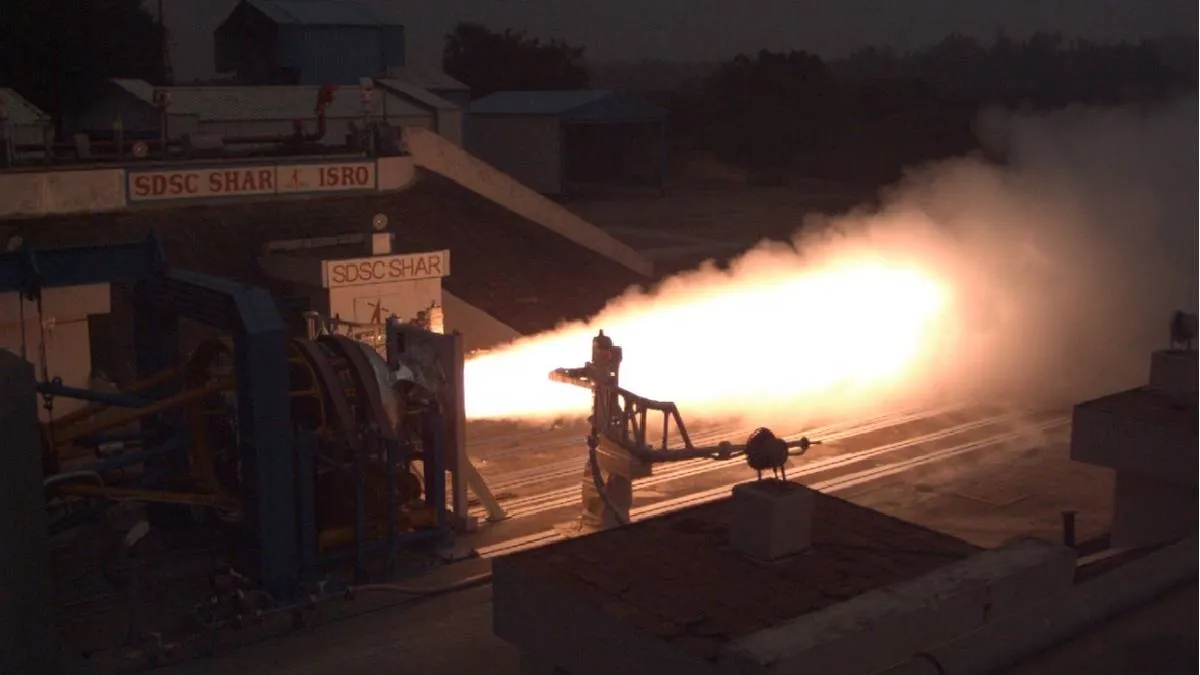
The Indian Space Research Organisation (ISRO) has successfully conducted a static test of an enhanced third stage for the Small Satellite Launch Vehicle (SSLV). The test took place on Tuesday at the Solid Motor Static Test Facility within the Satish Dhawan Space Centre (SDSC) in Sriharikota, Andhra Pradesh.
The SSLV is a three-stage, all-solid launch vehicle designed by ISRO to be compatible with large-scale industrial production. According to an official statement, the vehicle is built to meet "launch-on-demand" requirements with a rapid turnaround time between missions.
Regarding the technical specifics of this stage, ISRO stated:
"The upper stage or third stage solid motor delivers as high as 4 km/s velocity to the launch vehicle and employs a monolithic composite motor case and a free-standing nozzle divergent to limit the stage inert mass".
Technical enhancements and performance gains
The space agency confirmed that this static test validated an upgraded version of the SS3 (Stage 3) motor. By utilising a carbon-epoxy motor case, ISRO has significantly reduced the stage's overall mass. This optimisation directly improves the SSLV’s payload capacity by 90 kg.
In detailing the system's robustness, ISRO explained:
"The stage also features an improved design for the igniter and nozzle system, making the system more efficient and robust. The nozzle control is implemented through a fault-tolerant electro-mechanical actuation system with low-power control electronics".
The high-strength, carbon filament-wound motor case was developed at the Vikram Sarabhai Space Centre (VSSC) Composites Entity, while the solid motor itself was cast at SDSC’s production facilities.
Successful test results
Initial data suggests the test was a complete success.
"All the measured parameters are observed close to predictions over the test duration of 108 seconds. With this successful static firing test, the improved version of the SS3 motor is qualified for induction in flight," the statement read.
Expanding India's space infrastructure
Throughout 2025, several new facilities have been commissioned across India to boost the production capacity of solid motors for the national space program:
- July 2025: New Solid Motor production facilities were inaugurated at Sriharikota to augment existing capacity.
- September 2025: A second production line for Ammonium Perchlorate (a critical solid propellant ingredient) was commissioned at the Alwaye plant, effectively doubling its output.
- Propellant Mixing: An indigenous 10-tonne vertical mixer, the world’s largest solid propellant mixing equipment, was commissioned at SDSC this year.
Furthermore, the Solid Motor Production and Static Testing (SMPST) facilities at SDSC recently completed the realisation and static testing of a solid motor intended for the first orbital launch by a private Indian space start-up.
ALSO READ: Suspected ISRO rocket debris discovered on Sri Lankan coast | See pics