CERN detects first matter-antimatter imbalance in Baryons, clue to universe's existence
This discovery has the potential to provide valuable insights into why matter is more prevalent than antimatter in the universe.
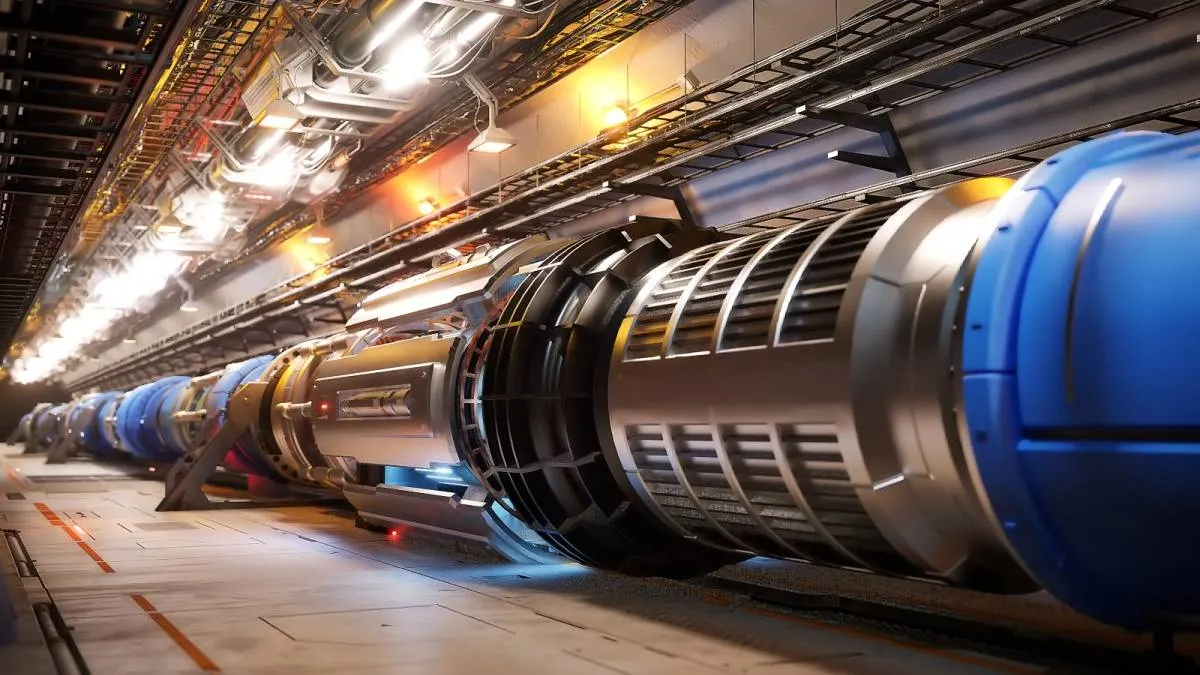
Physicists at CERN have reported significant findings regarding the imbalance between matter and antimatter in a subatomic particle known as a baryon. This discovery may offer insights into the predominance of matter in the universe. According to the research, antiparticles, which are particles of antimatter, have the same mass as baryons but possess an opposite charge. It has been theorised that equal amounts of matter and antimatter should have emerged following the Big Bang. However, studies indicate a notable discrepancy, with matter prevailing over antimatter. Understanding this preference for matter is considered a significant challenge in contemporary physics.
Charge-parity (CP) violation
The Standard Model of particle physics, which is currently regarded as the leading framework for explicating the fundamental properties of matter, indicates that matter and antimatter behave differently. This model posits that swapping a particle with its antiparticle while mirroring its position in space would result in a violation of physical laws, a phenomenon known as charge-parity (CP) violation.
While CP violation had previously been observed in mesons—subatomic particles that lie between electrons and protons—recent research from the Large Hadron Collider beauty (LHCb) Collaboration at CERN marked the first instance of such a violation being detected in baryons, which include protons and neutrons. The findings highlighted that CP violation occurred in a baryon that decayed into a proton and mesons.
The researchers behind the study highlighted some interesting differences between baryons and their counterparts, antibaryons. They stressed that understanding these differences is important because baryons are a big part of what we know about the universe. This finding could open up new possibilities for exploring physics beyond what we currently understand.
Data from collisions of protons
By studying data from collisions of protons at the Large Hadron Collider, the team found evidence of a particular difference in behavior between regular matter and antimatter. This difference, known as charge-parity violation, doesn’t solve the mystery of why we have more matter than antimatter since the Big Bang, but the researchers believe that looking closer at this violation could help us uncover important information. Such investigations could lead to deeper insights into the nature of these particles and the underlying principles of physics.
Additionally, it was noted that matter and antimatter can engage in interactions leading to annihilation, a process that converts their mass entirely into radiant energy, which exists in the absence of matter.
ALSO READ: Next astronaut to travel in homegrown spacecraft, says Jitendra Singh